


 Whatsapp :
 Home
HomeDual-Use Solar and Agrivoltaics: Solar for Agriculture Solutions
 Aug 21,2025
 0
0
 sunchees solar system
Introduction
Dual-use solar and agrivoltaics refer to the co-location of solar photovoltaic (PV) systems with agricultural activities such as crop cultivation, livestock grazing and aquaculture. By integrating PV modules on the same land used for food production, farms can simultaneously harvest sunlight for electricity and continue agricultural operations. This approach helps address land-use conflicts arising from the expansion of solar infrastructure and offers environmental, social and economic benefits. Agrivoltaics can mitigate heat and drought stress on crops, reduce water consumption and provide shade and shelter for livestock. It also gives farmers an additional income stream by leasing land to solar developers or producing electricity for on-farm use.
How agrivoltaic technology is implemented
Crop production under elevated solar panels
In agrivoltaic systems, PV panels are mounted several metres above crop rows to allow machinery access and maintain sufficient light for photosynthesis. Shading from the panels alleviates heat stress, optimizes light conditions and reduces water evaporation. Studies show that crops grown under panels need less irrigation and may experience extended growing seasons. A dynamic agrivoltaic system in the Hérault wine region of France covered 600 m² of vines; it reduced water demand by 12–34 % and improved grape quality, increasing anthocyanin content by 13 % and acidity by 9–14 %.
Livestock grazing around solar arrays
Solar plants can also host grazing animals. Panels provide shade and shelter for livestock, reducing heat stress. Sheep grazing beneath panels control vegetation growth, which lowers maintenance costs and reduces the risk of wildfire. In Greece, Enel adopted sheep grazing at several solar farms; the practice minimized vegetation overgrowth, created natural firebreaks and eliminated the need for fuel-intensive mowing and herbicides.
Aquaculture and aquavoltaics
Aquaculture sites integrate PV panels above ponds or reservoirs, creating aquavoltaics. At an aquaculture site near Dongying City in China’s Shandong Province, solar panels installed several metres above shrimp ponds generate 260 GWh of electricity annually – enough to power 113,000 households. The panels cool the water by 2–3 °C, boosting shrimp and sea cucumber yields by 50 %. The solar company leases the space and invests in pond embankments and irrigation systems, reducing farmers’ costs.
Greenhouse and livestock barns
In China’s Hainan province, photovoltaic greenhouses supply clean electricity and protect crops from typhoons while producing vegetables year-round. Inner Mongolia’s 1 MW photovoltaic livestock project leases land to a herder cooperative and returns dividends to herders; it demonstrates how solar can co-exist with traditional pastoral practices, delivering annual returns of around 20 % to local farmers.
Real-world agrivoltaic projects
|
Project & Location |
Key features |
Outcomes |
|
BayWa r.e. pilot sites (Netherlands & Germany) |
Elevated PV panels over crops including wheat, potatoes, celery and berries. Panels create cooler microclimates; conditions under the modules were 2–5 °C cooler on hot days. |
Reduced heat stress and evaporation lowered water demand; energy generation diversified farm income. |
|
Endesa & Enel Agri-PV (Spain) |
Five pilot projects integrate solar panels, crops and beehives across Carmona (Seville), Totana (Murcia) and other sites. |
Co-location supports crop growth and pollinator habitats, illustrating community benefits of agrivoltaics. |
|
Sun’Agri viticulture project (France) |
Dynamic agrivoltaic system covers 600 m² of vines. |
Water use reduced by 12–34 %, anthocyanin content increased 13 % and acidity improved by 9–14 %. |
|
Sheep grazing under solar (Greece) |
Solar farms host grazing sheep to control vegetation. |
Lower maintenance costs, natural firebreaks and reduced use of herbicides. |
|
Dongying aquavoltaics (China) |
PV panels installed above shrimp ponds generate 260 GWh annually. |
Water cooled by 2–3 °C; shrimp and sea cucumber yields increased 50 %, and farmers receive lease payments and infrastructure upgrades. |
|
Hainan PV greenhouses (China) |
2 GW of PV-powered greenhouses supply vegetables to ~3 million people year-round. |
Reduce greenhouse gas emissions and mitigate typhoon damage, while providing free land to agricultural companies. |
|
Inner Mongolia PV grazing project (China) |
1 MW PV plant with leased grassland; profits shared with herders. |
Farmers receive about 20 % return; project showcases integration of solar with livestock grazing. |
These examples span Europe and Asia, demonstrating that agrivoltaics can work with various crops (berries, grapes, vegetables) and animals (sheep, aquaculture species) and deliver multiple benefits.
Principles and benefits of agrivoltaics for farmers
Agrivoltaics works because solar panels provide partial shade, which moderates microclimates around crops and animals. Under this shade, soil moisture lasts longer, reducing irrigation needs and improving plant resilience. The panels protect livestock from heat stress and provide shelter, while grazing animals help manage vegetation and improve soil health.
Benefits include:
-
Improved yields and water efficiency – Studies show that shading can reduce water evaporation by 30 % and raise yields; the Shandong aquavoltaic project increased shrimp yields by 50 %, and Sun’Agri’s vineyards achieved higher anthocyanin content.
-
Extended growing seasons and microclimate control – Cooler daytime temperatures and warmer nights under panels help crops withstand heatwaves and extend growing seasons.
-
Reduced operating costs – Using sheep to control vegetation eliminates mowing and herbicide costs, and solar companies may pay farmers to lease land.
-
Additional revenue and energy independence – Farmers can lease land to solar developers or own the PV system to offset farm electricity use. Decentralized solar improves energy reliability and creates rural jobs.
-
Lower panel temperatures and increased efficiency – Vegetation under panels helps keep module temperatures down; PV modules lose 0.1–0.5 % efficiency for each degree Celsius above 25 °C, so agrivoltaics can improve power output.
Challenges:
-
Panels need to be elevated and spaced more widely than conventional ground-mounted arrays to accommodate farm operations and irrigation.
-
Site design can be complex and costly, limiting agrivoltaics to smaller-scale or niche applications.
-
Suitable crops and livestock are site-specific; shade-tolerant plants (leafy greens, root vegetables) and sheep or goats are most compatible.
Sunchees off-grid systems for agrivoltaics
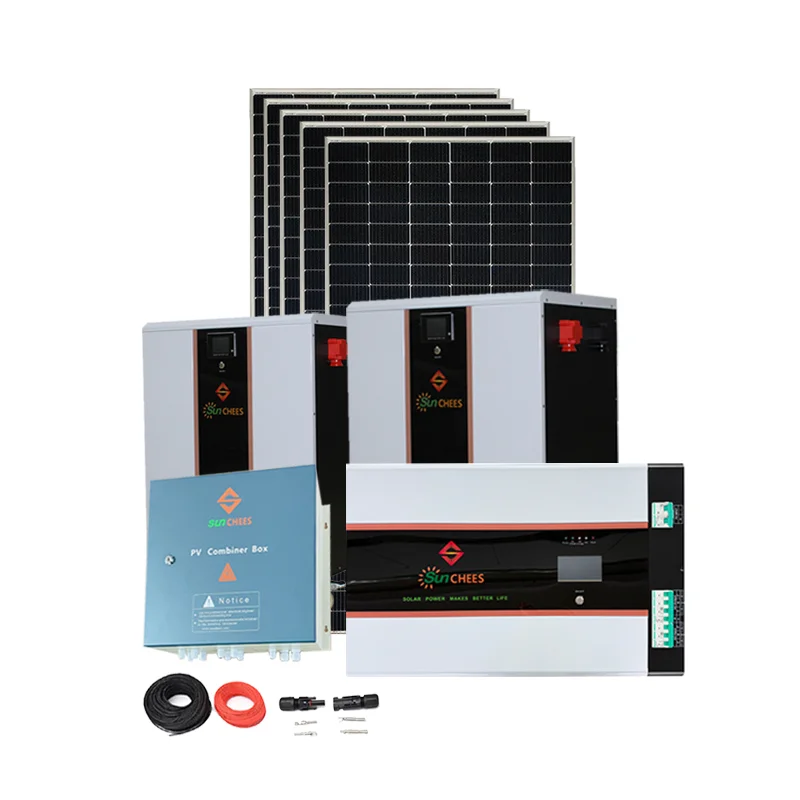
Sunchees is a Chinese manufacturer that designs its own inverters and lithium batteries. All system components are 100 % compatible, eliminating reliance on third-party brands and reducing failure rates. Sunchees offers off-grid solar systems from 6 kW to 100 kW, with modular expansion up to 1 MW. The company provides remote installation guidance and free on-site installation for systems over 50 kW, and promises on-time delivery backed by penalties for delays. Its products have a 25-year design life and are used in more than 200 countries, especially in the Caribbean and Latin America.
Choosing a Sunchees system for agricultural applications
|
Agricultural scenario |
Suitable Sunchees system(s) |
Why it works |
|
Small farm with irrigation and greenhouse |
10 kW or 15 kW single-phase system – 17 kWh or 30.6 kWh batteries, generating up to 12,000 kWh/year |
Powers irrigation pumps, fans and greenhouse lights. Battery storage allows nighttime pumping. |
|
Aquaculture pond or shrimp farm |
20 kW three-phase system – 108 kWh battery, generating 15,000–16,000 kWh/year |
Supports aerators, pumps and chilling equipment; high-capacity battery ensures power during cloudy periods. Panels can be mounted above ponds similar to the Shandong aquavoltaic project. |
|
Dairy or livestock barn |
30 kW three-phase system – 108 kWh battery, generating 22,000–24,000 kWh/year |
Provides energy for milking machines, ventilation and lighting. Three-phase output handles heavy equipment. |
|
Large-scale farming co-operative or agribusiness |
50 kW or 100 kW systems with 71.68 kWh or 120 kWh batteries |
Suitable for processing facilities, cold storage or multiple barns. Modular design allows further expansion up to 1 MW. |
Because Sunchees systems are off-grid or hybrid, they are ideal for remote areas where grid power is unreliable. Farmers can select different panel brands through Sunchees’ OEM options and customise system size. The company offers long warranties: 10 years on PV panels, 3 years on lithium batteries and 2 years on inverters and controllers.
Countries suited for agrivoltaics
Agrivoltaics thrives where agricultural land is valuable and solar irradiance is high. Regions with strong sunlight, high land pressure and supportive policies are ideal:
-
Europe: Countries like the Netherlands, Germany, France and Greece have implemented numerous agrivoltaic projects (BayWa r.e., Sun’Agri and Enel’s grazing sites).
-
China: Since 2011, China has deployed more than 500 agrivoltaics projects, including crop cultivation, livestock grazing, aquaculture and tea plantations. Projects in Shandong, Hainan and Inner Mongolia demonstrate large-scale potential.
-
Southeast Asia: Countries like Indonesia and the Philippines could benefit from agrivoltaics due to abundant sunshine and vast agricultural land, yet they have few projects so far.
-
Mediterranean & dryland regions: Areas with frequent droughts and water scarcity, such as parts of Spain, Italy, Greece and the American Southwest, can use agrivoltaics to reduce irrigation demand and protect crops.
Conclusion
Dual-use solar and agrivoltaics offer a promising path toward sustainable food and energy production. By sharing land between solar panels and agriculture, farmers can reduce heat stress on crops and animals, cut water use and gain new revenue streams. Real-world projects across Europe and Asia show that agrivoltaics can be applied to crops, livestock and aquaculture, delivering yield improvements of 12–50 % and reducing water use by up to 34 %. However, design complexity and cost may limit large-scale deployment; site-specific designs and supportive policies are crucial.
Sunchees provides off-grid and hybrid solar systems that can empower farmers to implement agrivoltaics without reliance on the grid. With modular systems from 6 kW to 100 kW, long warranties and customisable options, Sunchees offers reliable solutions for irrigation, greenhouses, livestock barns and aquaculture. Combined with the environmental and economic benefits of dual-use solar, agrivoltaics represents a win-win opportunity for agricultural communities seeking resilient energy and sustainable food production.
 Solar Panel Pergola Kit: The Complete, User-First Guide (with Sunchees Options)
 You May Also Like



 Tel
Tel
 Email
Email
 Address
6th Floor, Zhonghe Zinan Industrial Park, No. 1 Zinan Changang West Road, Nanzhuang Town, Chancheng District, Foshan City, Guangdong Province. China (Mainland)