


 Whatsapp :
 Home
HomeSolar Panel Pergola Kit: The Complete, User-First Guide (with Sunchees Options)
 Aug 22,2025
 0
0
 sunchees solar system
Key takeaways (read this first)
-
A solar panel pergola kit combines a shade structure and a photovoltaic (PV) system: one build, two jobs (shade + power).
-
A typical 3 kW kit using five 600 W panels can produce roughly 4,000–5,100 kWh/year depending on location and sun hours.
-
Expected static load on the roof frame is modest (~16–22 kg/m² including rails/cables), but wind uplift and snow usually control the design.
-
Ideal placements: backyard lounge, carport, poolside, café patio—anywhere you wanted a pergola anyway.
-
Sunchees offers integrated inverters and lithium batteries designed to work together (fewer compatibility issues), remote install guidance, and fast lead times.
What is a solar panel pergola kit?
A solar panel pergola kit pairs a pergola frame (wood/steel/aluminum) with PV modules as the roof surface. Instead of glass or shingles, panels sit on top rails, feeding DC to an inverter that provides AC for household or business loads. Excess can be exported to the grid (grid-tie) or stored in batteries (hybrid/off-grid).
How it works
-
Daytime: panels generate DC → inverter → AC for appliances → surplus to grid or battery.
-
Night/overcast: pull from grid or battery.
-
Always: the pergola provides shade and weather cover for outdoor living.
Secondary terms you may be searching for (all relevant to this product type): solar pergola, pergola with solar panels, pergola for solar panels, pergola solar panels, solar pergola kits, pergolas with solar panels, modern solar pergola.
How much power can a 3 kW solar panel pergola kit produce?
Below is a realistic example using five 600 W panels (total DC ≈ 3 kW). Assume good orientation with ~4–5 “full-sun” hours per day; actual yields vary with geography, tilt, shading, season, and inverter clipping.
Quick math
-
Panels needed: 3,000 W ÷ 600 W ≈ 5 panels
-
Daily energy: 3 kW × 4–5 h ≈ 12–15 kWh/day
-
Annual energy (typical ranges): 4,000–5,000 kWh/year
Regional yield & bill-savings illustration (example only)
|
Region |
Annual kWh/kW |
3 kW Kit kWh/yr |
Retail / Export (USD/kWh) |
Self-use / Export |
Notes |
|
Jamaica |
~1,700 |
~5,100 |
$0.38 / $0.10 |
80% / 20% |
High retail rates favor self-consumption |
|
Mainland U.S. (avg) |
~1,400 |
~4,200 |
$0.16 / $0.07 |
80% / 20% |
Local net-metering policies vary |
|
Caribbean (typical) |
~1,600 |
~4,800 |
$0.30 / $0.10 |
80% / 20% |
Tourism/hospitality patios benefit |
*If your utility offers 1:1 net-metering, savings rise because exported kWh credit at retail.
How big is a 3 kW solar panel pergola kit?
600 W “large-format” panel size: about 2.2 m × 1.1 m (≈ 2.3 m² each).
Area for five panels: ~11.5 m² of roof coverage.
Common layouts
|
Layout |
Approx. frame footprint |
Notes |
|
5 panels in one row |
~11 m × 1.1 m |
Long, narrow canopy |
|
2 + 3 staggered |
~2.2 m × 3.3 m (net panel area 7.3 m²; allow edges/rails to ~11–12 m² total) |
Compact, popular for patios/carports |
What loads should I plan for in a solar panel pergola kit?
Panel weight per m²
-
Panel mass ≈ 27.5 kg per 2.3 m² → ~12 kg/m²
-
Add rails/wiring/fittings: +5–10 kg/m²
-
Total static load: ~17–22 kg/m² (≈ 0.17–0.22 kPa)
Line load example (joists/rafters at 600 mm centers):
0.22 kPa × 0.6 m ≈ 0.13 kN/m (~13 kg/m). Deflection criteria typically L/240–L/360; confirm with your local code.
What really governs?
-
Wind uplift/edge zones: Highest forces near edges/corners—select rail spans, clamps, and anchoring for your wind region and roof height.
-
Snow (if applicable): Can exceed panel self-weight—design to local values.
-
Fixings & waterproofing:
-
Tiled roofs: use chemical anchors/lag screws into rafters/purlins, with gaskets and flashings.
-
Metal roofs: prefer standing-seam/rib clamps to avoid penetrations.
-
Flat roofs: ballasted where possible; penetrations must be properly sealed.
-
-
Load path: Align rails over rafters/purlins/beams, not on insulation/screed alone.
-
Setbacks: Keep ≥0.3–0.5 m from eaves/parapets/penetrations (per product & wind zone).
-
Durability: hot-dip galvanized/Al-Zn/stainless hardware; treated timber for outdoor use.
-
Access & safety: keep ≥0.6 m service aisle; follow cable routing and fire-clearance rules; mount inverter/combiners to structural members.
3 kW pergola quick totals
-
Panel mass: ~138 kg (5 × 27.5 kg)
-
Rails/brackets/etc.: ~35–50 kg
-
Total static mass on roof: ~180–190 kg spread over ~11.5 m² → ~16 kg/m² added load
Practical rule: After a quick uniform-load check, re-check anchorage for wind/snow. Target a pull-out safety factor ≥1.5–2.0. Keep a simple calc sheet for permits and maintenance records.
Where does a solar panel pergola kit fit best?
-
Backyard/Patio/Deck: outdoor lounge with power.
-
Carport: shade + power; good for EV charging.
-
Poolside/rooftop terrace: architectural shade element.
-
Cafés/Restaurants: comfortable seating with visible sustainability.
-
Resorts/Farms: guest shade structures that reduce utility bills.
These are exactly the spaces people picture when they search for a pergola with solar panels, pergola for solar panels, or pergolas with solar panels—all valid forms of a modern solar pergola.
How does a solar panel pergola kit compare to rooftop PV?
|
Criteria |
Solar panel pergola kit |
Rooftop PV |
|
Primary goal |
Shade + small-to-mid power |
Maximize kWh on existing roof |
|
Siting flexibility |
High (yard, carport, pool, patio) |
Fixed (roof geometry) |
|
Aesthetic control |
Very high (structure is the feature) |
Moderate |
|
Typical system size |
1.5–6 kW (residential), larger for patios |
Often larger if roof area allows |
|
Structural checks |
Pergola beams/columns, wind uplift |
Roof framing, waterproofing |
|
Best for |
Usable outdoor area + energy |
Highest possible kWh on site |
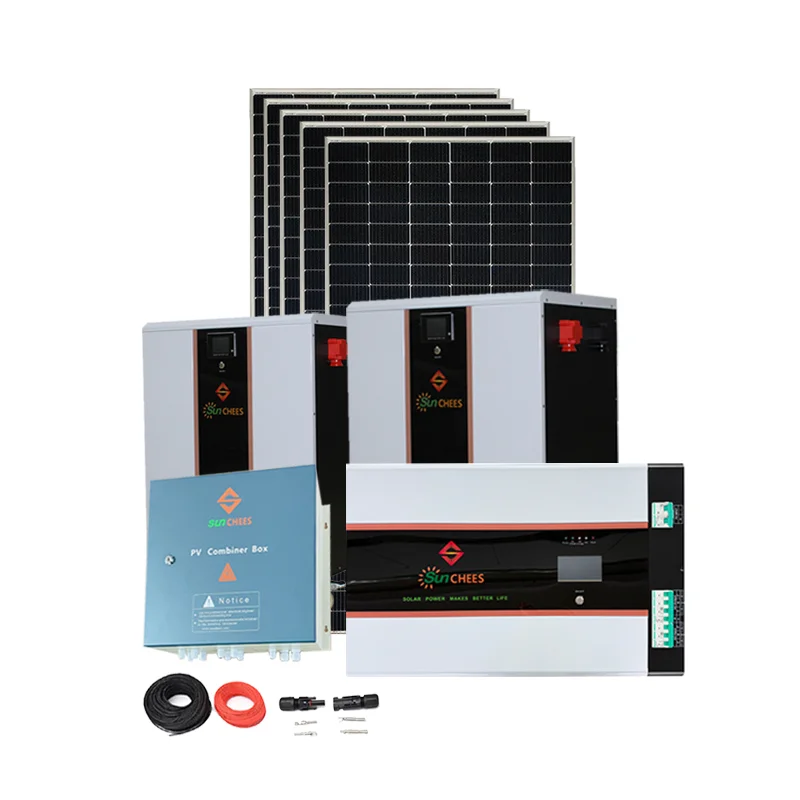
What comes in a solar panel pergola kit from Sunchees?
A Sunchees solar panel pergola kit is built around integrated components designed to work together:
Typical contents
-
PV modules (e.g., 600 W class)
-
Mounting rails & clamps for pergola application
-
Inverter (Sunchees self-developed) and combiner/protections
-
Lithium battery options (Sunchees self-developed) for hybrid/off-grid
-
Cabling, breakers, surge protection
-
Remote installation guidance; on-site engineering for large systems
Why Sunchees (company highlights)
-
Brand: Sunchees (founded 2008; HQ Foshan, Guangdong, China)
-
Core tech: in-house inverters + lithium batteries; 100% internal compatibility for stable systems with lower fault rates
-
Customization: OEM support; selectable panel brands; custom solar systems and solar air-conditioning solutions
-
Service life: systems designed for up to 25 years
-
Installation support: full remote guidance; on-site engineers for single systems ≥50 kW
-
Lead times: 1–10 sets: 5–7 business days; 20–100 sets: 10–20 business days
-
Delivery assurance: on-time delivery for any order size; 5% penalty if delayed (per contract)
-
Production tracking: dedicated progress updates
-
Customer follow-up: satisfaction callbacks after each project
-
Packaging: panels (carton + pallet); inverters/combiner (wooden crate); controllers/batteries/cables (carton); mounting (carton + bulk)
-
Warranty (typical): panels 10 yr; lithium battery 3 yr; inverter/controller/combiner 2 yr (PCB replacement provided)
-
Global reach: projects in 200+ countries/regions; strong focus on the Caribbean & Latin America (e.g., Jamaica, Costa Rica, Guyana, Dominican Republic, Ecuador, Trinidad and Tobago, Guam, Saipan).
-
Applications: residential, agriculture, industrial, finance, power, transport, security; off-grid, hybrid, and scalable systems 30 kW–1 MW.
(Some claims reflect Sunchees’ own program and policy statements; ask our team for current terms in your region.)
How to plan your solar panel pergola kit (step-by-step)
-
Define the use case: lounge, carport, or café terrace?
-
Size the array: start from desired kWh/year or roof area. Quick rule: Panels ≈ Target kW ÷ 0.6 (for 600 W modules).
-
Check structure: beam spans, column bases, and uplift anchorage; confirm local wind/snow values.
-
Choose topology: grid-tie vs. hybrid/off-grid; pick battery size if backup needed.
-
Electrical design: inverter rating, DC/AC protection, cable routes, shut-offs, inspections.
-
Layout & aesthetics: panel orientation, edge setbacks (≥0.3–0.5 m), maintenance aisle (≥0.6 m).
-
Permits & interconnection: follow local code and utility rules.
-
Install & commission: torque checks, labeling, IR scan if available, export/import tests.
-
Monitor & maintain: clean panels, check fixings, review production vs. expectations.
Solar panel pergola kit FAQs
Q1. Is a solar panel pergola kit right for small spaces?
Yes. You can achieve ~3 kW with just ~11.5 m² of canopy using five 600 W panels, ideal for compact solar pergola designs.
Q2. Can a solar panel pergola kit power EV charging in a carport?
A 3 kW setup contributes 12–15 kWh/day in sunny climates—enough for meaningful daily top-ups. Many owners build a pergola with solar panels specifically above parking bays.
Q3. What if my region has snow or high winds?
Your structural design will be governed by wind uplift and/or snow load, not panel weight. Use certified rails/clamps, align anchors to beams/rafters, and verify pull-out capacity with a ≥1.5–2.0 safety factor.
Q4. How does a solar panel pergola kit compare to adding more panels to my roof?
Rooftop PV is great for maximum kWh. A pergola offers usable outdoor space and flexible siting—what many people want from pergolas with solar panels or a modern solar pergola.
Q5. Can I start grid-tie and add batteries later?
Yes. Many solar pergola kits are hybrid-ready. Sunchees’ inverter-battery ecosystem simplifies later upgrades because components are designed to be internally compatible.
Q6. What maintenance is required for a pergola for solar panels?
Keep modules clean, inspect fixings annually, and maintain clear cable paths and labels. Most issues are avoided by correct anchoring and weatherproofing from the start.
Q7. Are permits needed for a pergola solar panels installation?
Usually yes—both structure and electrical may require approvals. Sunchees provides documentation support and remote guidance to streamline inspections.
Q8. How fast can I get a Sunchees solar panel pergola kit?
Indicative lead times: 1–10 sets: 5–7 business days; 20–100 sets: 10–20 business days, with delivery commitments and progress updates provided.
Why choose a solar panel pergola kit by Sunchees?
-
One vendor, one system: inverter + battery from the same maker → fewer compatibility risks, smoother commissioning.
-
Proven logistics: published lead times, packaging standards, and delivery commitments (including delay penalties per contract).
-
Hands-on support: remote install guidance for all kits; on-site engineers for larger builds (≥50 kW).
Custom options: choose panel brands, battery capacities, and structure finishes to match your modern solar pergola aesthetic.
 How Many Amps Does a 550-Watt Solar Panel Produce? A Definitive Guide to Solar Performance & The Sunchees Advantage
 You May Also Like



 Tel
Tel
 Email
Email
 Address
6th Floor, Zhonghe Zinan Industrial Park, No. 1 Zinan Changang West Road, Nanzhuang Town, Chancheng District, Foshan City, Guangdong Province. China (Mainland)