


 Whatsapp :
 Home
HomeSolar Power Grants for Homeowners in Jamaica – Guide to Incentives and System Choices
 Aug 20,2025
 0
0
 sunchees solar system
Overview
Many Jamaican homeowners are exploring solar power grants for homeowners to reduce energy costs and secure an independent power supply. Jamaica’s government introduced an income-tax credit that reimburses homeowners 30% of the purchase and installation cost of a solar photovoltaic (PV) system for a primary residence, up to a maximum system cost of J$4 million. This tax credit, capped at J$1.2 million, applies to PV systems installed after 1 January 2023 and can be carried forward to future tax years if unused. Additionally, major components such as solar panels, inverters and batteries are exempt from the General Consumption Tax (GCT). These incentives make it more affordable for households to invest in solar.
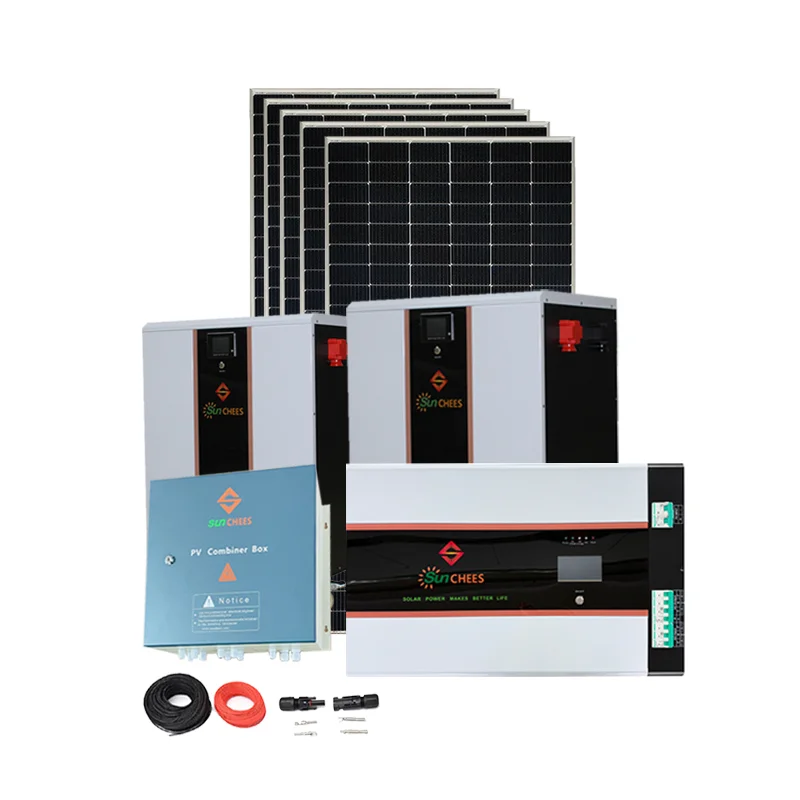
However, incentives are only part of the decision. Homeowners also need to decide which system size suits their property. Factors include the number of floors, roof space, garden area, and typical electricity use. Sunchees, a manufacturer of integrated solar systems, offers a range of solutions from 6 kW to 100 kW that combine PV panels, lithium-iron-phosphate batteries and inverters. Below we explain how to match a system to your home and compare Sunchees’ products with typical alternatives.
Solar incentives and requirements in Jamaica
Key features of the Jamaican solar tax credit
|
Income-tax credit rate |
30% of acquisition and installation cost, max eligible cost J$4 million, credit limited to J$1.2 million |
|
Eligibility period |
Only systems installed on or after 1 January 2023 qualify |
|
Carry-forward provision |
Unused portion can be carried forward if credit exceeds 50% of tax payable in current year |
|
Tax credit nature |
Offsets income tax but non-refundable |
|
Proof required |
Invoices and independent verification required |
|
Duty and GCT exemptions |
Solar PV panels, inverters and lithium batteries are exempt from GCT |
Other potential support
Some banks and the National Housing Trust (NHT) offer low-interest “green” mortgages or loans for renewable-energy improvements, but these schemes change frequently. Homeowners should confirm current programmes with local banks or the NHT. Jamaica Public Service (JPS) also allows net billing; homeowners can sell excess electricity back to the grid if they install an approved meter. Off-grid systems are exempt from licensing for the tax credit, but a net-billing licence is required for future incentives.
How to size a solar system for your home
Jamaican homes vary from compact two-storey houses to large villas with gardens. The table below summarises typical system sizes and the type of property they suit. A 600 W solar panel occupies roughly 2 – 2.3 m²; therefore, roof space or garden area becomes a key constraint. Homeowners should also check the roof orientation and shading.
|
Home type |
Approx. daily use |
Recommended system sizes |
Considerations |
|
Small house or townhome (1–2 bedrooms) |
10–15 kWh/day |
6 kW system (~4,700 kWh/year, 13 kWh battery, ~20 m²) |
Reduces up to 70% of grid consumption |
|
Medium home or small villa (3–4 bedrooms) |
15–25 kWh/day |
10 kW (~7,000–8,000 kWh/year, 17 kWh, ~25 m²) |
Suitable for families with air-conditioning, 15 kW offers longer backup |
|
Large villa or small business |
25–40 kWh/day |
20 kW three-phase (~15,000–16,000 kWh/year, 108 kWh, ~100 m²) |
Supports heavy loads, EV chargers, several days of autonomy |
These sizes are estimates; actual consumption can vary. Homeowners who plan to add electric vehicles, pool pumps or other high-power devices should consider larger systems (30 kW or more) or modular battery expansion.
Additional Note on System Compatibility in Jamaica
Most Jamaican homes are supplied with 120/240V split-phase power, which is technically a type of single-phase service. This means that standard residential properties can only use systems designed for split-phase (single-phase) connections, such as 6 kW, 10 kW, or 15 kW units. Three-phase systems (20 kW, 30 kW and above) are only suitable for properties that have already been granted three-phase service by the utility (JPS), such as large villas, commercial buildings, farms, or factories. Without three-phase access, these larger systems cannot be connected to the grid. Homeowners on split-phase who need larger capacity should instead consider parallel single-phase inverters rather than attempting to install a three-phase system.
Comparing Sunchees systems with typical alternatives
Sunchees product overview
|
Model |
Inverter rating & phase |
PV array |
Battery capacity |
Annual generation |
Recommended area / uses |
|
6,000 W single-phase |
6×600 W (3.6 kW) |
13.3 kWh |
~4,700 kWh |
~20 m² – homes, small shops, farms |
|
|
10,000 W single-phase |
9×600 W (5.4 kW) |
17 kWh |
7,000–8,000 kWh |
~25 m² – houses, cabins, farms |
|
|
15,000 W single-phase |
16×600 W (9.6 kW) |
30.6 kWh |
10,000–12,000 kWh |
~50 m² – villas, farms |
|
|
20,000 W three-phase |
30×600 W (18 kW) |
108 kWh |
15,000–16,000 kWh |
~100 m² – medium business |
|
|
30,000 W three-phase |
50×600 W (30 kW) |
108 kWh |
22,000–24,000 kWh |
~155 m² – small factories |
Advantages of Sunchees systems
• All-in-one integration: Unlike typical home solar setups, Sunchees supplies the entire package, reducing installation complexity.
• High-capacity batteries: For example, the 20 kW system includes a 108 kWh battery, providing several days of backup.
• Flexible scaling: Expandable up to 1 MW for communities or micro-grids.
• Vertical integration: In-house inverters and batteries, 25-year system life, customization, and warranties.
Considerations versus generic systems
• Higher upfront cost: Large batteries increase cost, but the tax credit reduces net price.
• Space requirements: The 20 kW system requires ~100 m² of roof/garden area.
• Grid connection: Net-billing licence required for grid tie-in; off-grid exempt but no revenue from selling energy.
Frequently asked questions
• What solar power grants exist? – The Jamaican Government offers a 30% income-tax credit (capped at J$1.2 million). Solar panels, inverters, and batteries are exempt from GCT, and unused credit can be carried forward.
• How do I determine the right system size? – Consider daily usage, roof/garden space, and future demands. Small homes may need 6 kW; medium villas 10–15 kW; larger properties 20–30 kW.
• Can off-grid homeowners claim the tax credit? – Yes, no licence required unless selling power to the grid.
• Why consider Sunchees? – Fully integrated, compatible, high-capacity batteries, long warranties, and support.
• What maintenance is required? – Minimal: clean panels, check batteries/inverters. Sunchees offers guidance and support.
Conclusion
The combination of solar power grants for homeowners, duty exemptions and net-billing opportunities makes solar energy an attractive investment in Jamaica. The 30% income-tax credit and GCT exemption can offset a significant portion of installation costs, especially when paired with reliable systems. Choosing the right system involves balancing energy needs, space availability and budget. Integrated solutions from Sunchees offer turnkey options with large battery capacities, long warranties and the ability to scale up, making them ideal for households seeking energy independence. Always consult certified installers and verify the latest incentive requirements to ensure a smooth transition to solar power.
 Best Solar Power Inverter for Home in Jamaica: Cost, Benefits and Real Case Studies
 You May Also Like



 Tel
Tel
 Email
Email
 Address
6th Floor, Zhonghe Zinan Industrial Park, No. 1 Zinan Changang West Road, Nanzhuang Town, Chancheng District, Foshan City, Guangdong Province. China (Mainland)