


 Whatsapp :
 Home
HomeAquavoltaics: Floating Solar + Aquaculture for a Sustainable Future
 Aug 19,2025
 0
0
 sunchees solar system
Aquavoltaics (also called fishery-solar hybrid) is a breakthrough model where solar power generation coexists with aquaculture. The principle is straightforward: “solar above, fish below.” Floating PV systems generate clean energy while ponds, reservoirs, or salt pans continue to support fish, shrimp, and crab farming.
This article explores:
-
How aquavoltaics works
-
Environmental and economic benefits
-
Practical challenges and design considerations
-
Real-world case studies
-
How the Sunchees 20 kW solar-storage system empowers aquavoltaic projects
Key Benefits of Aquavoltaics
|
Benefit |
Details |
|
Dual Use of Water Surfaces |
Solar panels float on ponds/reservoirs, leaving land available for farming or urban use. |
|
Improved Water Quality |
Shading reduces water temperature, increases dissolved oxygen, and limits algal growth. |
|
Higher Solar Efficiency |
Water cooling boosts PV efficiency by 15–20% compared to land-based solar. |
|
Reduced Evaporation |
Up to 50% less water loss, critical for drought-prone areas. |
|
Carbon Reduction |
Each acre can cut 50 tons of CO₂ emissions annually. |
|
Increased Farm Profit |
Lower fish mortality, better shrimp/crab quality, plus revenue from selling surplus power. |
1. Floating Solar Power Meets Aquaculture
Floating PV systems use HDPE floats anchored to shorelines for stability against wind and waves.
-
Waterproof design: Modules sealed to IP67+ standards.
-
Resilient installation: Inverters housed in onshore control rooms or waterproof cabinets.
-
Ideal sites: Fish ponds, reservoirs, salt fields—locations where land use is constrained.
2. Shading Effects: A Natural Water Conditioner
Studies and projects show remarkable ecological benefits from PV shading:
-
Temperature Regulation: Shading blocks 89–93% of solar radiation, lowering pond water temperature by ~1.5 °C.
-
Water Quality: Dissolved oxygen rises by 8–24%; nitrogen, phosphorus, and chlorophyll-α concentrations drop, limiting algal blooms.
-
Reduced Evaporation: AccuSolar notes 50% less water evaporation, preserving resources.
-
Better Yields:
-
Shrimp ponds in Shandong(China) reported fresher shrimp and extended maturity periods.
-
Crab ponds in Jiangsu(China) saw water temperature drop by 2 °C, reducing crab diseases and increasing profits (farmers earned >3000 RMB/acre annually).
-
Aquavoltaics isn’t just beneficial in summer. While shading from floating solar panels is most valuable in hot seasons—lowering water temperature, preventing algae blooms, and reducing oxygen stress—it also brings year-round advantages: stabilizing water quality in spring and autumn, reducing evaporation in dry seasons, and ensuring continuous power supply for aeration and monitoring even in winter. In short, it improves both fish health and farm productivity throughout the year.
3. Powering Aquaculture with Solar Energy
Aquavoltaics integrates clean energy into fishery operations:
|
Application |
Solar + Storage Role |
|
Aeration & Pumps |
Daytime solar drives pumps; batteries supply night-time oxygenation. |
|
IoT Monitoring |
Solar powers sensors for water temperature, DO, pH, enabling automated feeding/aeration. |
|
Cold Chain & Processing |
Supports refrigeration, ice-making, and on-site processing. |
|
Grid Connection |
Surplus electricity exported for additional income. |
4. Ecological & Economic Advantages
-
Healthier Ecosystems: Reduced algae, stable oxygen levels, balanced nutrients.
-
Improved Energy Output: 15–20% higher solar efficiency on water.
-
Carbon Reduction: Each acre produces 40,000–60,000 kWh annually, saving ~19 tons coal.
-
Farmer Benefits: Higher yields, reduced risks, plus rental income models.
5. Implementation Challenges & Design Keys
|
Consideration |
Best Practice |
|
Shading Ratio |
Maintain 40–60% coverage; allow open water for sunlight, oxygen exchange, and harvesting. |
|
Materials |
Anti-corrosion panels, waterproof connectors, flexible prestressed supports. |
|
Anchoring & Stability |
Structures must withstand typhoons up to Category 15 (wind tunnel tested). |
|
Operations & Maintenance |
Regular cleaning of panels, corrosion checks on chains/anchors. |
|
Costs |
Higher upfront investment, but offset by dual income from power + aquaculture. |
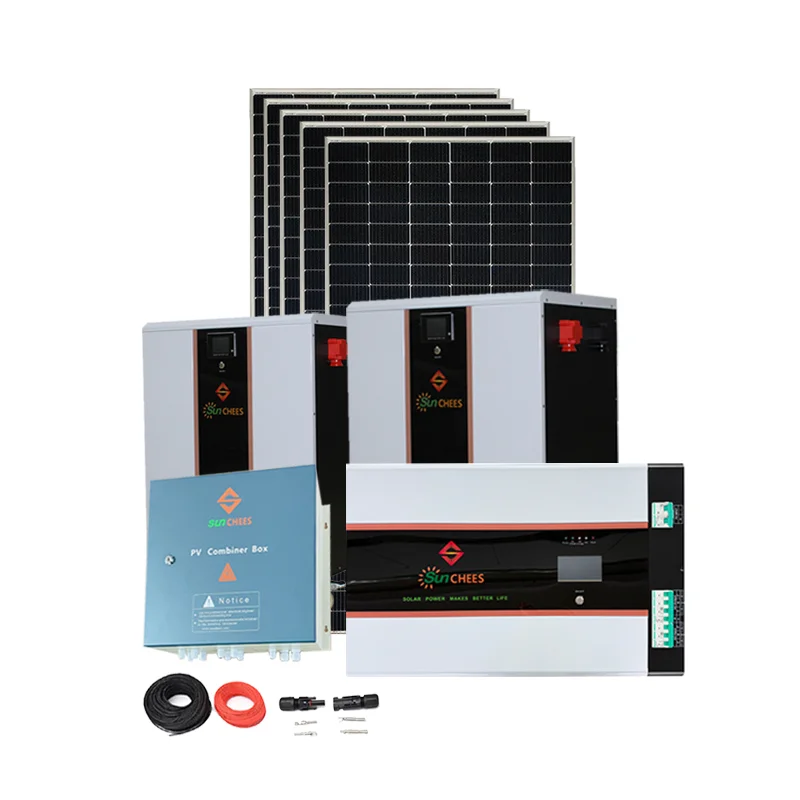
6. Sunchees 20 kW Solar-Storage System in Aquavoltaics
The Sunchees 20 kW integrated PV + storage system is purpose-built for medium-scale aquaculture.
|
Feature |
Details |
Benefit for Aquaculture |
|
PV Array |
30 × 600 W modules = 18 kW |
Daily generation ~41 kWh, enough for pumps + batteries. |
|
Battery |
108 kWh LiFePO₄ storage |
Keeps aerators and pumps running 10 days without sunlight. |
|
Inverter |
20 kW three-phase, 192 V DC |
Supports heavy equipment like aeration and cold storage. |
|
Annual Output |
~15,000–16,000 kWh |
Meets farm needs. |
|
System Life |
Up to 25 years |
Long-term stability with integrated design. |
Example: If a farm consumes 10 kWh/day, Sunchees’ 108 kWh battery covers operations for 10 days during low sunlight. Daily generation recharges batteries.
7. Key Aquavoltaics Projects & Companies
|
Country/Region |
Company / Project |
Scale & Model |
Progress & Highlights |
|
Netherlands |
Seafloat Project (Marine Shellfish Farming) |
2.6 MW floating PV array |
Supplies clean power to offshore shellfish farms, demonstrating co-existence of aquaculture and solar power |
|
China (foreign-led trial) |
Egret Nature Reserve Project |
500 kW floating PV |
Provides renewable electricity to aquaculture facilities inside a protected reserve |
|
Norway |
Ocean Sun System |
Concept & R&D stage |
Proposed deployment of floating PV in offshore aquaculture zones, exploring multi-use marine applications. |
|
United States (Florida, Ohio, Utah, etc.) |
D3Energy + Ciel & Terre (Hydrelio system) |
Multiple floating PV projects (not directly aquaculture, but water-related) |
Deployed at water treatment plants and public facilities. Systems survived hurricanes in 2024, proving high resilience. |
-
Direct fishery + floating PV projects overseas are still rare and mostly at pilot stage.
-
The Netherlands and China already have real operational examples, especially in shellfish farming and nature reserve contexts.
-
Norway’s Ocean Sun is advancing a forward-looking offshore aquavoltaics model, with strong future commercialization potential.
-
D3Energy (U.S.) is not aquaculture-focused but provides proven, hurricane-resilient floating solar technology that could support future aquavoltaics expansion.
Conclusion
Aquavoltaics is more than an energy solution—it’s a sustainable transformation of aquaculture. By combining floating solar with fish farming, it:
-
Improves water quality and farm productivity
-
Increases solar generation efficiency
-
Cuts carbon emissions
The Sunchees 20 kW solar-storage system offers a practical, reliable, and profitable way to bring aquavoltaics to life—delivering energy independence, stable operations, and long-term returns.
Frequently Asked Questions
Q1: What is aquavoltaics (fishery-solar hybrid)?
Aquavoltaics is the integration of floating solar panels on water surfaces while continuing aquaculture activities (fish, shrimp, crabs) below. It maximizes water resources for both clean energy and food production.
Q2: Does shading from solar panels harm fish farming?
No. In fact, shading often improves water quality by reducing temperature, increasing dissolved oxygen, and suppressing algae—creating healthier conditions for aquaculture.
Q3: How much electricity can aquavoltaics generate?
One acre of fishpond with floating PV can produce 40,000–60,000 kWh annually, improving solar efficiency by 15–20% compared to land-based systems.
Q4: Can aquavoltaics reduce water evaporation?
Yes. Floating PV reduces evaporation by up to 50%, making it valuable in drought-prone regions.
Q5: How does the Sunchees 20 kW system support aquavoltaics?
The Sunchees 20 kW solar-storage system provides continuous, reliable power for aeration, pumping, monitoring, and cold storage.
 Solar Power Grants for Homeowners in Jamaica – Guide to Incentives and System Choices
 You May Also Like



 Tel
Tel
 Email
Email
 Address
6th Floor, Zhonghe Zinan Industrial Park, No. 1 Zinan Changang West Road, Nanzhuang Town, Chancheng District, Foshan City, Guangdong Province. China (Mainland)