


 Whatsapp :
 Home
Home10kW Home Solar System With Battery Backup – Pricing, Requirements and Sunchees Comparison
 Aug 15,2025
 0
0
 sunchees solar system
Why consider a 10kW home solar system with battery backup?
A 10kW home solar system with battery backup is large enough to power a typical family home or a small business, yet small enough to fit on a modest roof. In most markets a 10 kW solar array can generate roughly 11–15 MWh per year, which covers the average electricity consumption of many households. When paired with battery storage, the system can keep essential appliances running during outages and maximise self‑consumption by storing solar energy for use at night or during peak‑price periods.
Suitability
-
Daily energy output – A 10 kW solar array produces about 40 kWh per day (≈14,517 kWh per year on average in the U.S.). This is enough to offset a typical U.S. home using 29–33 kWh/day.
-
Roof space – Most 10 kW systems use 25–27 panels and need 440–475 square feet (≈40–44 m²) of roof area. Other sources estimate 60–90 m² of shadow‑free space depending on panel efficiency and roof orientation.
-
Cost – On average a 10 kW solar installation costs US $27,500 before incentives or around US $21,000 after the 30 % federal tax credit. Costs vary by location and equipment; prices range from $21,400 to $33,500 across U.S. states.
-
Power independence – With the right battery capacity, a 10 kW system can operate off‑grid or provide backup during outages. However, going fully off‑grid requires substantial battery storage and careful load management.
Understanding battery needs for a 10 kW solar system
Energy storage sizing depends on how you plan to use your solar electricity. According to EnergySage, the average solar battery stores about 10 kWh. One battery will provide basic backup for short outages, two to three batteries allow households to avoid buying power during peak‑price periods, and eight to twelve batteries are needed for off‑grid living.
For a 10 kW system, many homeowners choose 15–30 kWh of lithium‑iron‑phosphate (LiFePO₄) storage so that they can run typical loads (refrigerator, lights, internet, some air‑conditioning) for 24–48 hours without sunlight. When connected to the grid, fewer batteries may suffice because the system can export excess energy via net metering or draw electricity when the battery is low.
Key battery considerations
|
Factor |
Guidance |
Evidence |
|
Purpose of storage |
Decide whether the battery is for emergency backup, saving on time‑of‑use rates or going fully off‑grid. More batteries are required for greater independence. |
EnergySage notes that one battery is adequate for basic backup; two to three for peak‑price savings; eight to twelve for off‑grid. |
|
Battery chemistry |
LiFePO₄ (lithium‑iron‑phosphate) batteries are popular due to long life, high safety and deep discharge capability. |
Sunchees’ systems use LiFePO₄ batteries, offering 17 kWh for the 10 kW model. |
|
System integration |
Choose batteries compatible with your inverter and local regulations; some kits require AC‑coupled storage (e.g., Tesla Powerwall). |
The Sunchees 10 kW system includes an inverter and battery that are 100 % compatible. |
|
Future expansion |
Consider modular batteries that can be scaled as your energy needs grow. |
EnergySage suggests that adding batteries later can help avoid expensive utility rates. |
How big is a 10 kW solar array and what does it produce?
A 10 kW array generally consists of 25–27 panels rated around 400 W each. In sunny conditions, it can produce 11,000–15,000 kWh per year. The system’s output depends on location—Phoenix, Arizona sees about 35 % more production than Boston—and on shading, panel orientation and tilt. Properly sized, a 10 kW system will cover the average U.S. household’s annual electricity use of ~10,715 kWh.
Roof area and panel count
|
Panel wattage |
Number of panels |
Roof area estimate* |
Source |
|
400 W |
25 panels |
440–475 ft² (40–44 m²) |
SolarReviews |
|
300 W |
34 panels |
≈600 ft² (56 m²) |
Derived from 10 kW ÷ 0.3 kW/panel |
|
17 panels |
≈30 m² |
Used in Sunchees 10 kW system (5.4 kW total PV) |
*Roof area requirements vary widely; another source suggests 60–90 m² of shadow‑free space.
Comparing popular 10 kW solar systems with battery backup
Below is a comparison of typical 10 kW solar solutions and the Sunchees 10 kW integrated system.
|
System |
Key features |
Pros |
Cons |
|
Typical 10 kW grid‑tie kit (no battery) |
About 25–27 panels; uses a string or micro‑inverter; cost ≈ US $27,500 before incentives; produces 11–15 MWh/year. |
Lower upfront cost; simple installation; net‑metering credits. |
No backup during outages; requires separate battery purchase; large roof area (40–90 m²). |
|
10 kW kit with third‑party battery (e.g., Tesla Powerwall) |
Adds one or more 10–13.5 kWh batteries; backup available; AC‑coupled; total cost rises to US $30 k–$40 k. |
Flexible sizing; widely available; high‑capacity battery options (Powerwall 2 is 13.5 kWh). |
Batteries purchased separately; compatibility issues; installation complexity; may need multiple batteries for full backup. |
|
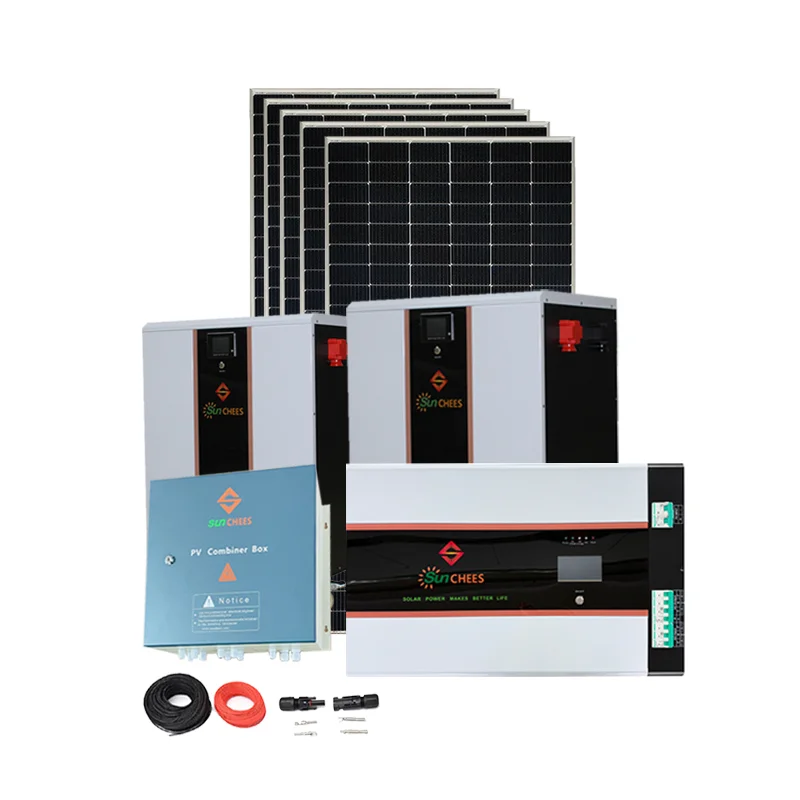
Complete kit including 9×600 W panels (5.4 kW), pure‑sine 10 kW single‑phase inverter and 51.2 V/260 Ah (≈17 kWh) LiFePO₄ battery; estimated 7,000–8,000 kWh/year generation; 25 m² recommended roof area. |
Integrated and compatible components (battery, inverter and panels); compact array (9 panels); customizable panel brands; long service life (25 years); remote installation guidance and free on‑site installation for systems ≥50 kW; 10‑year panel warranty, 3‑year battery warranty and 2‑year inverter warranty. |
PV array (5.4 kW) may be smaller than typical 10 kW kits, so annual generation is lower (7–8 MWh vs. 11–15 MWh); product availability may be limited to certain regions. |
Sunchees company strengths
Sunchees is a vertically integrated Chinese manufacturer. They develop inverters and lithium batteries in‑house; their system components are 100 % compatible. They offer OEM customization, letting customers specify solar‑panel brands and tailor systems for solar air‑conditioners. Sunchees claims a 25‑year system life and provides remote installation guidance; for orders above 50 kW, engineers install on site at no extra cost. The company serves over 200 countries and reports 100 % five‑star customer satisfaction.
Sunchees also publishes installation videos on YouTube and TikTok demonstrating real‑world projects. These videos show the assembly process and performance of their 10 kW and other systems, giving potential customers visual insight into system size, wiring and battery placement. (You can search “Sunchees solar system installation” on platforms like YouTube or TikTok to view them.)
Typical usage scenarios and savings
A 10 kW solar system can power a mid‑size home with central air conditioning, electric cooking and EV charging. With a 17 kWh battery (as in Sunchees’ kit) the system can run critical loads—lighting, refrigerator, internet, fans—for about one full day without sun. Larger batteries (25–30 kWh) would enable 1–2 days of autonomy.
Assuming a 10 kW grid‑tie system produces 14,517 kWh annually and electricity costs US $0.30 per kWh, annual savings can reach ~US $4,300. When installed with battery storage, the system can also avoid peak‑hour rates, providing additional savings. However, the payback period varies by state: SolarReviews estimates 8–20 years depending on local rates and incentives.
Frequently asked questions
Q: How many panels does a 10 kW home solar system with battery backup need?
A: Most 10 kW systems use 25–27 panels of around 400 W each, requiring ≈40–44 m² of roof space. High‑efficiency panels (500–600 W) reduce the number of panels and area; for example, the Sunchees 10 kW kit uses 9×600 W panels.
Q: How much roof space do I need?
A: Space requirements vary by panel wattage and layout. A typical 10 kW array needs 40–90 m² of shadow‑free roof. Always leave extra room for ventilation and maintenance.
Q: How big should my battery be?
A: The average solar battery is 10 kWh. One battery suffices for short outages; two to three batteries (20–30 kWh) are needed to maximise time‑of‑use savings. Going off‑grid may require 8–12 batteries (80–120 kWh) depending on load.
Q: Can I go off‑grid with a 10 kW system?
A: Technically yes, but you’ll need significant battery storage and careful load management. While a 10 kW system can produce enough energy for an average home, off‑grid living requires eight or more batteries to provide power during extended cloudy periods. For most homeowners, a grid‑tied hybrid system with one or two batteries offers a better balance of independence and cost.
Q: What makes the Sunchees 10 kW system different?
A: Sunchees delivers a turn‑key package: inverter, panels and LiFePO₄ battery are designed and tested together. The system uses only nine high‑power panels, saving roof space, and includes a 17 kWh battery, which is larger than many kits with similar PV capacity. Sunchees provides customised options, long warranties and installation support, targeting customers in remote areas or markets lacking reliable installers.
Conclusion
A 10 kW home solar system with battery backup is a versatile solution for households seeking energy independence, resilience and long‑term savings. A typical 10 kW array costs around US $27,500 before incentives, uses 25–27 panels and requires 40–90 m² of roof space. Adding 20–30 kWh of battery storage ensures power during outages and maximises self‑consumption.
When comparing solutions, integrated systems like Sunchees’ 10 kW kit stand out for their compact panel array, built‑in battery and inverter compatibility, along with customisation and long‑term support. However, Sunchees’ PV capacity (5.4 kW) is smaller than typical 10 kW kits, so annual generation is lower. As with any major purchase, evaluate your electricity consumption, roof space, budget and backup needs before selecting the right 10 kW solar system.
 Aquavoltaics: Floating Solar + Aquaculture for a Sustainable Future
 You May Also Like



 Tel
Tel
 Email
Email
 Address
6th Floor, Zhonghe Zinan Industrial Park, No. 1 Zinan Changang West Road, Nanzhuang Town, Chancheng District, Foshan City, Guangdong Province. China (Mainland)