


 Whatsapp :
 Home
Home3 Phase Solar Power Inverter – Complete Guide and Product Comparison
 Aug 15,2025
 0
0
 sunchees solar system
Why a 3 phase solar power inverter matters
A 3 phase solar power inverter converts the direct‑current (DC) electricity produced by a photovoltaic (PV) system into alternating current (AC) using three separate waveforms. A three‑phase supply has three live wires and one neutral wire, whereas a single‑phase supply has only one live wire. Because the load is split across three phases, the inverter can deliver more power and operate more efficiently than a single‑phase unit. The design reduces voltage drops, gives better voltage regulation and can supply large appliances – including EV chargers and air‑conditioning systems – that may not run on a single‑phase supply. Three‑phase inverters therefore suit businesses or large homes with high energy demand.
When is a three‑phase inverter necessary?
-
High power needs – Three‑phase inverters can transmit more power than single‑phase units, making them essential for PV systems above ~5 kW where single‑phase inverters struggle.
-
Better efficiency & lower costs – Spreading the load across three phases reduces the risk of overloading any single phase and improves overall efficiency. Improved efficiency means lower electricity bills and longer life for electrical equipment.
-
Stable voltage & grid support – Three‑phase inverters provide smoother voltage regulation and help stabilise the grid; they are also less prone to voltage drop over long cables.
-
Larger or commercial loads – They handle pool heaters, electric‑vehicle chargers and industrial machinery that single‑phase systems cannot support.
Benefits of a 3 phase solar power inverter over single‑phase
|
Advantage |
Evidence |
Why it matters |
|
Higher power output |
Three‑phase inverters transmit more power than single‑phase models. |
Essential for powering many appliances simultaneously (e.g., dishwasher + EV charger) or running commercial equipment. |
|
Improved efficiency & lower energy costs |
Spreading the electrical load across three phases boosts efficiency and reduces dependence on the grid. |
Higher efficiency translates into lower energy bills and longer equipment life. |
|
Better voltage regulation |
Three‑phase inverters provide more consistent voltage than single‑phase units. |
A consistent voltage protects appliances and supports sensitive electronics. |
|
Enhanced reliability & smoother power delivery |
GivEnergy notes that three‑phase inverters deliver more consistent power distribution, enabling seamless operation of multiple devices. |
Suitable for critical loads and reduces lights flickering or equipment stalling. |
|
Future‑proofing |
With homes increasingly upgrading to three‑phase connections and adding EVs, installing a three‑phase inverter ensures the PV system can meet future demand. |
Avoids costly replacements later. |
Potential drawbacks
-
Higher cost – Three‑phase inverters are generally more expensive than single‑phase units.
-
Backup limitations – Some hybrid inverters limit backup power to about one third of their rated output per phase; for example, users of Sungrow SH10RT and Fronius systems report backup output capped at ~3–4 kW per phase. Proper load balancing and possibly multiple inverters may be required in blackout scenarios.
Comparison of popular 3 phase solar power inverters
Sungrow SH10RT (10 kW three‑phase hybrid)
The Sungrow SH10RT is a widely‑used 10 kW three‑phase hybrid inverter designed for residential and light commercial applications. It has two MPPTs and three DC inputs. Key data from Sungrow’s datasheet are summarised below:
|
Parameter |
SH10RT‑20 value* |
Notes |
|
Max. DC input power |
15 kW |
Allows oversizing of PV array. |
|
MPPT voltage range |
200–950 V |
Wide range for string design flexibility. |
|
Number of MPPTs / DC inputs |
2 MPPTs / 3 inputs |
Allows panels on multiple roof orientations. |
|
Max. AC output power |
10 kW |
Three‑phase output. |
|
Max. efficiency / Euro efficiency |
98.4 % / 97.9 % |
High efficiency reduces conversion losses. |
|
Weight & size |
27 kg and 540×460×170 mm |
Compact and wall‑mountable. |
|
Cooling & protection |
Natural cooling, IP65 rating |
Suitable for outdoor installation. |
|
Grid support |
Power factor 0.99 and THD < 3 % |
Helps maintain grid stability. |
*Data correspond to the SH10RT‑20 model variant.
Pros: High efficiency, wide MPPT range and multiple inputs make system design flexible. Natural cooling and IP65 rating allow outdoor installation.
Cons: Forum users note that backup output may be limited to around one third of rated power per phase, requiring careful load distribution during outages.
GivEnergy three‑phase hybrid inverters (6 kW, 8 kW, 10 kW & 11 kW)
GivEnergy offers a line of three‑phase hybrid inverters with outputs of 6 kW, 8 kW, 10 kW and 11 kW. The units convert DC power into three separate AC waveforms and can be paired with the company’s stackable battery system, allowing homeowners to customise storage capacity.
Key features (as described by GivEnergy):
-
Enhanced efficiency and reliability – Three‑phase inverters distribute the load evenly, resulting in higher efficiency and lower risk of overloading.
-
Flexible storage – Stackable battery modules enable customised capacity, supporting future expansion.
-
Focus on large homes and SMEs – The power range (6–11 kW) suits larger residences or small‑to‑medium enterprises needing more than a single‑phase system.
Pros: Modular battery system, improved efficiency and reduced energy costs.
Cons: Being a newer product line, software and feature parity with single‑phase models is still evolving; maximum power is lower than 20 kW systems.
Other notable brands
Many manufacturers produce three‑phase inverters for residential and commercial use. Models from Fronius (Symo series) and Growatt (MID & MOD series) offer high system voltages, wide input voltage ranges, multiple MPPTs and integrated monitoring. Users appreciate their high efficiency (>98 %) and flexibility; however, these products often require additional batteries and may lack the customisation and all‑in‑one convenience that Sunchees provides.
Sunchees three‑phase power systems
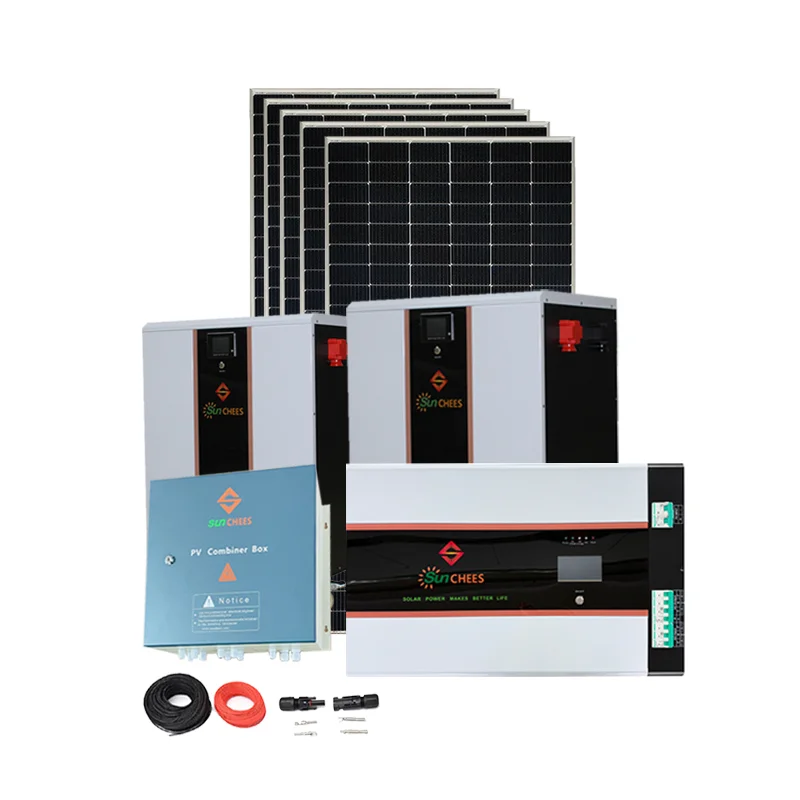
Sunchees manufactures complete solar systems that integrate PV panels, battery storage and inverters. Their three‑phase systems range from 20 kW to 100 kW and are designed for off‑grid or hybrid installations. Each system includes a Sunchees inverter and a lithium‑iron‑phosphate battery pack, ensuring full component compatibility. Key specifications from the Sunchees product catalogue are summarised below:
|
Model |
Inverter rating & DC voltage |
PV array |
Battery capacity (LiFePO₄) |
Estimated annual generation |
Recommended area |
Typical applications |
|
20 kW / 192 V DC |
30 × 600 W panels (18 kW) |
204.8 V / 300 Ah ≈ 108 kWh |
~15,000–16,000 kWh/yr |
~100 m² |
Medium‑size businesses, villas, farms, off‑grid villages |
|
|
30 kW / 192 V DC |
50 × 600 W panels (30 kW) |
204.8 V / 300 Ah ≈ 108 kWh |
~22,000–24,000 kWh/yr |
~155 m² |
Small factories, farms, resorts, off‑grid communities |
|
|
360 V DC |
80 × 600 W panels (48 kW) |
358.4 V / 300 Ah ≈ 71.68 kWh |
~70,000 kWh/yr |
~240 m² |
Factories, villa zones, farms, public infrastructure |
|
|
384 V DC |
160 × 600 W panels (96 kW) |
358.4 V / 330 Ah ≈ 120 kWh |
~140,000 kWh/yr |
~480 m² |
Large factories, industrial parks, mines, microgrids |
Sunchees also offers smaller single‑phase systems (6 kW, 10 kW and 15 kW) for residential use. These integrate 3.6–9.6 kW PV arrays and 13–30 kWh battery packs, generating 4,700–12,000 kWh per year.
Advantages of Sunchees systems
Sunchees positions itself as a vertically‑integrated manufacturer. Company information shows that the brand develops its own inverters and lithium batteries; all system components are 100 % compatible, eliminating reliance on third‑party brands and improving stability. Additional advantages include:
-
Customisation and OEM support – Customers can specify solar‑panel brands and receive customised solar or solar‑air‑conditioner solutions.
-
Long service life – Systems are designed to last up to 25 years.
-
Installation assistance – Sunchees provides remote installation guidance; orders exceeding 50 kW include free on‑site installation by engineers.
-
Reliable delivery and warranty – The company promises on‑time delivery with penalties for delays, offers 10‑year warranty on PV panels, 3‑year warranty on lithium batteries and 2‑year warranty on inverters/controllers.
-
Global presence & customer satisfaction – Sunchees supplies systems to over 200 countries, focusing on Caribbean and Latin‑America markets; customer feedback reports 100 % five‑star ratings.
How Sunchees compares to other brands
Sunchees systems differ from stand‑alone inverters like Sungrow or GivEnergy in that they package the entire PV system (panels, inverter and battery). The high power ratings (20–100 kW) and large battery capacities (up to 120 kWh) suit businesses or off‑grid communities that need reliable, high‑capacity power. In contrast, Sungrow’s SH10RT is aimed at households requiring around 10 kW of output, and GivEnergy’s largest three‑phase inverter is 11 kW. Sunchees offers customisation, long warranties and global installation support, whereas other brands often require third‑party batteries and separate installers.
Typical usage scenarios and potential savings
Household or small business backup
The Sunchees 20 kW and 30 kW systems include ~108 kWh of battery storage. Assuming a family consumes around 15 kWh per day, the battery alone can power the household for roughly 7 days (108 kWh ÷ 15 kWh/day). For a small business consuming 50 kWh per day, the same battery would provide about 2 days of autonomy. The integrated PV array generates roughly 15,000–16,000 kWh (20 kW system) or 22,000–24,000 kWh (30 kW) per year. At an electricity rate of US $0.30 per kWh, this could offset about US $4,500–$7,000 per year in grid electricity.
Medium‑size factory or farm
The 50 kW system with a 71.68 kWh battery produces around 70,000 kWh per year. A factory consuming ~200 kWh daily would get 0.35 days of backup from the battery but benefit from high PV generation that could save roughly US $21,000 per year at the same electricity rate. Installing multiple battery modules can extend autonomy.
Micro‑grid or industrial park
For large facilities, the 100 kW system offers 96 kW of PV panels and a 120 kWh battery. Annual generation (~140,000 kWh) could save around US $42,000 per year at US $0.30 per kWh. Battery backup would power a 15 kW load for about 8 hours, making it ideal for emergency situations or peak‑shaving. For larger demands, multiple systems can be paralleled to support capacities up to 1 MW, according to Sunchees’ company information.
Frequently asked questions (Q&A)
Q: What does a 3 phase solar power inverter do differently from a single‑phase inverter?
A: A 3 phase solar power inverter generates three separate AC waveforms instead of one. This configuration distributes power more evenly, improves efficiency and enables higher power output. Single‑phase inverters are adequate for small systems but can struggle with larger loads.
Q: How can I tell whether my property needs a three‑phase inverter?
A: Check your meter or switchboard: if you have three main switches, you have a three‑phase supply. If your system is above ~5 kW, uses heavy appliances (EV chargers, air‑conditioning, pool heaters) or if you’re planning to expand, a three‑phase inverter is recommended.
Q: Do three‑phase inverters reduce electricity bills?
A: Yes. By operating more efficiently and allowing for larger PV systems, three‑phase inverters maximise solar self‑consumption and reduce reliance on the grid. Over time this translates into lower energy costs.
Q: Are there downsides to using a three‑phase hybrid inverter?
A: Three‑phase inverters are usually more expensive than single‑phase units. Hybrid models may limit backup output per phase; for instance, the Sungrow SH10RT and Fronius units cap backup power to roughly one third of their rating. Proper load balancing or multiple inverters may be required.
Q: What makes Sunchees different from other three‑phase inverter brands?
A: Sunchees manufactures complete solar systems with in‑house‑developed inverters and batteries. Their components are 100 % compatible, enabling stable operation and lower failure rates. Sunchees also offers customisable solutions, long warranties and worldwide installation support. Competitors like Sungrow or GivEnergy primarily offer stand‑alone inverters that need third‑party batteries and may not include installation.
Conclusion
A 3 phase solar power inverter is indispensable for larger homes and businesses that need robust, efficient power conversion. By distributing loads across three phases, these inverters deliver higher output, smoother voltage regulation and lower energy costs. Popular models such as the Sungrow SH10RT offer high efficiency and flexible design options but may have backup limitations. GivEnergy’s range provides modular storage and emphasises efficiency.
For users seeking an integrated solution, Sunchees stands out with its all‑in‑one three‑phase systems (20–100 kW). These packages combine PV panels, lithium‑iron‑phosphate batteries and proprietary inverters, backed by customisable options, remote installation and extensive warranties. Depending on the system size, Sunchees’ products can deliver days of autonomous power and save thousands of dollars per year in electricity costs. Choosing the right 3 phase inverter therefore involves assessing load requirements, desired autonomy, budget and the level of integration and support needed.
 10kW Home Solar System With Battery Backup – Pricing, Requirements and Sunchees Comparison
 You May Also Like



 Tel
Tel
 Email
Email
 Address
6th Floor, Zhonghe Zinan Industrial Park, No. 1 Zinan Changang West Road, Nanzhuang Town, Chancheng District, Foshan City, Guangdong Province. China (Mainland)