


 Whatsapp :
 Home
Home240v inverter solar – regions of use, benefits and Sunchees solutions
 Aug 15,2025
 0
0
 sunchees solar system
What does “240v inverter solar” mean?
A 240v inverter solar converts DC from solar panels and batteries to 240 V alternating current. The “240 V” refers to the output voltage rather than the solar array voltage. Unlike 110 V systems (common in the U.S. and Japan), 240 V systems deliver more power with less current. Historically, America chose a 120 V/60 Hz standard, while Europe went with 230 V/50 Hz because it allowed better long‑distance transmission. Countries in Asia and Africa also adopted the higher voltage.
Where is a 240 V inverter solar needed?
Most regions outside North America run domestic mains at 220–240 V. Homes and businesses in Europe, Africa, Australia and much of Asia require a 240 V output to match their grid. Even in North America, split‑phase systems provide both 120 V and 240 V; 240 V is used for heavy appliances like ovens, dryers, water heaters and EV chargers. Large equipment such as compressors, pumps and refrigerators also run on 220/240 V, so off‑grid solar installations often specify a 240 V inverter to power them. Builders therefore install 240 V outlets in laundry rooms and kitchens while placing 120 V outlets elsewhere.
Why choose 240 V?
-
Lower current, less loss: Doubling the voltage cuts transmission losses by 75 % due to Ohm’s law, allowing thinner cables or longer runs. This is particularly important when panels are far from loads.
-
Power for large loads: 240 V outlets supply twice the power of 120 V; they are used for electric ranges, dishwashers, dryers, water heaters, central air conditioners, EV chargers and industrial tools.
-
Better scalability: Higher voltage leaves headroom for system expansion and reduces strain on inverter components.
-
Regional compatibility: Many European/Asian appliances are rated for 220–240 V and require an inverter with matching voltage.
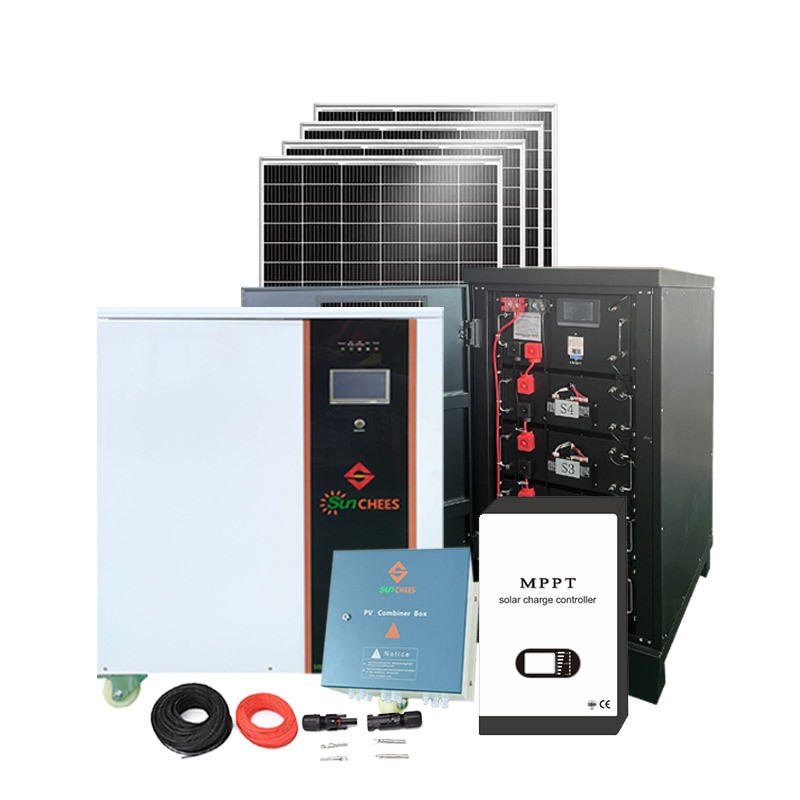
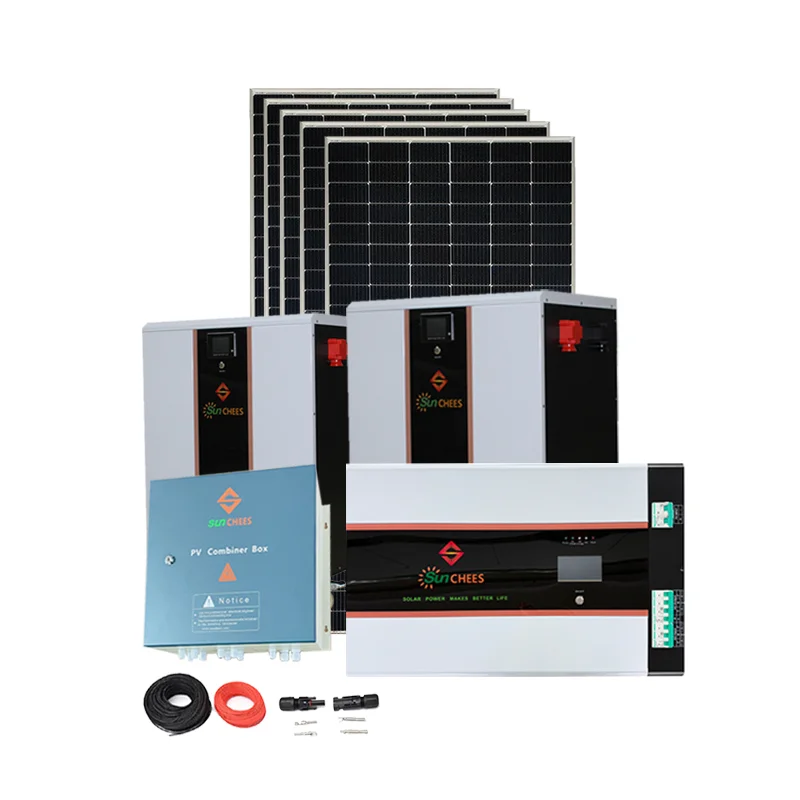
Below is a comparison of typical Sunchees off‑grid systems with 240 V‑capable inverters. Each integrates a pure‑sine‑wave inverter, LiFePO₄ battery and monocrystalline panels for reliability and longevity.
|
Model |
Inverter & voltage |
Solar panel capacity |
Battery (LiFePO₄) |
Approx. annual output |
Application scenarios |
|
6 kW / 48 VDC inverter, outputs 240 V single‑phase AC |
6 × 600 W (3.6 kW) panels |
51.2 V / 260 Ah, 13.31 kWh |
≈ 4,700 kWh |
Houses, small shops, farms, off‑grid RVs |
|
|
10 kW pure‑sine‑wave inverter, outputs 240 V single‑phase AC |
9 × 600 W (5.4 kW) panels |
51.2 V / 260 Ah, 17 kWh |
≈ 7,000–8,000 kWh |
Homes, cabins, farms, workshops |
|
|
15 kW / 96 VDC inverter, suitable for 240 V single‑phase supply |
16 × 600 W (9.6 kW) panels |
102.4 V / 300 Ah, 30.6 kWh |
≈ 10,000–12,000 kWh |
Villas, farms, small clinics |
Frequently asked questions
Q1. Can I use a 240 V inverter solar in a 120 V country?
Yes, but you’ll need a split‑phase inverter that outputs both 120 V and 240 V. In North America, split‑phase inverters convert DC into 110/240 V AC so that common loads receive 120 V while heavy loads get 240 V.
Q2. Will higher voltage damage my appliances?
Appliances must match the outlet’s voltage. Running a 220 V device on a 240 V line is generally acceptable, but using a 240 V device on a 120 V circuit will cause under‑voltage and overheating. Always check manufacturer specifications.
Q3. Is 240 V safer or more dangerous than 120 V?
Higher voltage can cause more severe electric shocks. Regions that use 120 V do so partly for safety; 240 V systems, however, transmit electricity more efficiently. Modern systems incorporate grounding and protection to mitigate risks.
Q4. What size of 240 V inverter solar do I need?
Choose based on load and annual energy consumption. For a small home or cabin, a 6 kW system (≈ 4.7 MWh per year) provides sufficient power. Larger homes or workshops may require 10–15 kW systems to support higher loads and future expansion.
Q5. How is Sunchees different?
Sunchees designs integrated inverters and LiFePO₄ batteries, ensuring all components are 100 % compatible. The systems support remote installation guidance, optional OEM branding and long service life (~25 years). For orders above 50 kW, Sunchees can dispatch engineers to install systems on‑site.
Conclusion
A 240v inverter solar system is not just about voltage—it’s about matching regional standards, powering high‑demand appliances and reducing wiring losses. Countries in Europe, Asia and Africa use 220–240 V mains, while North American homes rely on 240 V circuits for heavy loads. Higher voltage means less current and better efficiency. Sunchees’ 6 kW, 10 kW and optional 15 kW systems provide reliable 240 V output, integrated batteries and scalable design, making them ideal for residences, farms and small businesses seeking energy independence.
 3 Phase Solar Power Inverter – Complete Guide and Product Comparison
 You May Also Like



 Tel
Tel
 Email
Email
 Address
6th Floor, Zhonghe Zinan Industrial Park, No. 1 Zinan Changang West Road, Nanzhuang Town, Chancheng District, Foshan City, Guangdong Province. China (Mainland)