


 Whatsapp :
 Home
HomeThe 200 Amp Solar System Guide for Caribbean Homeowners
 Apr 20,2026
 0
0
 sunchees solar system
The 200 Amp Solar System Guide for Caribbean Homeowners
Off-grid ready, battery-first, installed in 5 days — across Jamaica, Dominican Republic, Puerto Rico, Trinidad, Martinique and beyond.
What Is a 200 Amp Solar System?
Before you can size a solar system for your home, you need to understand what "200 amps" actually refers to — because it means three very different things depending on context, and confusing them can cost you thousands of dollars.
Meaning #1 — Your 200 Amp Main Service Panel (most common)
When a solar installer talks about a "200 amp solar system," they almost always mean your home's main electrical service panel. This is the large metal box — usually in your garage, utility room, or on an exterior wall — where electricity from the grid enters your home and gets distributed to every circuit. A 200 amp panel is the modern standard for new residential construction and means your home can draw up to 200 amps of current at any moment. Older homes may only have 60 amp or 100 amp panels, which can be a bottleneck when installing solar.
Meaning #2 — A 200 Watt Solar Array (common misuse)
Sometimes people say "200 amp" when they actually mean 200 watts of solar panel capacity. This is an extremely small entry-level system — think RV rooftops, camping generators, or boat charging setups. A 200W array produces roughly 0.8–1.0 kWh per day in good sun. That's enough to charge a laptop and run a few LED lights, but nowhere near enough for a home with air conditioning, a refrigerator, or even a ceiling fan running all day.
Meaning #3 — A 200 Amp-Hour Battery Bank (storage context)
In off-grid and battery-storage conversations, "200 amps" often refers to amp-hours (Ah) — the capacity rating of a battery. A 12V 200Ah lithium battery stores 2.4 kWh of usable energy. This is a useful unit for sizing battery banks, particularly in the Caribbean where grid outages make battery capacity a critical factor, not just a nice-to-have.
Why Your 200 Amp Panel Is Your Solar "Golden Ticket"
Think of your 200 amp main panel as the master valve on your home's electrical plumbing. Every watt of solar energy produced on your roof eventually passes through this valve before reaching your appliances. If your panel is undersized — say, an old 60 amp or 100 amp box still common in many Caribbean homes — the additional current from solar will overwhelm it, causing breaker trips, overheating, or in worst cases, electrical fires.
Good news: If you already have a 200 amp panel, you own the most solar-ready electrical infrastructure available for residential use. In most cases, you will not need to pay $2,000–$4,000 USD to upgrade your panel before installing solar — a cost that catches many homeowners off guard.
Upgrading an electrical panel in the Caribbean is often more expensive and time-consuming than on the US mainland, because licensed electricians are scarcer, materials must be imported, and permitting processes vary dramatically between islands. The savings from having a 200 amp panel already in place are therefore even greater in the Caribbean context.
The 120% Rule: How Much Solar Can Your Panel Handle?
The US National Electrical Code (NEC) — which governs electrical installations in Puerto Rico, the US Virgin Islands, and is used as a reference in many other Caribbean territories — contains a critical safety rule known as the 120% Rule. It states that the total amperage flowing into your panel's main bus (from the grid plus from solar) cannot exceed 120% of the panel's rated capacity.
The math for a 200 amp panel:
200A × 120% = 240A maximum bus rating
240A − 200A (main breaker) = 40A available for solar
40A × 240V = approximately 7.6–9.6 kW of solar AC output without panel modifications.
For homeowners who want to go larger — say, 12–15 kW or beyond — there are technically advanced connection methods called Line Side Tap or Main Lug Connection that bypass the main breaker limitation entirely and allow a 200 amp service to support systems well above 15 kW. These should only be performed by a licensed electrician familiar with local codes.
How Much Solar Can You Actually Install?
What size system do you need? The easiest starting point is your monthly electricity bill. If you pay between $150–$250/month, a 10 kW system will typically cover 100% of your consumption. If your monthly bill exceeds $400 — because you have electric vehicles, a pool pump, large air conditioning units, or heavy industrial loads — you should be looking at 12–20 kW. If you want full energy independence from the grid entirely, plan for 15 kW or more of panels paired with a battery bank sized to cover 2–3 days of cloudy weather without any solar generation.
200 Amp Solar System by Caribbean Country
The Caribbean is not one market — it's dozens of distinct electrical environments shaped by colonial history, grid infrastructure, and local regulation. The "200 amp solar system" concept translates very differently depending on which island you're on. Here is what you need to know, country by country.
| Country / Territory | Voltage | Frequency | Panel Size | Solar Capacity | Sunchees Model | Panel Upgrade? |
|---|---|---|---|---|---|---|
| Puerto Rico / USVI | 120/240V | 60Hz | 100–200A | 8–12 kW | 10kW MHIC | Usually not needed |
| Jamaica / Barbados | 110V | 50Hz ⚠ | 60–100A | 3–5 kW | 6kW All-in-One | Often required |
| Trinidad & Tobago | 115V | 60Hz / 50Hz ⚠ | 60–100A | 3–6 kW | 6kW All-in-One | Often required |
| Dominican Republic | 120V | 60Hz | 100–150A | 6–10 kW | 10kW MHIC | Not needed |
| Martinique / Guadeloupe | 220V | 50Hz ⚠ | 60A (French) | 3–9 kW | 6kW or 10kW | French kVA system |
| Guam / Saipan | 120/240V | 60Hz | 100–200A | 8–15 kW | 10kW or 15kW | Usually not needed |
Sunchees Inverter Lineup for the Caribbean
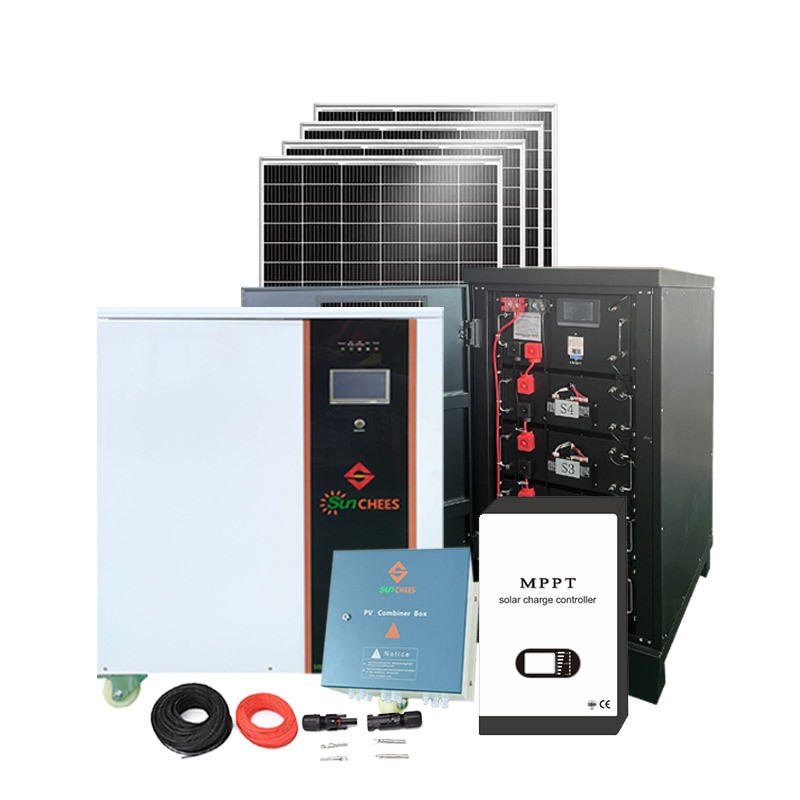
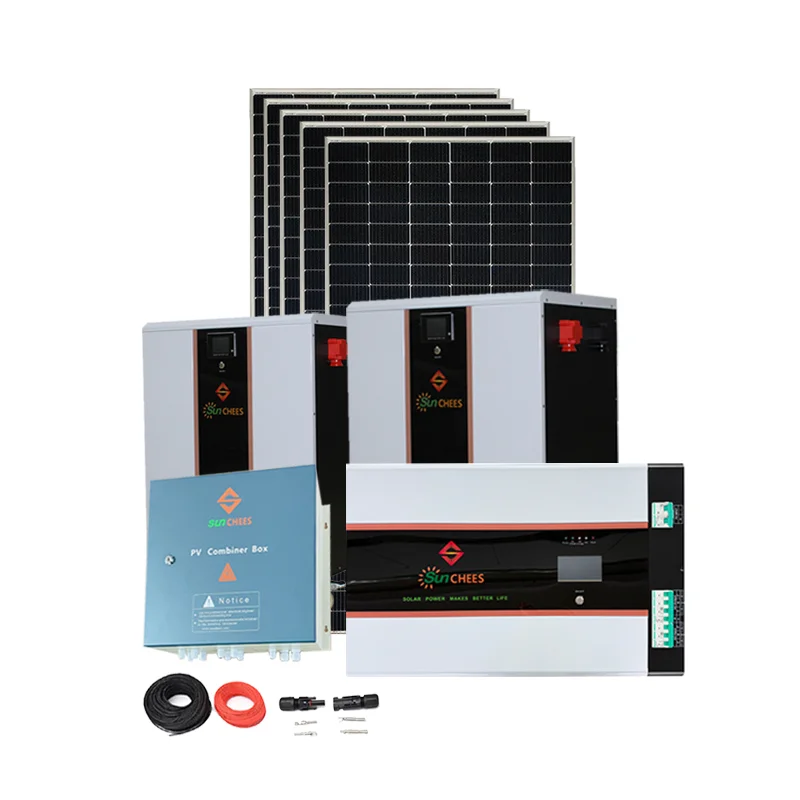
All Sunchees inverters are designed for exactly the Caribbean use case: wide-frequency AC input (45–65Hz), pure sine wave output switchable between 50Hz and 60Hz, battery-priority operating mode, less-than-10ms grid failover, and an operating temperature range of −15°C to +60°C that covers even the hottest Caribbean summers. Every unit integrates a high-efficiency MPPT solar charge controller, eliminating the need for a separate charge controller and simplifying your installation.
All models include: Pure sine wave output · 3 operating modes (grid-priority / power-saving / battery-priority) · Battery over/under-voltage, overload, short-circuit, and over-temperature protection · Intelligent SOC-based charge management · LCD display · Wide operating range −15°C to +60°C, 0–90% humidity non-condensing.
Installed in 5 Days — Including Commissioning
One of the most common frustrations with solar in the Caribbean is installation timelines that drag on for weeks or months. Sunchees has solved this by partnering with certified local installers across the region who are trained specifically on Sunchees systems and can complete a full residential installation — panels, inverter, battery bank, wiring, and commissioning — in just 5 working days.
Ready to Get a Quote?
Tell us your island, your monthly electricity bill, and your roof size. We'll size your 200 amp solar system and connect you with a local installer.
Contact Sunchees →Mobile System · Wheels Included
Unlike most solar equipment that is permanently fixed to a concrete pad, Sunchees inverter and battery units come equipped with wheels and are designed to be repositioned as needed. This makes them ideal for Caribbean homeowners who rent their property, are in a temporary location, or simply want the flexibility to move the equipment if they relocate.
Important note on wall mounting: Our standard units are floor-standing with wheels and are not designed for wall mounting. However, we understand that in flood-prone coastal areas — common across the Caribbean and Pacific — customers want their equipment elevated off the ground. We offer a wall-mount installation option that secures the unit to a wall at a safe height. If you are in a flood-risk zone, please ask about wall-mount configuration when you contact us.
Free Upgrade: Bifacial Double-Glass Panels
Why this matters in the Caribbean: Bifacial panels perform particularly well in environments with high albedo (reflected light) — including white-painted Caribbean rooftops, sand, and open water reflections common in coastal homes. The double-glass construction also provides better resistance to salt corrosion and moisture ingress, directly addressing one of the most common panel degradation causes in the Caribbean.
About Sunchees
Sunchees is a vertically integrated solar energy company founded in 2008, headquartered in Foshan, Guangdong, China. Unlike many solar brands that assemble systems from third-party components, Sunchees independently develops and manufactures both inverters and lithium battery systems, ensuring 100% component compatibility across every system sold. This eliminates the most common source of off-grid system failures: component incompatibility between inverters and batteries from different manufacturers.
| Brand | Sunchees |
| Founded | 2008 |
| Headquarters | Foshan, Guangdong, China |
| Factory size | 1,000 km² |
| Core technology | Proprietary inverter & lithium battery R&D. 100% in-house component compatibility — no dependency on third-party brands |
| Customization | OEM available. Custom solar panel brand specification. Custom solar systems and solar AC solutions |
| System lifespan | 25 years |
| Installation support | Full remote guidance. Free on-site engineer dispatch for orders ≥50 kW |
| Sample lead time | 1–10 units: 5–7 business days |
| Bulk lead time | 20–100 units: 10–20 business days |
| Delivery guarantee | All orders delivered on time regardless of size. Late delivery: 5% contract value penalty |
| Production tracking | Dedicated progress updates throughout manufacturing |
| Warranty — Solar panels | 10 years. Quality defects replaced free of charge |
| Warranty — Lithium battery | 3 years. Leakage / deformation replaced free of charge |
| Warranty — Inverter / controller | 2 years. Free PCB replacement provided |
| Global reach | 200+ countries. Priority focus on Caribbean and Latin America |
| Key markets | Jamaica, Costa Rica, Guyana, Dominican Republic, Ecuador, Trinidad & Tobago, Guam, Saipan |
| Customer satisfaction | 100% five-star ratings from global customers across residential, agriculture, industrial, finance, power, transport, and security sectors |
| Scalability | Systems from residential 6kW to industrial 1MW+. Off-grid, hybrid, and grid-tied configurations |
Frequently Asked Questions
Get Your 200 Amp Solar System Quote Today
Tell us your island, your monthly electricity cost, and your roof space. We'll design a system and connect you with a local installer who can have you running in 5 days.
Contact Sunchees Now →Instagram · TikTok · YouTube · Facebook — we're transparent and always active.
 The Complete Guide to the 48 Volt Solar System: Efficiency, Stability, and Off-Grid Freedom
 You May Also Like



 Tel
Tel
 Email
Email
 Address
6th Floor, Zhonghe Zinan Industrial Park, No. 1 Zinan Changang West Road, Nanzhuang Town, Chancheng District, Foshan City, Guangdong Province. China (Mainland)