


 Whatsapp :
 Home
HomeA 10 kW Hurricane-Grade Flat-Roof PV System on the Shores of the Caribbean Sea
 Apr 10,2026
 0
0
 sunchees solar system
Case Background
Located in the Caribbean Sea, the island of Saint Martin is a picturesque region characterized by its challenging climatic conditions. During the annual hurricane season—spanning from June to November—wind speeds can exceed 200 km/h, and the local power grid frequently suffers outages due to storms. Given the high cost of electricity and the instability of the power supply, many households have begun seeking self-sufficient, off-grid photovoltaic solutions.
The Client's Current Situation and Requirements
| Building |
Three-Story Traditional Caribbean-Style Residence |
| Primary Loads |
Refrigerator, lighting, TV, fans, small appliances, etc. |
| Pain Points |
Unreliable Local Grid; Frequent Hurricanes |
| Requirements |
Hurricane-Resistant and Capable of Fully Off-Grid Operation,Split phase |
The homeowner in question owns a three-story, traditional Caribbean-style residence in the Grand Case District. The home features four bedrooms and two bathrooms, with primary electrical loads consisting of a refrigerator, lighting, televisions, fans, and various small appliances. Due to the unreliability of the local grid, the homeowner sought to install a solar energy system capable of withstanding hurricane-force winds and operating entirely off-grid, while remaining within a reasonable budget.
Solution Finalized
The homeowner initially contacted us via WhatsApp after discovering our website. As a vertically integrated solar supplier—handling both manufacturing and sales—and having already successfully completed multiple installations in Dutch Saint Martin, we quickly garnered the client's interest in our products. Our sales representative promptly assessed the homeowner's specific requirements: an estimated daily electricity consumption of 12–15 kWh (calculated based on past utility bills) and a peak simultaneous load of approximately 5 kW (with provisions made for future expansion, specifically for air conditioning units that had not yet been installed). Furthermore, the residence features a flat concrete roof structure with ample load-bearing capacity; thus, the system installation had to strictly adhere to structural safety standards to ensure resilience during hurricane conditions. Finally, the client requested that the system possess split-phase output capabilities to support standard 120/240V household appliances.
Based on these specific client requirements, we provided a complimentary upgrade to double-glass solar panels to enhance power generation efficiency. Additionally, we recommended a system configuration featuring a 10 kW wall-mounted, split-phase solar inverter paired with a lithium-ion battery storage unit. After comparing proposals from two other suppliers, the homeowner concluded that this solution offered the best value for money in terms of wind-resistant structural design, the durability of the double-glass modules, and the configuration of the split-phase inverter. Consequently, they signed the contract and paid a 30% deposit.
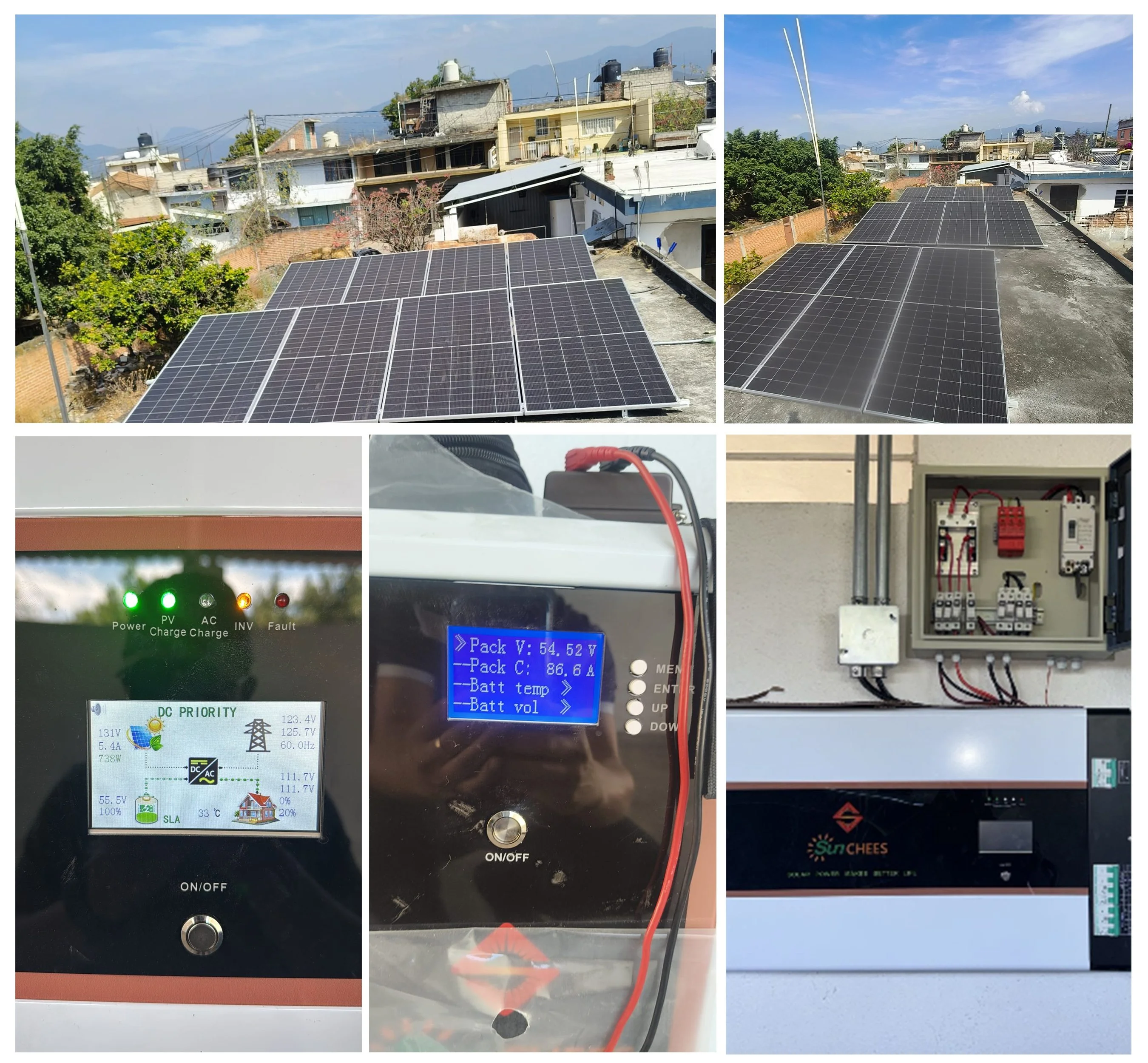
The sales team arranged for factory production and shipment—a process that took approximately two weeks. Upon receiving the goods, the client promptly engaged an electrician to carry out the installation.
The construction team began by precisely marking out the layout on the concrete roof, drilling holes, and embedding M12 chemical anchors. After allowing the anchors to cure for two hours, they installed the aluminum alloy main rails. They utilized reinforced triangular mounting brackets, adding diagonal braces between each bracket and the main rail for enhanced stability. Next, they installed 12 double-glass modules. These modules—which feature a dual-glass construction rather than a traditional backsheet—offer superior corrosion resistance in humid, salt-mist environments, and their glass surfaces are less prone to dust accumulation. The inverter was configured for split-phase output (L1/L2/N) and connected to the homeowner's existing distribution box. A transfer switch was installed to enable seamless switching between three operating modes: "PV (Solar) – Battery – Grid (Backup)." Additionally, the team installed the multi-function display panel included with the Sunchees inverter, along with a separate battery monitoring screen, allowing the homeowner to conveniently track data such as power generation, battery State of Charge (SOC), and load power consumption at any time.
Upon successful installation, a full-load test was conducted: a refrigerator, lighting, a television, a fan, and a dummy load (totaling approximately 8 kW) were switched on simultaneously. The inverter maintained a stable output, the battery discharge current remained within a controllable range, and a simulated grid outage and subsequent restoration confirmed that the system's automatic switchover to off-grid mode functioned correctly.
After three months of operation, the homeowner provided feedback noting that the double-glass modules required virtually no cleaning after heavy rains; the rainwater alone was sufficient to wash them clean. The split-phase output allowed them to directly power their American-style clothes dryer without needing to modify any existing wiring. Furthermore, the data displayed on the monitoring screens was highly detailed and comprehensive. In comparison to their previous average monthly electricity bill of $280, their current electricity costs have dropped to zero. This has undoubtedly proven to be a reliable and sound investment in solar energy.
This case study demonstrates that, even in regions with extreme climatic conditions, it is entirely possible—through the careful selection of materials and intelligent structural design—to implement a safe, reliable, and cost-effective off-grid power supply solution utilizing solar energy.
 St. Martin 5kW All-in-One Solar System
 You May Also Like



 Tel
Tel
 Email
Email
 Address
6th Floor, Zhonghe Zinan Industrial Park, No. 1 Zinan Changang West Road, Nanzhuang Town, Chancheng District, Foshan City, Guangdong Province. China (Mainland)