


 Whatsapp :
 Home
HomeHow a Solar Panel Regulator Charge Controller Extends Battery Life and Boosts System Efficiency
 Jul 02,2025
 0
0
 sunchees solar system
When building a solar energy system, choosing the right solar panel regulator charge controller is just as important as selecting quality solar panels or batteries. This device ensures your battery remains safe, efficient, and long-lasting by managing the flow of electricity between the solar panel and regulator system.
Why Is a Solar Panel Regulator Charge Controller Essential?
|
Function |
Description |
|
Prevents Overcharging |
Stops your battery from receiving too much current once it’s fully charged. |
|
Avoids Deep Discharge |
Disconnects the battery from the load when charge drops too low, preventing permanent battery damage. |
|
Improves Battery Life |
By regulating charging and discharging cycles, it helps batteries last longer and perform better. |
|
Optimizes Energy Use |
Especially with an MPPT charge controller, it ensures maximum energy is harvested from your solar panel. |
|
System Stability |
Acts as the “brain” or “traffic controller” between solar panels and batteries, maintaining smooth and safe operation across all conditions. |
How Does a Solar Panel Charge Controller Work?
Imagine your solar panel is a faucet, your battery is a bucket, and your charge controller is a smart valve:
-
When the bucket is almost full, the valve slows or stops the water (charging current) to avoid overflow (overcharging).
-
When the bucket is nearly empty, it prevents further usage to avoid breaking the bucket (battery damage).
This simple analogy perfectly illustrates why a solar panel regulator charge controller is indispensable in any solar setup.
Types of Solar Charge Controllers: PWM vs MPPT
|
Type |
||
|
Efficiency |
Lower, usually 70-80% |
Higher, up to 99% |
|
Cost |
More affordable |
Higher upfront cost |
|
Use Case |
Small-scale systems (e.g., RVs, cabins) |
Larger systems or areas with variable sunlight |
|
Technology |
Basic voltage matching |
Dynamic adjustment for max power output from solar panels |
If you’re investing in a medium or large-scale system, an MPPT solar battery charge controller is the smarter long-term choice.
When to Use an MPPT Charge Controller?
You should consider an MPPT charge regulator if:
-
You have a high-wattage solar panel setup.
-
Your environment has fluctuating light or temperature.
-
You want to maximize the ROI of your solar energy investment.
-
You’re powering a factory, office building, or any large commercial facility.
Real-World Example: Solar Panel and Regulator System in Action
A basic camping solar kit includes:
-
Solar panel to generate power.
-
Solar panel charge controllers to regulate power flow.
-
Battery to store energy.
-
Loads like lamps or phone chargers.
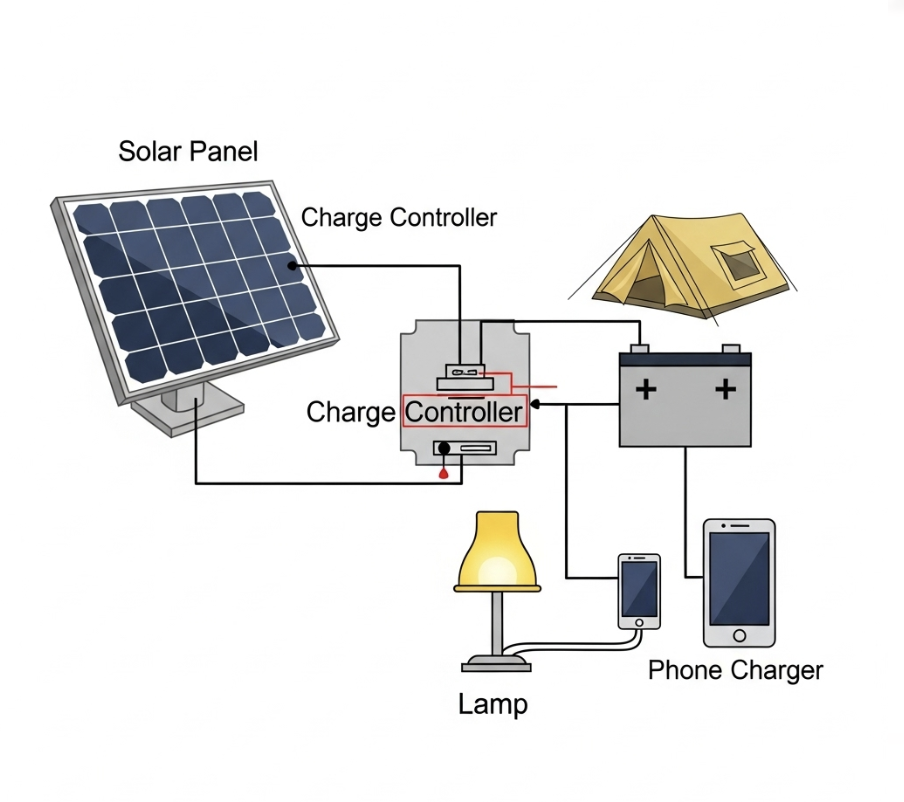
This image illustrates a simple solar power kit designed for camping, consisting of several key components that help you power your devices outdoors.
On the left is a solar panel, which captures sunlight and converts it into electricity.
The solar panel is connected via wires to a central device called a charge controller. This component acts as the system’s “brain” or “bodyguard,” managing and regulating the flow of electricity. It protects the battery by preventing overcharging and over-discharging, which helps extend the battery’s lifespan.
From the charge controller, wires run to the battery on the right. The battery stores the electricity generated by the solar panel so you can use power even when the sun isn’t shining.
Finally, the battery is connected to two powered devices: a lamp and a phone charger. This shows how the stored energy can be used to light up your campsite or recharge your phone.
In summary, the diagram clearly demonstrates how sunlight is converted into usable electricity by the solar panel, safely stored in the battery via the charge controller, and then used to power your camping gear.
In contrast, a large-scale commercial system might involve:
-
Dozens of panels on a factory roof.
-
An MPPT solar charge controller (often inside an inverter).
-
Integration with the grid.
-
Energy monitoring and safety protection features.
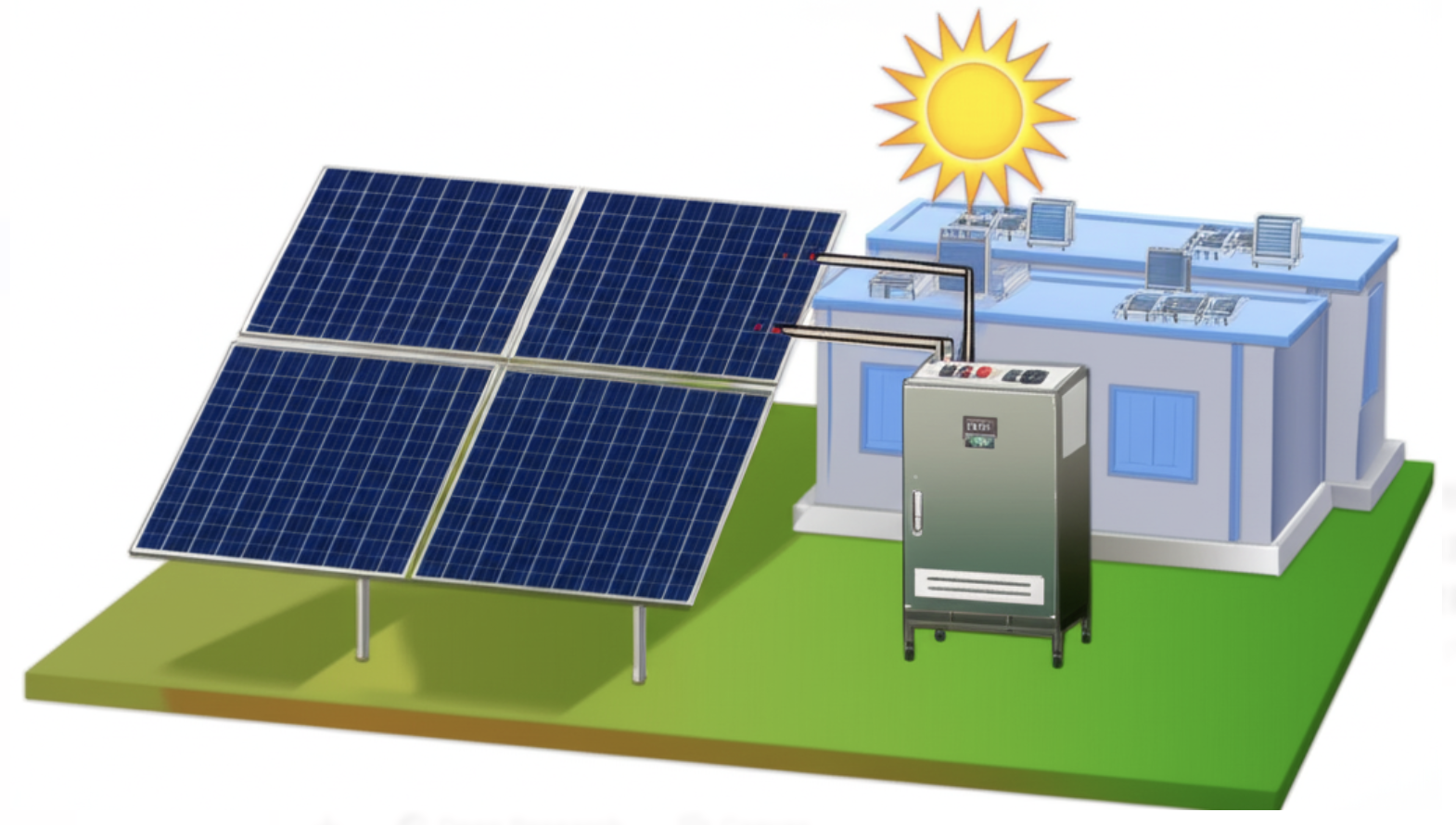
This image shows multiple solar panels installed on a rooftop, where they capture sunlight. The panels are connected by cables to a large grid-tie inverter located on the ground.
The inverter plays a crucial role: it converts the direct current (DC) electricity generated by the solar panels into alternating current (AC), which is suitable for use in a factory or commercial building. Additionally, the inverter can interact with the power grid (not directly shown in the image, but indicated by a connection on the inverter), allowing excess electricity to be fed back into the grid or drawing power when solar energy is insufficient.
The converted electricity is then supplied to various electrical systems inside the building — for example, air conditioning units mounted on the roof.
In summary, the diagram illustrates how rooftop solar panels generate electricity, which is converted by a grid-tie inverter and used to power commercial or industrial facilities, while also maintaining a connection to the main power grid.
These systems depend on smart charge control to function efficiently under heavy loads and dynamic energy usage.
What Sets Sunchees Apart in Solar Charge Controller Solutions?
Sunchees is a global leader in off-grid and hybrid solar systems with advanced MPPT solar battery charge controller technology built into their inverters.
|
Feature |
Sunchees Advantage |
|
100% System Compatibility |
In-house developed inverters and lithium batteries ensure seamless integration and stability. |
|
Global Coverage |
Projects in 200+ countries including Jamaica, Ecuador, and Costa Rica. |
|
Durability & Warranty |
Systems last up to 25 years, with warranties of up to 10 years. |
|
Custom Solutions |
OEM-friendly, solar AC & large-capacity customization supported. |
|
Fast Delivery |
Sample orders in 5-7 days, mass production in 10-20 days. |
|
Hands-on Support |
Remote installation guidance and on-site engineering (for 50kW+ systems). |
Explore the Sunchees 6kW Off-Grid MPPT Solar Inverter to see their advanced solar charge controller with MPPT in action.
FAQs About Solar Panel Regulator Charge Controllers
Q1: What’s the difference between a solar charge controller and a solar panel controller?
A: Technically, they refer to the same thing. Terms like solar battery charging controller or solar panel controllers are often used interchangeably, but all serve the purpose of regulating battery charge from solar input.
Q2: Can I connect a solar panel directly to a battery without a charge controller?
A: It’s not recommended. Without a charge regulator solar, your battery may overcharge or discharge too deeply, leading to permanent damage.
Q3: Is an MPPT charge controller worth the cost?
A: Yes—especially for larger systems. An MPPT charge controller can increase energy harvest by up to 30%, making your solar system more efficient and cost-effective over time.
Q4: What size solar panel charge controller do I need?
A: Match it to your system’s voltage and current. A typical guide is:
|
Panel Wattage |
System Voltage |
Suggested Controller Type |
|
100W–300W |
12V |
PWM or Basic MPPT |
|
500W–2kW |
24V |
MPPT |
|
2kW+ |
48V+ |
High-efficiency MPPT |
When in doubt, contact Sunchees for expert system sizing and controller recommendations.
Q5: Where can I buy reliable solar panel charge controllers?
A: Visit Sunchees.com to explore their range of advanced solar panel charge controllers with integrated MPPT charge regulator technology.
Conclusion: Maximize Solar Efficiency with the Right Charge Controller
A high-quality solar panel regulator charge controller protects your battery, maximizes your energy efficiency, and ensures your solar system operates safely. Whether you’re camping off-grid or powering a factory, choosing the right solar charg controller—especially with MPPT—makes all the difference.
Choose Sunchees for:
-
Proven performance in harsh environments
-
Advanced MPPT integration
-
Global service and support
Explore custom solar solutions today at Sunchees.
 Solar Panel Wiring Diagram for Home – Understanding Connections, Components, and Practical Use
 You May Also Like



 Tel
Tel
 Email
Email
 Address
6th Floor, Zhonghe Zinan Industrial Park, No. 1 Zinan Changang West Road, Nanzhuang Town, Chancheng District, Foshan City, Guangdong Province. China (Mainland)