


 Whatsapp :
 Home
Home10kW Solar System in Montserrat: A Two-Storey Home in St. Peter
 Aug 05,2026
 0
0
 sunchees solar system
If you own a two-storey home in Montserrat and want solar power for everyday use plus battery support during an outage, this project offers a practical reference point. Sunchees supplied a 10kW-class single-phase solar and storage system for a traditional four-bedroom, two-bathroom house in St. Peter. The installation used twelve 600W double-glass solar panels and two 51.2V 300Ah lithium batteries. The roof-mounted equipment and electrical system were installed and commissioned in two days.
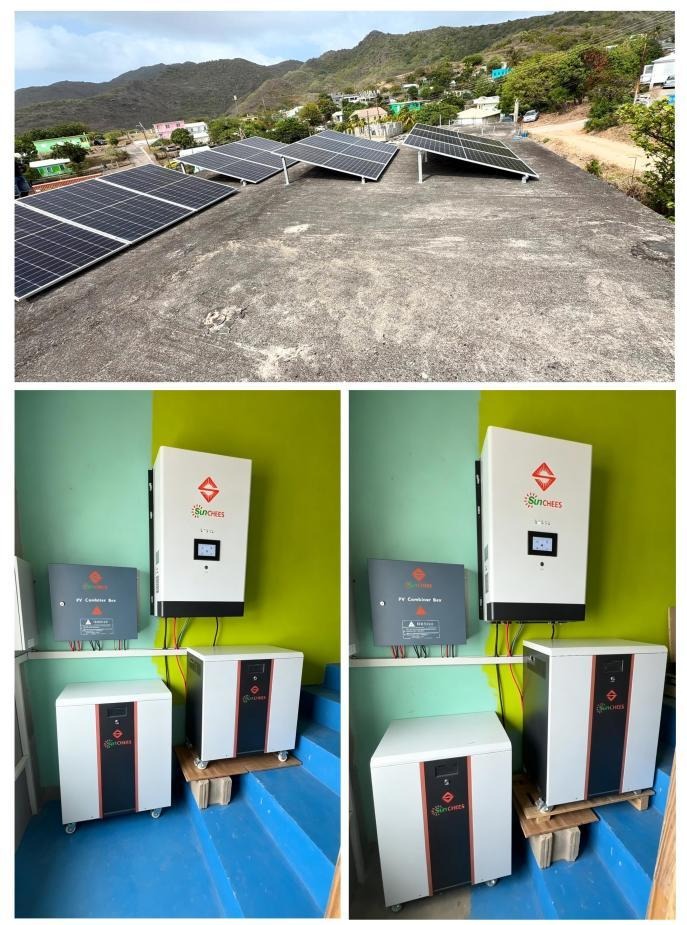
A St. Peter residential installation with a raised rooftop array, wall-mounted power equipment and two floor-standing lithium batteries.
Project at a glance
|
|
|
|
|
|
|
|
|
|
|
|
|
|
|
|
|
|
|
|
|
|
|
|
|
|
|
Three capacity figures every buyer should compare
The project combines three different ratings. The 10kW figure describes the system or inverter power class. The twelve 600W modules make a 7.2kWp DC solar array. The two 51.2V 300Ah batteries provide approximately 30.72kWh of nominal stored energy in total.
Those figures describe different jobs: the inverter rating relates to the AC loads the system can serve, the array rating relates to solar generation capacity, and the battery rating relates to stored energy. A useful quotation should show all three separately, together with the inverter model, module quantity, battery voltage and amp-hour rating.
Nominal battery energy is not the same as usable AC energy. The available amount will be lower after the battery's permitted depth of discharge, minimum state-of-charge setting, conversion losses, temperature and system protection settings are considered.
What this battery capacity is intended to support
The two batteries allow part of the daytime solar production to be stored for evening use and for selected circuits during a power interruption. In many homes, priority loads include refrigeration, essential lighting, internet equipment, security equipment and phone charging.
Backup time cannot be stated accurately from battery capacity alone. It depends on which appliances remain on, their starting and running power, and how long they are used. For a new system, send us the rated power and expected operating time of each essential appliance. We can then size a critical-load plan around usable battery energy instead of quoting an unsupported number of backup hours.
Planning a flat-roof installation for Montserrat conditions
Montserrat's public solar work has previously included hurricane exposure, coastal conditions and corrosive sea air in its engineering requirements. For a homeowner, that means the roof structure, anchor positions, roof-edge wind zones, mounting materials, fasteners and corrosion protection all deserve specific attention.
The project record describes reinforced aluminium mounting selected for a hurricane-prone environment, and the photo shows a raised array on the concrete roof. That description is not a universal wind certification for another property. Each new installation should have its roof and anchoring reviewed for the site. We recommend asking for the mounting specification, project design wind speed, fastener details, corrosion measures and structural responsibility to be recorded in the handover documents.
What a two-day installation tells a buyer
The rooftop equipment, wall-mounted inverter and controls, two floor-standing batteries and connecting cables were installed and commissioned in two days. A prepared roof, confirmed equipment locations and a clear cable route help site work move efficiently. Your own schedule may differ because of weather, roof condition, distribution-board changes or other site preparation.
At handover, ask for the test and commissioning record. It should cover DC polarity and voltage, insulation, grounding, protective devices, inverter settings, battery communication, charging and discharging, critical-load operation and monitoring access. These records make future maintenance and remote support much easier.
How Sunchees prepares a matched Montserrat quotation
Send us your location, twelve months of electricity use, the appliances that must remain available during an outage, roof and equipment-area photos, shading information, cable distances and details of wind, salt exposure, drainage and access. We will assess the array, inverter and battery as separate parts of one design and match them to the way your household actually uses power.
For more local context, read the Sunchees guide to solar energy in Montserrat. You can also review our 10kW-class complete solar home system. The final bill of materials for any new project should be based on the property survey and load assessment, not copied automatically from this case.
If you are sourcing a complete package from China, our guide to shipping a 10kW solar system to Montserrat explains the purchasing and delivery questions to confirm.
Frequently asked questions
Is the solar array in this project 10kWp?
No. The project uses a 10kW-class system or inverter and twelve 600W solar modules. The modules add up to a 7.2kWp array. Compare the inverter power and solar-array capacity as separate figures.
How much energy can two 51.2V 300Ah batteries store?
Voltage multiplied by amp-hours gives about 15.36kWh of nominal energy per battery, or approximately 30.72kWh for two. A system design must then account for depth of discharge, state-of-charge limits, conversion efficiency and the selected critical loads.
Is this flat-roof mounting hurricane-proof?
The project record describes reinforced aluminium mounting for a hurricane-prone environment. A new home's final design must still be checked against its roof structure, anchoring, roof-edge wind pressure, fasteners and project-specific design wind speed. “Hurricane-proof” should not replace documented engineering.
Can every Montserrat home be installed in two days?
No. This project's installation and commissioning took two days. The schedule for another home will depend on its roof, cable routes, electrical modifications, weather and level of site preparation.
What should I send Sunchees for a quotation?
Send the exact location, twelve months of electricity use, a list of critical loads, photos of the roof and equipment area, shading and distribution-board information, your backup objective, and details of wind and salt exposure. We can then assess the array, inverter, battery and site requirements separately.
Editorial sources
 10kW Home Battery Backup in Montserrat: A Three-Storey St. Peter Case
 You May Also Like



 Tel
Tel
 Email
Email
 Address
6th Floor, Zhonghe Zinan Industrial Park, No. 1 Zinan Changang West Road, Nanzhuang Town, Chancheng District, Foshan City, Guangdong Province. China (Mainland)