


 Whatsapp :
 Home
HomePhotovoltaic Panels Suppliers: A Comprehensive Guide to Choosing and Using Solar Panels
 Aug 25,2025
 0
0
 sunchees solar system
Introduction
Solar energy has become one of the most cost‑effective and environmentally friendly ways to generate electricity. However, most of the world’s photovoltaic (PV) manufacturing capacity is concentrated in a handful of suppliers, especially in China. Understanding the market and comparing suppliers is crucial for buyers who want reliable products at competitive prices. This guide explains how to assess PV panels suppliers, focuses on Chinese manufacturers, compares a selection of well‑known brands, and presents Sunchees, a company offering complete solar systems with customised services.
Why China Dominates Photovoltaic Panels Supply
China’s dominance stems from long‑term government support, massive investment in polysilicon and wafer capacity, and a large domestic market that helps manufacturers achieve economies of scale. As a result, manufacturers can offer competitive prices while continuing to improve efficiency and reliability. However, the concentration of production also means buyers need to evaluate the resilience and transparency of individual companies, particularly for long‑term projects.
Key Criteria for Selecting Photovoltaic Panels Suppliers
-
Manufacturing Reputation and Volume – Companies like Tongwei, JA Solar, LONGi, Jinko Solar, Trina Solar, and Aiko Solar ship tens of gigawatts of panels each year. High volumes indicate robust production lines and suggest stability.
-
Technology and Efficiency – Modern panels are mostly monocrystalline (higher efficiency) or polycrystalline (slightly lower cost). Many top Chinese brands now offer mono PERC or even N‑type modules with efficiencies exceeding 22 %, narrowing the gap with premium US or European products.
-
Quality Certifications – Verify that panels meet IEC/UL standards for performance, reliability, and fire safety. Reputable manufacturers often hold ISO certifications for quality management and environment management.
-
Warranty and After‑Sales Support – Panels typically come with a 25‑year performance warranty. In addition, check the warranties for inverters (often two to five years) and batteries (three to ten years). Strong after‑sales support is essential for troubleshooting and replacement logistics.
-
Supply‑Chain Diversity – Manufacturers that source silicon and components from multiple suppliers can better handle raw material price fluctuations or geopolitical disruptions.
-
Customization and Services – A good supplier will offer tailored system design, installation advice, and accessible customer service, ensuring the solution meets local regulations and user needs.
Comparing Leading Chinese Solar Panel Brands
Below is an overview of prominent Chinese manufacturers to help potential buyers differentiate among them:
-
Tongwei Solar – Known primarily for upstream production, Tongwei has become one of the world’s largest cell and module manufacturers. They invest heavily in research and maintain high volume output, offering cost‑effective panels widely used for utility‑scale projects.
-
JA Solar – Recognized for consistent quality and innovation, JA Solar offers a broad product line, including bifacial modules and N‑type technology. They balance efficiency with price, making them a common choice for commercial and residential projects.
-
LONGi Solar – Specializes in monocrystalline wafers and modules and is considered a leader in high‑efficiency technology. LONGi’s panels often feature robust warranties and strong performance in low‑light conditions, appealing to buyers willing to pay a premium for efficiency.
-
Jinko Solar – One of the best‑known brands worldwide, Jinko Solar combines competitive pricing with global distribution. They offer a range of products and have strong bankability, which is important for large projects seeking financing.
-
Trina Solar – Trina offers advanced technologies such as Vertex series modules with large cell formats and high power ratings. They also provide comprehensive solutions, including trackers and energy storage, suited for large utility projects.
-
Aiko Solar – A newer entrant with innovative cell technology, focusing on achieving very high conversion efficiencies at competitive prices.
-
Canadian Solar – Though headquartered in Canada, most manufacturing is in China. Canadian Solar offers strong global support and is often considered alongside top Chinese brands for reliability and bankability.
When comparing these brands, consider not only efficiency and cost but also the reputation for warranty service and local support in your region. Some buyers prefer to split orders across multiple suppliers to balance pricing and delivery risk.
Introducing Sunchees: A Reliable Solar Plate Manufacturer and System Supplier
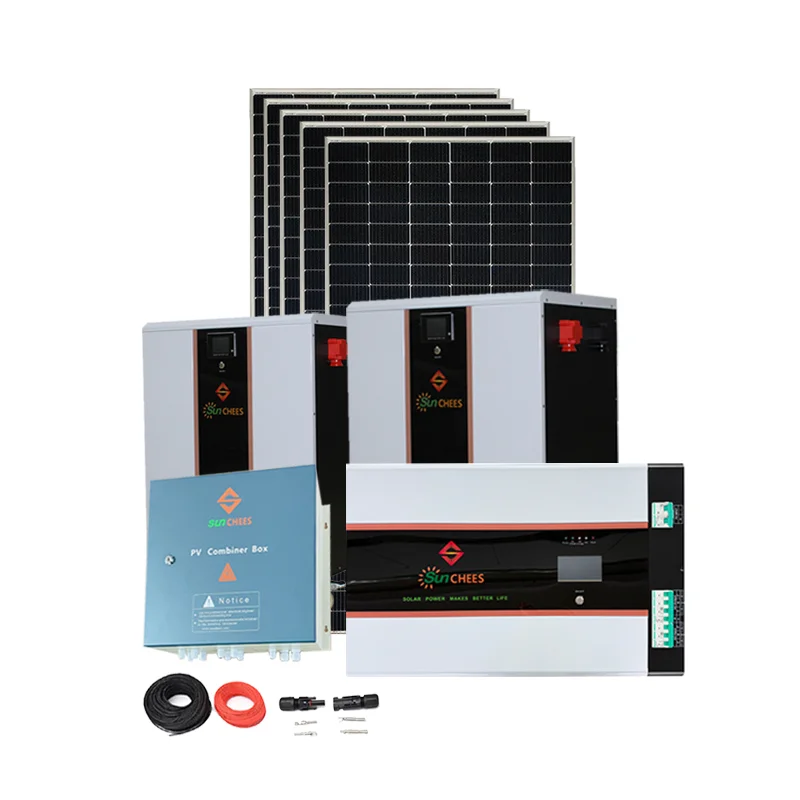
Sunchees differentiates itself by providing not only solar panels but complete systems that include inverters, LiFePO4 batteries, and mounting hardware. With more than 15 years of OEM/ODM experience, Sunchees offers customized system design, fast delivery, and comprehensive technical support. Sunchees’ integrated approach means buyers can work with a single supplier for the entire system, simplifying logistics and ensuring compatibility among components. The company sells worldwide and offers warranties of up to 10 years for panels, three years for batteries, and two years for inverters.
Comparison of Sunchees Off‑Grid Systems (10 kW–30 kW)
|
System |
Panels & Battery |
Estimated Daily Generation (kWh) |
Load Reference & Typical Appliances |
Estimated Daily Savings* |
Backup Duration (Battery Only)** |
|
18 × 550 W panels (~9.9 kW) and 32 kWh LiFePO4 battery |
~30–50 kWh/day (depends on sunlight) |
Lights, fans, computers, printers, refrigerators, washing machine, microwave oven, electric cookers, one or two air conditioners, TV, water pump (total load around 7,105 W) |
Savings around ¥1,000–1,700/day at ¥33.522 per kWh |
Powers a 1–2 person household (15–20 kWh/day) for ~1.6–2.1 days without sunlight |
|
|
40 × 550 W panels (~22 kW) and 58 kWh battery |
~60–100 kWh/day |
Larger refrigerators, washing machines, microwaves, electric stove, 2–3 air conditioners, pumps, office equipment (load around 16,010 W) |
Savings around ¥2,000–3,350/day |
Powers a 3–4 person household (25–30 kWh/day) for ~1.9–2.3 days without grid |
|
|
50 × 600 W panels (~30 kW) and 300 Ah/192 V battery (~62 kWh) |
~90–150 kWh/day |
More air conditioners, water pumps, heavier appliances; roughly 184 kWh total capacity requiring ~140 m² roof space |
Savings around ¥3,000–5,000/day |
Supports a 5+ person household (35–50 kWh/day) for ~1.2–1.8 days |
*Estimates based on Japan’s average residential electricity price (¥33.522 per kWh); actual savings depend on local tariffs and sunlight.
**Backup duration is based on typical household consumption.
System Functionality
-
Hybrid Operation: All systems can operate off‑grid or hybrid (connected to the grid for charging during low sunlight).
-
UPS Mode: The inverter automatically switches to battery power during outages, ensuring continuous supply.
-
Remote Monitoring: Users can track energy production and battery status via built‑in displays or mobile apps.
-
Longevity: Sunchees panels are rated for 25–30 years, and LiFePO4 batteries are designed for thousands of cycles.
Additional Considerations When Importing From China
If your goal is to source PV panels or complete systems directly from China, keep these points in mind:
-
Minimum Order Quantity (MOQ): Many factories require a minimum number of panels or systems per order. Smaller buyers should check if suppliers are willing to ship lower quantities or partner with local distributors.
-
Shipping and Logistics: Consider incoterms (FOB, CIF, DDP) and freight costs. Air shipping is faster but expensive; sea freight is cheaper but slower. Customs duties and local taxes may apply.
-
Currency and Payment: Suppliers often quote prices in USD; payment terms can include a down payment before production and the balance upon delivery. Ensure the supplier accepts secure payment methods and uses escrow or letters of credit if necessary.
-
Quality Inspection: Independent inspection agencies can check product quality before shipment. This step is vital for first‑time purchases or when working with new suppliers.
-
Local Certifications: Some countries require additional certifications (e.g., UL, TÜV Rheinland) beyond standard IEC tests. Confirm that imported modules meet your region’s grid code and safety regulations.
Frequently Asked Questions (FAQ)
Q: How do I choose between major Chinese brands?
A: Evaluate your priorities. If you need maximum efficiency, LONGi or JA Solar modules may be suitable. For lower upfront cost with solid reliability, Jinko Solar or Trina Solar may suffice. If bankability and global warranty support are key, Canadian Solar is a strong candidate.
Q: Are cheaper panels from unknown suppliers worth considering?
A: While lesser‑known factories can offer low prices, they may lack robust warranty support or long‑term reliability. It’s safer to select established brands unless you can thoroughly vet the supplier’s quality control.
Q: How does Sunchees compare to big module manufacturers?
A: Sunchees focuses on integrated solutions rather than mass‑market modules. Although their panels may not reach the absolute highest efficiency benchmarks, their value lies in providing complete, ready‑to‑install systems, custom design, and dedicated support. For buyers seeking turnkey off‑grid or hybrid solutions, that convenience can outweigh marginal efficiency differences.
Q: What are the key drivers of panel pricing?
A: Raw material costs (especially polysilicon), manufacturing scale, cell technology (mono vs. poly, PERC vs. N‑type), and supply‑demand dynamics all influence prices. External factors like tariffs, shipping costs, and currency fluctuations also play a role.
Q: Should I use multiple suppliers?
A: Using multiple suppliers can diversify supply risk and potentially optimize pricing. However, it may complicate warranty claims and integration. For small projects, sticking with one reliable supplier simplifies logistics.
Conclusion
China’s solar manufacturing industry sets the pace for global supply, with leading brands offering high volumes, advanced technology, and attractive pricing. When selecting a photovoltaic panels supplier, compare well‑known manufacturers based on efficiency, warranty, price, and after‑sales support. For customers seeking turnkey solutions, Sunchees provides integrated off‑grid kits that combine panels, batteries, and inverters with tailored system design. By carefully evaluating your needs and comparing top manufacturers, you can source high‑quality panels from China and build a solar system that delivers long‑term performance and savings.
 Sunchees 600W Solar Panel: Real 13.9A Output Tested in Jamaica’s Sunlight
 You May Also Like



 Tel
Tel
 Email
Email
 Address
6th Floor, Zhonghe Zinan Industrial Park, No. 1 Zinan Changang West Road, Nanzhuang Town, Chancheng District, Foshan City, Guangdong Province. China (Mainland)