


 Whatsapp :
 Home
HomeInstalled Jul 24, 2026: 10kW Solar and Battery System for a Five-Bedroom Kingston Home
 Aug 13,2026
 0
0
 sunchees solar system
For a larger Kingston home, solar is not only about lowering daytime grid purchases. It can also keep the refrigerator, lights, internet and selected air conditioners running when the grid is unavailable. Jamaica records average solar irradiation of about 5kWh/m²/day, while OUR reported that the average JPS customer experienced 11.8 sustained interruptions totalling 2,403.3 minutes in 2023. This project combines that strong solar resource with substantial battery capacity: a 7.2kWp array supplies daytime energy, while 30.72kWh of nominal storage moves part of it into the night or an outage.
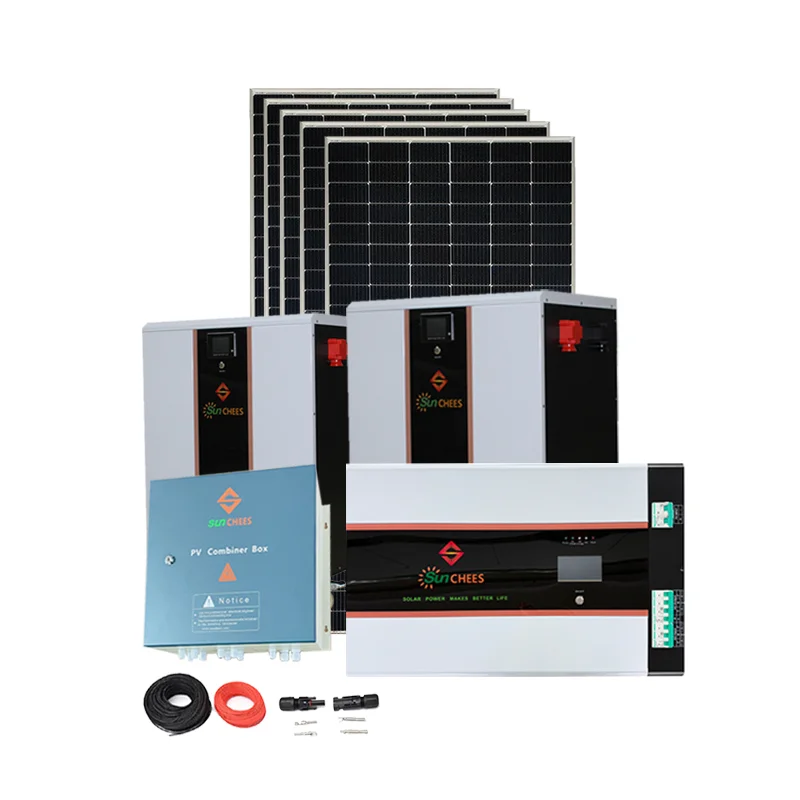
Kingston, Jamaica — Jul 24, 2026. Sunchees completed a rooftop solar-and-storage installation for a five-bedroom, two-bathroom home. The recorded system comprises twelve 600W double-glass modules, one 10kW split-phase inverter and two 51.2V 300Ah lithium batteries. The site work took two days.
Why solar and storage make sense for a five-bedroom home in Kingston
The latest parish-level household table directly available from STATIN reports an average household size of 3.0 people in both Kingston and neighbouring St Andrew in the 2011 Census. It does not cross-tabulate occupants by bedroom count, so we should not claim that a five-bedroom home has a fixed number of residents. For design, a useful comparison is a three-person household using spare rooms as an office or guest rooms versus a four-to-six-person multigenerational household using most bedrooms.
More occupants usually extend the operating hours of refrigeration, lighting, hot water, electronics and cooling. Five bedrooms can also mean several cooling zones running at once. Those are two separate sizing questions: simultaneous appliance demand determines inverter kW, while total overnight consumption determines battery kWh.
After installation, the improvement follows two practical paths. During the day, the 7.2kWp array first serves appliances that are already running, reducing purchases from JPS at the same time. Surplus solar can charge the batteries. At night or during an interruption, the batteries supply a preselected group of essential circuits. Bill savings depend on daytime self-consumption, tariff and weather; backup duration depends on the actual load schedule and battery settings.
What was installed
|
|
|
|
|
|
|
|
|
|
|
|
|
|
|
|
|
|
|
|
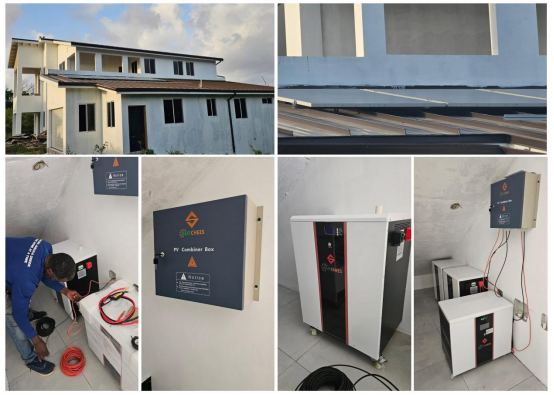
How much usable backup does 30.72kWh provide?
For preliminary planning, assume 80% usable depth of discharge and 90% inverter efficiency. The batteries would then deliver about 30.72 × 0.80 × 0.90 = 22.1kWh to AC loads. A steady 1kW average load would therefore run for roughly 22 hours; 2kW would run for about 11 hours.
This is a load-planning example, not site monitoring. A refrigerator, lights, router and fans form a relatively light essential-load group. Several air conditioners or electric heating appliances consume the reserve much faster. A final schedule should use each appliance's rated input, maximum input, starting current and intended operating hours.
How the 7.2kWp array and 10kW inverter divide the work
The 10kW figure is inverter power, not panel capacity. The inverter leaves room for larger short-term household demand; the 7.2kWp array determines how much solar energy can be collected during the day.
Using Jamaica's approximate 5kWh/m²/day solar resource and an 80% overall planning factor for temperature, dirt, wiring and conversion losses gives 7.2 × 5 × 0.8 = 28.8kWh/day. This is a long-term planning value, not measured production. A home using 20kWh per day may, in favourable conditions, cover that use and replace some stored energy. At 30kWh per day it is already close to the estimated array yield; at 40kWh per day there would be an approximate 11kWh daily shortfall before weather variation.
The battery shifts energy between hours. A persistent daily generation deficit remains an energy-supply gap, so continuous whole-home off-grid operation requires the annual load to fit sustainable generation, with additional reserve or another charging source for cloudy periods.
How many air conditioners can a 10kW inverter run?
Courts Jamaica currently lists inverter split units in 12,000, 18,000 and 24,000 BTU classes. These listings establish locally available capacity bands; sales-ranking evidence would be required to identify a best seller. As a technical reference, LG publishes nominal cooling inputs of about 1.08–1.12kW for a 12,000 BTU inverter unit and about 1.50–1.62kW for an 18,000 BTU unit.
If we limit planned continuous loading to about 8kW and reserve 1.5kW for refrigeration, lights, internet and outlets, approximately 6.5kW remains for cooling. On nominal inputs, that supports about five 12,000 BTU inverter units, or four 18,000 BTU units. Five 12,000 BTU units at 1.1kW each plus 1.5kW of base load total about 7.0kW.
That is a design example, not this home's measured operating condition. Maximum input in very hot weather, non-inverter starting current, uneven loading between phases and the battery's discharge-power limit can all reduce the practical number.
Three records a pitched-roof proposal should include
A site-specific proposal is most useful when it shows the structural and anchoring method, a shading and module-layout plan, and an equipment-room arrangement with clearances, ventilation and protection devices. Those records let the price accurately represent the roof work and electrical scope.
Sunchees starts a comparable design with the latest electricity bills or daily kWh, nameplates for air conditioners and other motors, the essential-load list, desired backup hours, roof photographs and site voltage. Our 10kW split-phase solar system is a product-range reference; the final bill of materials must follow the property load and site design.
Frequently asked questions
Can this system keep the entire five-bedroom home off-grid indefinitely?
Not from the equipment ratings alone. The preliminary array yield is about 28.8kWh/day. If the home's annualised daily use stays below sustainable generation and priority loads are controlled, extended off-grid operation may be possible. Loads near or above that figure, and several cloudy days, require more PV, reduced consumption, grid charging or another backup source.
Is the project enrolled in JPS Net Billing?
The project record supplied for this update does not include an approval, bidirectional-meter record or Standard Offer Contract, so participation is unverified. JPS Net Billing allows eligible customers to self-consume renewable energy and export surplus under the applicable arrangement.
What should I provide for a comparable quotation?
Provide recent bills or daily/monthly kWh, appliance power and operating hours, air-conditioner and motor details, site voltage, roof dimensions and photos, shading information, essential loads and desired backup duration.
Editorial sources
 Installed Jun 10, 2026: 10kW/15kWh Solar System for a Kingston Flat-Roof Home
 You May Also Like



 Tel
Tel
 Email
Email
 Address
6th Floor, Zhonghe Zinan Industrial Park, No. 1 Zinan Changang West Road, Nanzhuang Town, Chancheng District, Foshan City, Guangdong Province. China (Mainland)