


 Whatsapp :
 Home
HomeA Kingston Garden Home and Its Owner’s Off Grid Solar Feedback
 Sep 08,2026
 536
536
 sunchees solar system
“I am completely off the grid now at home with the system.” That was the message received after solar was installed at this Kingston home. Yellow walls, a grey pitched roof and an enclosed garden give the owner's feedback a recognisable setting.
The house has five bedrooms and two bathrooms, with a refrigerator, lights and air conditioning among its daily appliances. We completed the installation on August 15, 2026, after two days on site. Panels follow the roof slopes, and electrical equipment occupies a space behind louvred doors indoors.
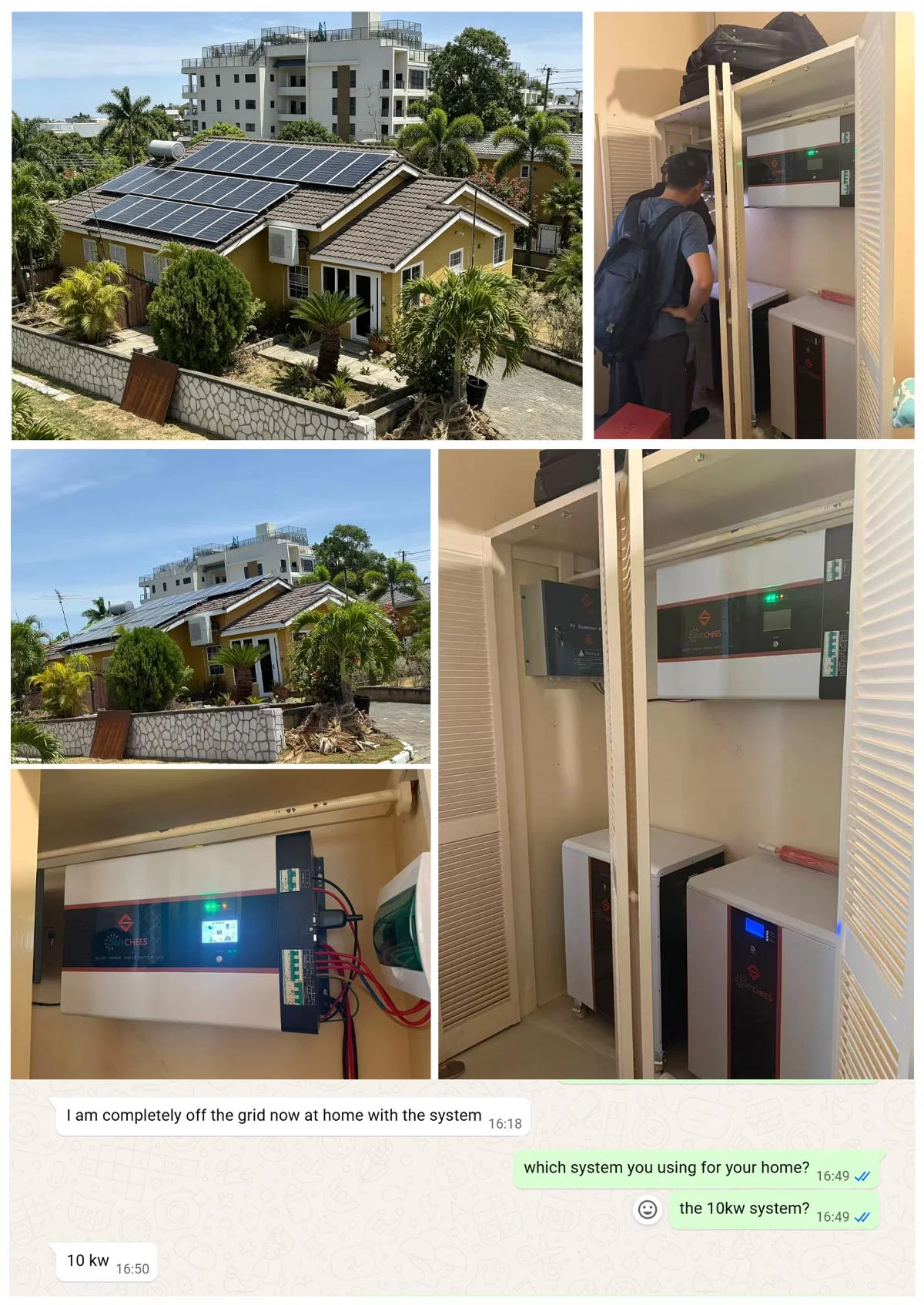
A yellow garden home with a grey pitched roof, solar panels, nearby taller buildings and power equipment behind indoor louvred doors.
A home within an established neighbourhood
The garden and boundary walls surround the yellow house, with a much taller building behind it. Hot water equipment remains beside the rooftop panels. Trees, neighbouring buildings and existing roof equipment all need to be considered with the roof planes when assessing sunlight. These conditions affect daily charging and are relevant to off grid operation.
The project uses twelve 600W panels, a 7.2kWp array, a 10kW split phase inverter and lithium storage. The customer also confirmed the 10kW configuration in the conversation. Daytime generation supplies electricity and stores some for use without sunlight.
Indoors, two floor standing cabinets are visible behind the louvred doors. Fitting equipment into an existing household space also means allowing the ventilation and service access it requires; louvres alone do not establish that ventilation is adequate. Rooftop generation, stored energy and evening appliance consumption need to work together in a house using air conditioning.
What the owner reported at the time
The message records the customer's report of operating off grid at home at that point. It does not include a year of operating records, so it is not a promise of year round independence or zero electricity bills in every weather condition.
From the pitched roof to refrigeration, lights and cooling indoors, the system had entered the customer's daily use. The owner's message provides a direct account of that experience after installation.
Plan Your Solar Project with Sunchees
Founded in 2008 and based in Foshan, Guangdong, China, Sunchees develops its own inverters and lithium batteries and provides customised solar power and solar air conditioning solutions for homes and businesses. We support OEM requirements and your choice of solar panel brand, with remote installation guidance throughout the process, from equipment configuration to on-site installation support.
If you are considering solar for your home or business, share your project location, building photographs and everyday electricity needs with us. We can discuss a system and installation arrangement that suits the site and how you use it.
We are transparent and active. You can find us on Instagram, TikTok, YouTube, and Facebook.
 Solar and Backup Power for a Fifteen Bedroom Villa in Montego Bay
 You May Also Like



 Tel
Tel
 Email
Email
 Address
6th Floor, Zhonghe Zinan Industrial Park, No. 1 Zinan Changang West Road, Nanzhuang Town, Chancheng District, Foshan City, Guangdong Province. China (Mainland)