


 Whatsapp :
 Home
HomeHow Much Solar and Battery Storage Does Your Caribbean Home Need?
 Sep 22,2026
 52
52
 sunchees solar system
How much solar do you need to keep the fridge running, sleep with the air conditioning on and buy less electricity from the grid? The answer starts with how you use your home—especially after sunset.
Your inverter determines which appliances can run together. Your battery determines how much electricity you can save for later. Your panels need to produce enough to supply the home and recharge that battery. Choosing each part for its job helps you avoid paying for capacity you do not need.
For example, a home using 900 kWh in a 30-day month uses about 30 kWh a day. But that does not mean it needs a 30 kWh battery. If only 12 kWh is used overnight and the grid remains available as backup, you can start by sizing storage for that night. Keeping the same home running for a full day without any incoming power is a much bigger job.
Below, we work through that example, including the extra capacity needed because some energy is lost along the way. You can use it to understand a quotation, then adjust the numbers for your appliances, location and backup needs.
Do You Want Lower Bills, Power During Outages, or Both?
Decide what you want to keep running before choosing a package. Keeping the fridge, lights and one bedroom air conditioner on during an outage is a different purchase from powering every appliance in the house.
If you have a grid connection, you may be able to use solar during the day, stored electricity at night and grid power when the battery runs low. The system needs the right equipment and settings to do this. You can then choose storage for your usual nights and the backup time you want, without automatically buying enough batteries for several days of full household use.
If there is no grid connection, the system must also get you through the months with less sunshine and spells of cloudy weather. A generator can provide another source of power. If you want to rely entirely on solar and batteries, the designer needs to check how they will cope over consecutive poor-weather days, hour by hour. A good annual generation figure cannot answer that question.
Hurricane backup needs particular thought: the grid may be down just when the panels are producing less. For a long outage, decide which appliances you can do without and how long the others must keep running. If a generator is part of the plan, include fuel availability and maintenance. Grid backup alone cannot cover you when the grid itself is unavailable.
Also ask whether the system simply takes power from the grid or can sell electricity back. Those are separate capabilities, and “hybrid” on a product label does not establish local approval to sell power. In Jamaica, JPS buys surplus electricity at wholesale or “avoided-cost” rates—the cost it avoids by buying that power—while customers pay their usual applicable tariff for electricity they buy. Sending out one unit does not simply cancel the charge for buying one unit later. See JPS's net billing explanation.
That is why buying more battery storage is a decision about both bills and backup. Compare what you pay for electricity, what you would receive for surplus solar, how much you use at night and the cost of the extra battery. Use your own utility's rules; the arrangements in Jamaica do not automatically apply in the Bahamas, Barbados or other countries.
Which Appliances Need to Run at the Same Time?
Picture dinner time: the oven is on, bedrooms are cooling down and the water pump starts. Your inverter has to supply the appliances running at that moment. Its kW rating describes how much power it can provide. The kWh figure on your bill tells you how much electricity you used over time. The US Department of Energy explains the distinction between power and energy capacity.
Here is an example of what those evening demands could add up to. The figures are assumptions, so replace them with the ratings or measured use of your own appliances.
|
|
|
|
|
|
|
|
|
|
|
|
|
|
|
|
|
|
|
|
|
These appliances need 8.7 kW together, so an inverter rated to supply 6 kW continuously would be too small. A 10 kW model is worth considering, but the installer still needs to check whether it can handle the brief extra power needed to start pumps and compressors, how long it can sustain an overload, and whether heat reduces its output. In a split-phase installation, power is shared across two supply legs; each leg must stay within its own limit too.
For air conditioning, look for electrical input power, not just the BTU/h cooling rating. An “18,000 BTU” label tells you about cooling, not how much electricity the unit uses. An inverter air conditioner's consumption also changes as the room cools and with your temperature setting. Two units with similar cooling ratings need not use the same amount of electricity.
You may be able to avoid a larger inverter by changing when you run a few appliances. For example, heat water or run the pool pump during daylight hours rather than alongside evening cooking. Also ask how much power the battery can deliver at once. A battery can hold plenty of electricity yet still have an output limit too low for several large appliances together.
How Much Battery Do You Need to Get Through the Night?
Start with your bills from the last 12 months. Divide each bill's kWh by the number of days it covers, and pay attention to the months when you use the most. Then work out how much is used after sunset: how many bedrooms need air conditioning, and for how many hours? For a holiday rental, look separately at occupied and empty periods.
In our example, the home uses 30 kWh a day, with 12 kWh needed overnight. The battery needs to hold more than 12 kWh because you may keep some charge in reserve and some electricity is lost before it reaches your appliances. Suppose you use 90% of a full battery and 92% of that energy reaches the appliances. The calculation is:
Battery size for the night: 12 kWh ÷ 0.90 ÷ 0.92 = about 14.5 kWh.
That is the battery's total rated storage, often called its “nominal capacity.” Here is how the requirement changes for different backup goals, using those same assumptions. Each row starts with a full battery and allows no solar, grid or generator power to top it up during the period.
|
|
|
|
|
|
|
|
|
|
|
|
|
|
|
|
These are starting estimates. The final choice also needs room for the battery losing capacity as it ages, electricity used by the system itself and any additional reserve you want. If a quotation lists “usable capacity,” ask what has already been deducted. It may already allow for the minimum charge setting; also check whether it describes energy leaving the battery or reaching your home's electrical supply.
Air conditioning can quickly change the answer. If two units each average 0.8 kW for eight hours, they use 12.8 kWh between them. That already exceeds our assumed 12 kWh for the whole night, before the fridge and lights are included. This is an example, not a prediction for your air conditioners, but it shows why their actual use matters so much.
Think about the morning too. If you use nearly all the available battery charge overnight, little remains if the power then goes out. You can keep more charge in reserve or buy a larger battery. The trade-off is straightforward: electricity held back for an outage is electricity you cannot use to cut your grid bill that evening.
Will the Panels Supply Your Home and Recharge the Battery?
Your panels have two jobs during a normal sunny day: supply the house and replace the electricity used from the battery. Their combined rating is usually shown in kWp, meaning peak power under standard test conditions. What they actually generate changes with the month, cloud, shade, panel direction, temperature and losses in the equipment.
A solar estimate may use “peak sun hours.” This is the day's sunshine expressed as an equivalent number of hours at a standard full-sun strength—not simply the time between sunrise and sunset. The right figure depends on your location and the month being planned for.
For our home using 30 kWh a day, suppose there are five peak sun hours and the panel system delivers 80% of the simple sunlight-based estimate after allowing for losses. The first calculation is:
Panel capacity: 30 kWh ÷ 5 hours ÷ 0.80 = about 7.5 kWp.
With four peak sun hours instead, the same calculation gives about 9.4 kWp. The sunlight figures and 80% allowance are examples, not measurements for a particular Caribbean country. Your proposal should use your address and roof layout to estimate generation month by month, using a tool such as PVWatts, and assess battery charging and use separately.
The 7.5 kWp result is only a starting point. It does not yet account for all the energy lost when electricity is stored in a battery and used later. The designer should include those losses, while avoiding a second deduction for losses already included in the software.
Now consider the day after cloudy weather. The home still needs its usual 30 kWh, but you also want to put back 20 kWh used from the battery. That raises the day's requirement to at least 50 kWh before allowing for losses. Panels that just cover a normal day may not have enough spare production to refill the battery quickly.
You can add panels, use less electricity while the battery recovers, allow more days to recharge or top up from another power source. The right choice depends on how quickly you need the reserve restored. Producing enough electricity on an average day does not mean the system will meet every day's needs without help.
Why Bedroom Count Alone Does Not Tell You What to Buy
We supplied different systems for two five-bedroom homes in St. Peter, Montserrat. The figures below show how much the equipment can differ even when the bedroom count is the same.
|
|
|
|
|
|
|
|
|
|
|
|
|
|
|
You can see the equipment in our 6 kW-class Montserrat home project and 10 kW-class ground-mounted installation. These are actual project configurations. They do not show that either package will suit every five-bedroom home or run all its air conditioners overnight.
When you receive a quotation for a “10 kW system,” ask what that number refers to. It may describe the inverter, while the panels and battery have quite different capacities. Having all three figures lets you see what can run together, how much electricity the panels can produce and how much the battery can hold.
Where Can You Save Without Losing the Backup You Need?
Start with the appliances that matter during an outage. Food storage, lighting, internet and one comfortable bedroom may need much less battery capacity than the whole house running as usual. Ask about a separate group of essential circuits that stays powered during outages, and move jobs such as water heating into daylight hours where practical.
If you want to buy a smaller battery now and add more later, ask the supplier to confirm the expansion options before you order. You need to know which batteries can work together, how many can be added and whether new and older batteries can be combined. Their voltage and control systems must match the inverter. Adding panels also depends on roof space and the voltage, current and charging limits of the existing equipment.
A higher wattage per panel does not settle the cost question. Twenty 450 W panels and fifteen 600 W panels both add up to 9 kWp. The second option has fewer panels to install, but compare their actual dimensions, weight, handling needs, mounting and electrical fit. The better buy is the combination that works for your space at the right complete price.
Ask what it will cost to have the system delivered, installed and working. Alongside panels, batteries and the inverter, compare the mounting and foundations, cables and safety equipment, freight, insurance, local taxes, design, approvals, installation and final testing. Make sure the quote also identifies who will handle repairs. A price for equipment alone covers a different job from a complete local installation.
A low-cost DIY list online can help you understand the parts, but it cannot tell you the finished cost for your home. Saving on equipment you do not need makes sense. Leaving necessary installation work out of the budget does not make that work disappear.
What Changes If Your Home Is Near the Coast?
If a storm damages the panels or their supports, a larger battery only buys time—it cannot restore daily solar generation. RMI's Solar Under Storm research, based on inspections after major storms, shows why strong foundations, mounting and secure connections deserve attention alongside the electrical equipment.
The installer should choose roof or ground mounting for your building and its exposure to wind. A portable rack surviving a storm somewhere else does not prove it is right for your property, and putting panels on the ground does not automatically remove the need for approvals.
Near the sea, ask whether the panels, supports, fasteners and electrical equipment are suitable for salt and moisture exposure. The battery and inverter also need an appropriate location, with the ventilation, weather protection and clearance from standing water required by their instructions.
You do not need to design those details yourself. You do need to know who will visit the site, check the building and electrical supply, arrange any necessary approvals and test the completed installation. The supplier must match the equipment to your home's voltage, frequency and supply arrangement; “suitable for the Caribbean” is not enough detail.
Let Us Help You Work Out What Your Home Needs
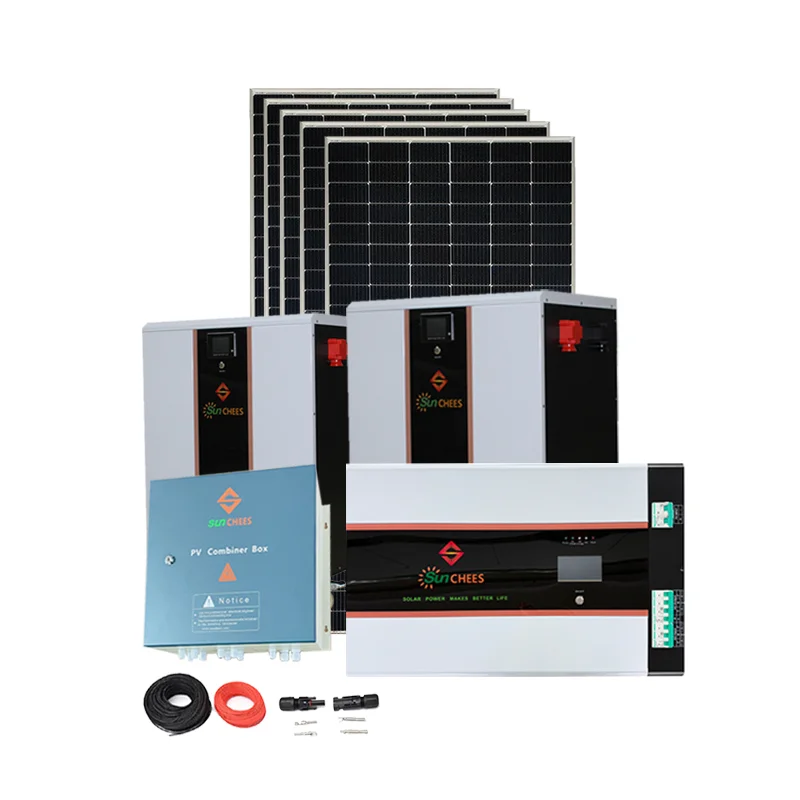
At Sunchees, we can help you choose an off-grid solar and battery configuration around the electricity you use and the appliances you want to keep running. Send us your country and town, your last 12 months of bills, and details of large appliances such as air conditioners and pumps. Tell us what should stay on during an outage and for how long.
Photos of the roof or available ground space, plus details of your grid supply and any generator, help us assess the options. You do not need to arrive with a system size already chosen.
Start with what you want the system to do for your home. We can then help assess the panel, inverter and battery sizes, with local installation needs and backup arrangements included in the discussion.
 High Power Solar Panels for the Caribbean
 You May Also Like



 Tel
Tel
 Email
Email
 Address
6th Floor, Zhonghe Zinan Industrial Park, No. 1 Zinan Changang West Road, Nanzhuang Town, Chancheng District, Foshan City, Guangdong Province. China (Mainland)