


 Whatsapp :

 Home
Solar Power Circuit: How It Works, Wiring Diagram, Components & Troubleshooting
 Oct 22,2026
 0
 sunchees solar system
A solar power circuit is an electrical system that converts sunlight into usable electricity, manages power distribution, and stores excess energy when a battery is included. It typically connects solar panels, protective devices, a charge controller or inverter, battery storage, and electrical loads.
The same basic principles apply to small solar garden lights, residential backup systems, and larger commercial solar installations. The main differences are system voltage, power capacity, energy storage, and the way electricity is delivered to appliances or the utility grid.
Understanding these connections helps homeowners and businesses select compatible equipment, identify common operating problems, and plan a solar installation that meets their electricity needs.
This guide covers the complete circuit—from solar generation and DC protection to battery charging, inverter operation, wiring verification, and troubleshooting.
What Is a Solar Power Circuit and How Does It Work?
A solar power circuit creates an electrical pathway between the solar panels and the equipment that uses the electricity.
In a conventional battery-based off-grid system, the energy pathway is:
Solar panels → DC protection → Charge controller → Battery system → Inverter → AC loads
In practice, a standalone inverter usually connects to the protected battery bus rather than drawing its full power through the charge controller.
Each part has a specific purpose:
- Solar panels convert sunlight into direct current (DC).
- Protective devices provide electrical isolation and protection against specified fault conditions.
- The charge controller regulates electricity delivered to the battery.
- The battery stores energy for nighttime use or periods of low solar generation.
- The inverter converts DC electricity into alternating current (AC) for household or commercial appliances.
Solar panels generate electricity whenever sufficient light is available. However, their voltage and current vary with sunlight, temperature, and operating conditions.
A charge controller or solar inverter manages this variable electricity so that it can be used by the rest of the system.
How does electricity flow during the day and at night?
|
|
|
|
|
|
|
|
|
|
|
|
|
|
|
|
|
|
|
|
|
|
|
|
|
|
|
|
|
|
|
|
|
|
|
The controller, battery management system, and inverter work together to maintain the intended operating conditions.
For example, if solar production exceeds electricity consumption, the surplus can charge the battery. When production decreases, stored energy can cover the difference.
Solar Power Circuit Diagram: How Are the Components Connected?
A solar power circuit diagram shows the electrical connections between generation, charging, storage, protection, and distribution equipment.
Basic off-grid solar power circuit
SOLAR PANELS
(PV ARRAY)
|
| DC Power
v
DC ISOLATION
& PROTECTION
(MCB / SPD*)
|
v
MPPT / PWM
CHARGE CONTROLLER
|
| DC Charging
v
DC PROTECTION
|
v
BATTERY BUS
/ \
/ \
BATTERY BANK DC PROTECTION
| |
| v
| INVERTER
| |
| | AC Power
| v
| AC DISTRIBUTION
| |
| v
| AC APPLIANCES
|
ENERGY STORAGE
Optional controller LOAD output
|
v
Compatible low-power DC loads
Figure 1. Simplified off-grid solar power circuit showing the main electrical pathways. The actual configuration includes equipment-specific protection, isolation, grounding, and distribution requirements. SPD installation depends on the system design.
|
|
|
|
|
|

What happens at each connection?
|
|
|
|
|
|
|
|
|
|
|
|
|
|
|
|
|
|
|
|
|
|
|
|
|
|
|
|
|
|
|
|
|
|
|
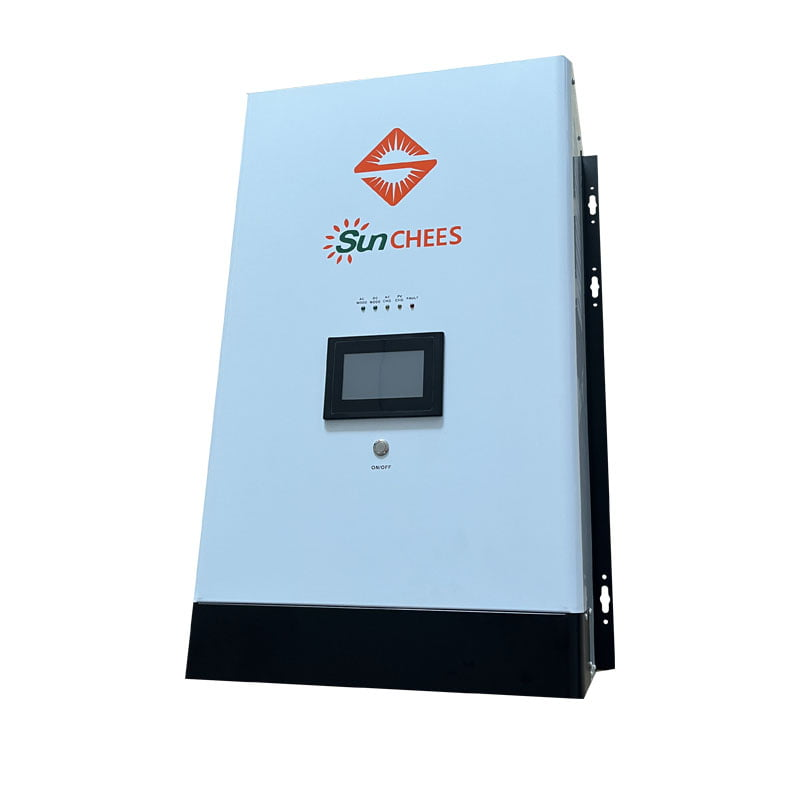
For a small standalone installation, these functions may be provided by separate devices.
For larger off-grid and hybrid systems, several functions may be integrated into one inverter cabinet, reducing the number of separate connections required on-site.
|
|
|
|
|
|
|
|
|

|
|
|

What Are the Main Components of a Solar Power Circuit?
The main components are the solar panels, electrical protection devices, charge controller, battery bank, and inverter.
Selecting compatible specifications is essential because each component operates within a defined voltage and current range.
1. Solar panels: Converting sunlight into DC electricity
Solar panels generate electricity through the photovoltaic effect.
When sunlight reaches the solar cells, the semiconductor material converts part of the incoming solar energy into electrical energy.
The resulting DC output depends on sunlight intensity, panel temperature, shading, and panel characteristics.
Several specifications are particularly important when designing a solar array.
|
|
|
|
|
|
|
|
|
|
|
|
|
|
|
|
|
|
|
|
|
|
|
|
|
|
|
|
Example:
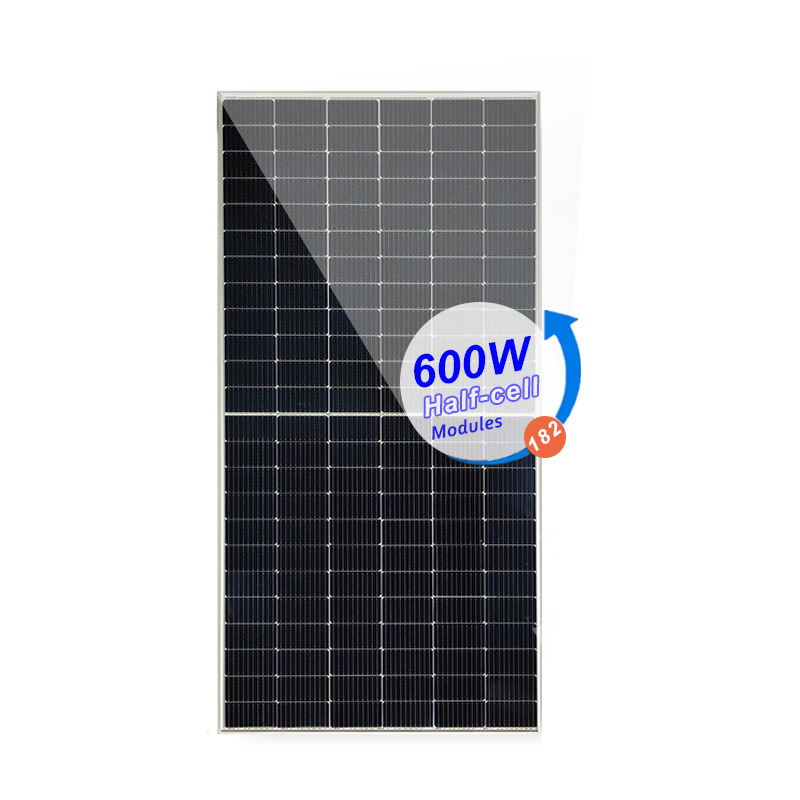
A solar array using ten 600W modules has a nominal DC capacity of:
10 × 600W = 6,000W, or 6kW
However, this does not mean the system continuously generates 6kW.
Actual production depends on the available solar resource and operating conditions.
2. DC circuit breakers and surge protection
DC protection equipment helps protect the electrical circuit and supports safe maintenance.
Two common devices are DC circuit breakers and surge protection devices.
DC miniature circuit breaker (DC MCB)
An appropriately selected DC-rated breaker can provide overcurrent protection and, if designed for the purpose, a means of disconnection.
DC switching devices must be rated for the intended circuit voltage, current, and fault-interruption requirements.
Surge protection device (SPD)
An SPD limits transient overvoltages caused by events such as lightning-induced surges or electrical switching.
Because PV arrays are frequently installed outdoors, surge protection is an important consideration in many solar designs.
SPDs must be properly selected and coordinated with the system's grounding and protection arrangement.
3. Solar charge controller: Regulating battery charging
The charge controller manages electricity flowing from the solar array to the battery.
Its functions commonly include:
- Regulating charging voltage and current
- Preventing excessive battery charging
- Supporting the correct battery charging profile
- Limiting reverse current where required
- Providing charging status information
- Supporting compatible low-power DC loads on models with a LOAD output
Two widely used technologies are PWM and MPPT.
PWM vs. MPPT charge controllers
|
|
|
|
|
|
|
|
|
|
|
|
|
|
|
|
|
|
|
|
|
|
|
|
|
|
|
|
MPPT controllers are commonly preferred for larger systems because they allow more flexible solar array configurations and can improve energy harvesting.
Depending on operating conditions, the energy harvested by MPPT equipment can be substantially greater than with PWM equipment. The actual difference must be calculated for the specific PV and battery arrangement.
4. Battery bank: Storing electricity
The battery stores electricity for use when solar generation is insufficient.
Common battery technologies include lithium iron phosphate (LiFePO4) and lead-acid batteries.
|
|
|
|
|
|
|
|
|
|
|
|
|
|
|
|
|
|
|
|
|
|
|
|
|
|
|
|
Common low-voltage battery configurations include:
- 12.8V nominal: Small systems
- 25.6V nominal: Medium-sized systems
- 51.2V nominal: Many residential battery storage systems
These are examples of lithium battery configurations. Actual charging voltages and allowable operating ranges depend on the selected battery.
5. Solar inverter: Converting DC to AC electricity
Most conventional household and commercial appliances use AC electricity.
An inverter converts the DC electricity supplied by the battery or PV system into AC electricity.
Depending on the destination market and equipment configuration, the output may be 110V, 120V, 220V, 230V, or another specified voltage.
When choosing an inverter, consider:
|
|
|
|
|
|
|
|
|
|
|
|
|
|
|
|
|
|
|
|
|
|
|
|
For integrated systems, inverter and battery compatibility is especially important.
At Sunchees, we develop inverter and lithium battery solutions that can be configured together as coordinated solar power systems. This approach helps customers avoid common integration problems when selecting equipment from different suppliers.
What Are the Three Types of Solar Power Circuit?
There are three main configurations: off-grid, grid-tied, and hybrid.
|
|
|
|
|
|
|
|
|
|
|
|
|
|
|
|
|
|
|
|
|
|
|
|
Off-grid solar power circuit
An off-grid system operates independently of the utility network.
It is commonly used in remote locations, agricultural facilities, islands, and properties where grid access is limited.
The system must generate and store enough electricity to support the intended loads.
Grid-tied solar power circuit
A grid-tied system connects the solar array to a grid-compatible inverter.
Electricity generated by the panels can supply local loads. Excess electricity may be exported to the utility network where regulations and interconnection agreements allow it.
Conventional grid-tied inverters automatically stop energizing the grid during an outage through anti-islanding protection.
Hybrid solar power circuit
A hybrid system combines solar generation, battery storage, and a utility connection.
Depending on its configuration, it can use solar electricity during the day, charge batteries, and supply selected loads during outages.
Hybrid systems are particularly useful where customers want to reduce grid electricity consumption while maintaining backup capacity.
Backup transfer time and available backup output depend on the selected inverter and installation design.
How Much Electricity Can a Solar Power Circuit Generate?
Solar energy production depends primarily on array size, local sunlight, and system losses.
A useful preliminary calculation is:
Daily solar energy (kWh) = PV capacity (kW) × Peak sun hours × Performance factor
The performance factor accounts approximately for losses from temperature, wiring, power conversion, and other operating conditions.
Example: A 5kW solar array
Assume:
- Installed PV capacity: 5kW
- Average peak sun hours: 5 hours/day
- Performance factor: 0.80
Estimated daily generation:
5 × 5 × 0.80 = 20kWh/day
Estimated generation over 30 days:
20 × 30 = 600kWh
This is an illustrative calculation, not a guaranteed production figure. Actual output varies by location, season, shading, system design, and weather.
Estimated output for different array sizes
Using the same assumptions:
|
|
|
|
|
|
|
|
|
|
|
|
|
|
|
|
|
|
|
|
|
|
|
|
These estimates help compare array sizes but should be adjusted using solar resource data for the installation location.
How to Size the Battery and Inverter for a Solar Power Circuit
Solar panels determine how much electricity the system can generate, while batteries determine how much energy can be stored.
The inverter must be able to supply the connected electrical loads.
How to calculate battery capacity
A simplified battery sizing formula is:
Nominal battery capacity (kWh) = Required AC energy (kWh) ÷ (Usable battery fraction × Inverter efficiency)
Suppose a household needs 10kWh of AC electricity during nighttime operation.
Assume:
- Required nighttime electricity: 10kWh
- Usable battery fraction: 90%
- Inverter efficiency: 90%
Calculation:
10 ÷ (0.90 × 0.90) = 12.35kWh
The system would require approximately 12.35kWh of nominal battery storage under these assumptions.
Additional capacity may be required for temperature effects, battery aging, reserve energy, and changing electricity consumption.
How to choose inverter capacity
Inverter sizing should be based on the maximum simultaneous power demand.
Consider this example:
|
|
|
|
|
|
|
|
|
|
|
|
|
|
|
|
|
|
|
|
|
|
|
|
If these appliances operate simultaneously, the inverter must support at least 2.7kW of continuous AC demand, plus a suitable design margin.
Compressor and motor startup requirements must also be considered.
A 3kW inverter may be insufficient if the combined starting load exceeds its short-duration surge capability.
How to Connect a Solar Power Circuit
For conventional systems using a separate charge controller and battery-fed inverter, installation follows a defined connection and commissioning process.
The correct sequence depends on the equipment design. Qualified installers should follow the specific controller, battery, and inverter manuals.
Standard connection sequence
|
|
|
|
|
|
|
|
|
|
|
|
|
|
|
|
|
|
|
|
|
|
|
|
|
|
|
|
|
|
Step 1: Prepare electrical protection
Depending on the installation, the circuit may require DC fuses, DC breakers, disconnects, surge protection, AC protection, and appropriate grounding arrangements.
All devices must be selected for the intended voltage, current, fault conditions, and local electrical requirements.
Step 2: Establish the battery connection
Many standalone charge controllers require the battery to be connected before the PV input is energized.
This allows the controller to detect the nominal battery voltage.
After the connection is established, the display should show the expected battery information without unexpected fault indications.
Step 3: Connect the solar panels
The solar array connects to the controller's PV input through the specified protective equipment.
The installer verifies the PV string voltage, polarity, connector compatibility, and electrical ratings before energizing the input.
Under suitable daylight conditions, the controller should recognize the solar array and report its operating status.
Step 4: Connect the inverter
For a conventional standalone inverter, the DC input connects to the battery bus through correctly sized cables and protective devices.
A high-power inverter should not be connected to a small charge controller LOAD terminal unless that arrangement is expressly supported by the manufacturer.
After commissioning, the inverter should display the configured DC input and AC output information.
Step 5: Test connected loads
Once the system passes the required commissioning checks, electrical loads can be introduced under controlled conditions.
Initial testing may use a small compatible load before progressing to normal operating conditions.
Permanent AC wiring must use a suitably designed and protected distribution arrangement.
How should the system be disconnected for maintenance?
For many conventional standalone controllers, PV input is isolated before the controller's battery supply is disconnected.
The inverter and AC loads also need to be shut down according to their equipment instructions.
Integrated hybrid systems may use different procedures.
Solar PV equipment can remain energized when exposed to sunlight, so isolation and verification are essential before maintenance.
How Can You Tell Whether a Solar Power Circuit Is Working Correctly?
A correctly operating circuit should show consistent voltage readings, expected charging behavior, stable inverter output, and no abnormal electrical heating.
The following checks help assess normal operation.
1. Check the charge controller
After startup, the controller should display the correct battery voltage and charging status.
For example, typical nominal lithium battery configurations include:
|
|
|
|
|
|
|
|
|
|
|
|
Actual displayed voltage changes with charge state and operating conditions.
A blank controller screen may indicate an interrupted supply, fuse issue, incorrect wiring, or equipment fault.
2. Check solar panel input
Under adequate sunlight, the controller should report a PV input voltage consistent with the installed array.
If the battery requires charging and all operating conditions are satisfied, positive charging current should normally be available.
A 0A charging reading does not always indicate a fault. Charging may be limited when the battery is full or when battery protection settings restrict charging.
3. Check inverter output
A normally operating inverter should supply AC electricity within the selected output voltage and frequency range.
Common indications include a normal operating status, stable output readings, and no active fault warnings.
An inverter that repeatedly restarts when an appliance starts may have insufficient surge capacity, excessive DC voltage drop, or a battery discharge limitation.
4. Check cable connections and temperature
Electrical connections should remain secure and operate within their specified temperature limits.
Qualified installers can use appropriate inspection methods, including thermal imaging, to identify abnormal connection heating.
Connections should be tightened to the manufacturer's specified torque with the circuit safely isolated.
Normal vs. abnormal operation
|
|
|
|
|
|
|
|
|
|
|
|
|
|
|
|
|
|
|
|
|
|
|
|
|
|
|
|
Solar Power Circuit Troubleshooting: Five Common Problems
Why is the charge controller screen blank?
A blank controller display may indicate that the required DC supply is unavailable.
Possible causes include an open disconnect, blown fuse, interrupted battery circuit, BMS protection, or equipment malfunction.
The battery supply and controller input should be checked according to the manufacturer's diagnostic instructions.
Why does the solar power circuit show 0A charging in sunlight?
A zero charging-current reading may occur when the battery is fully charged or when the controller is limiting charging.
If charging should be taking place, possible causes include inadequate PV voltage, shading, incorrect settings, an open circuit, or connector problems.
The diagnosis should consider battery state of charge, PV input voltage, and controller operating status together.
Why does the inverter show a fault and stop producing AC electricity?
Possible causes include low battery voltage, excessive input voltage, overload, overtemperature, output short circuit, or battery communication problems.
Fault codes vary by inverter model. The correct response depends on the specific code and equipment documentation.
Why does the inverter shut down when an air conditioner starts?
An air conditioner may require considerably more power during compressor startup than during normal operation.
Shutdown can result from insufficient inverter surge capacity, battery discharge limits, or excessive voltage drop.
The inverter's surge rating, DC wiring, battery condition, and appliance starting characteristics should be evaluated together.
Why are electrical connections becoming unusually hot?
Excessive heating can result from loose connections, inadequate cable sizing, poor terminal contact, or excessive current.
Abnormal heating, electrical arcing, smoke, or a burning smell requires the system to be safely isolated and inspected before further operation.
How Do You Choose the Right Solar Power Circuit for Your Property?
The correct configuration depends on daily electricity consumption, peak demand, local grid conditions, and the required backup duration.
Solar system selection guide
|
|
|
|
|
|
|
|
|
|
|
|
|
|
|
|
|
|
|
|
|
|
|
|
|
|
|
|
Before designing a system, we recommend collecting the following information:
- Installation country and location
- Monthly electricity consumption in kWh
- Maximum simultaneous load in kW
- Required battery backup duration
- Available roof or ground space
- Existing utility connection
- Any large motors, pumps, or air conditioners
These details help determine whether an off-grid, grid-tied, or hybrid configuration is the most appropriate solution.
Why Does Equipment Compatibility Matter in a Solar Power Circuit?
Solar panels, controllers, batteries, and inverters must operate within compatible electrical limits.
For example, a PV array can have sufficient wattage but an unsuitable operating voltage for the selected MPPT controller.
Similarly, a battery may have the correct nominal voltage but incompatible communication or charging requirements.
A coordinated system design helps prevent these issues.
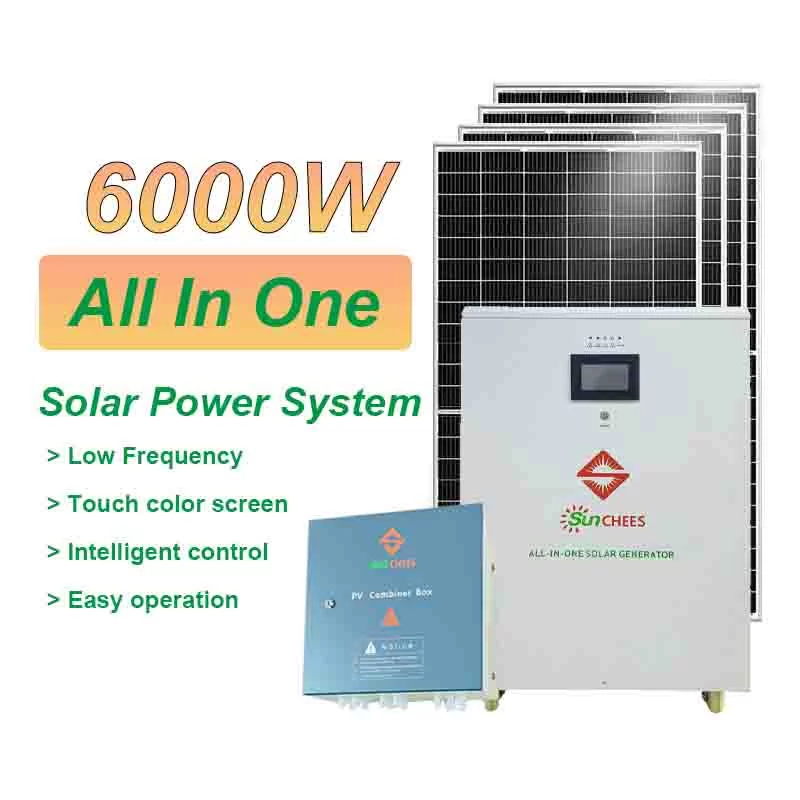
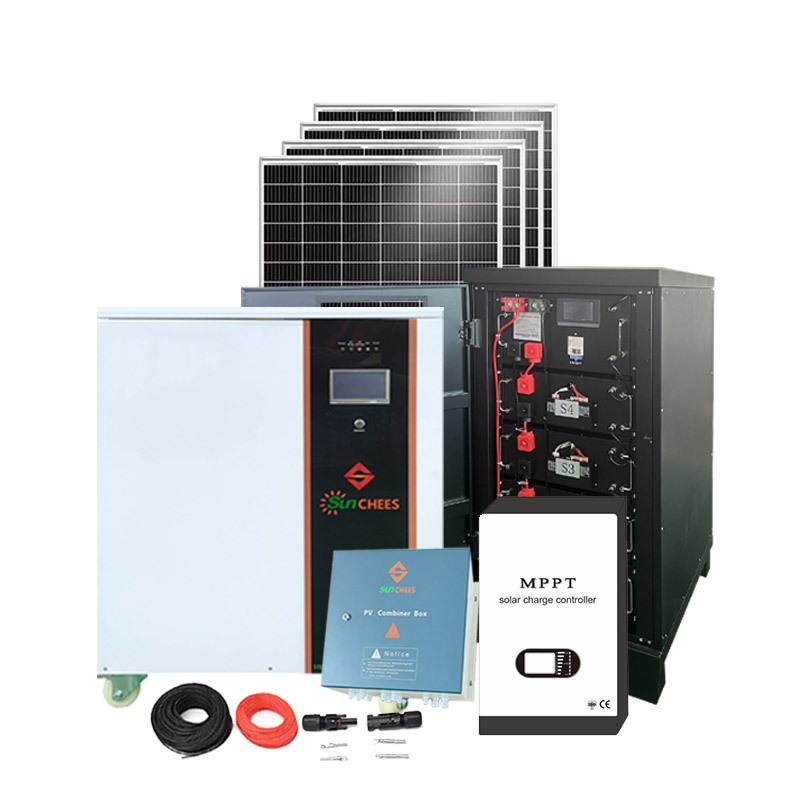
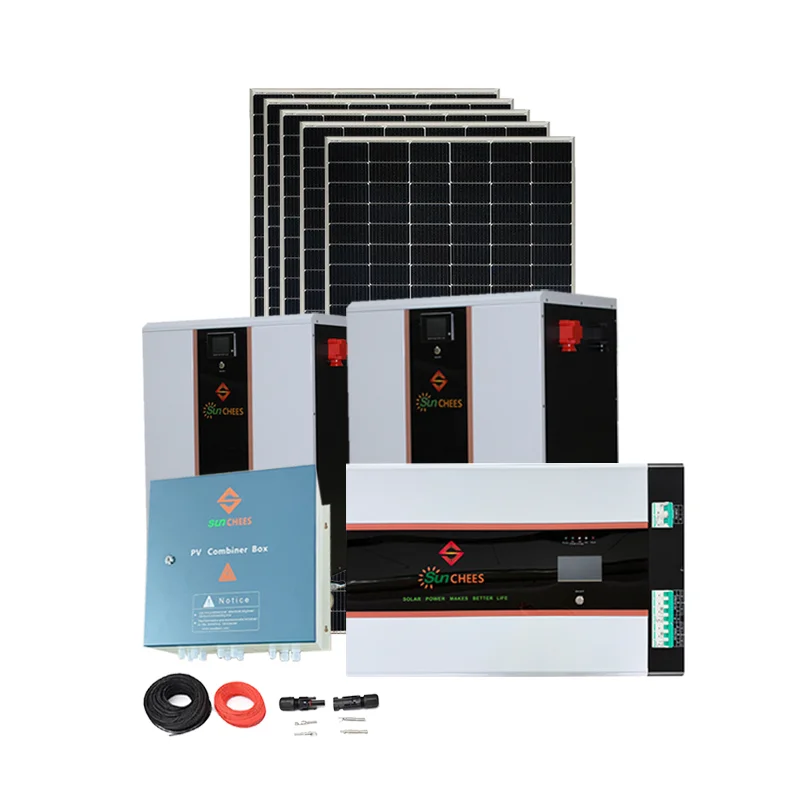
Sunchees integrated solar system solutions
Since 2008, Sunchees has manufactured solar energy equipment in Foshan, Guangdong, China.
We develop inverter and lithium battery solutions and provide integrated off-grid and hybrid systems for residential and commercial applications.
Our approach focuses on coordinating the main system components, including:
- Solar generation and inverter capacity
- Lithium battery charging and discharge requirements
- System protection and distribution
- Energy storage configuration
- Customer-specific operating requirements
By providing coordinated system configurations, we help customers reduce the complexity of combining equipment from multiple manufacturers.
We also provide OEM solutions, support customer-selected solar panel brands, and offer customized solar power systems and solar air conditioning solutions.
System specifications are selected according to the application, with configurations available for residential installations and larger projects from 30kW to 1MW.
Can Dual-Glass Bifacial Panels Improve Solar System Performance?
Dual-glass bifacial solar panels can capture light from both the front and rear surfaces.
Their potential energy advantage depends on reflected light, mounting height, surface conditions, and array design.
|
|
|
|
|
|
|
|
|
|
|
|
|
|
|
Sunchees currently offers a complimentary upgrade to dual-glass bifacial solar modules for eligible system orders.
Depending on the selected module and installation conditions, the upgraded configuration may provide more than 1.5% additional electricity generation compared with the applicable standard module option.
Actual energy gains depend on the installation environment.
How Does Sunchees Support Solar System Installation?
Sunchees provides remote installation guidance and works with installation partners in selected international markets.
Our installation network includes Jamaica, Guam, Sint Maarten, Trinidad and Tobago, and Saipan.
We have supported solar installations for hundreds of residential and commercial customers.
Installation time and technical support
For suitable projects in supported locations, our local installation partners can complete installation and commissioning in approximately five days, depending on site readiness and system requirements.
Remote technical guidance is available for customers who work with their own qualified local installers.
For qualifying individual projects above 50kW, Sunchees offers on-site engineering installation support under the applicable project terms.
Customers can contact us with their installation location and project requirements to confirm available support.
What installation options are available?
Some Sunchees integrated systems use floor-standing equipment cabinets with wheels.
This design allows the battery and inverter cabinet to be repositioned when safely disconnected and handled according to its installation requirements.
The solar panels are installed separately on suitable roof-mounted or ground-mounted structures.
For customers who require equipment to be installed above floor level, we can discuss alternative equipment configurations during system planning.
In locations exposed to flooding, electrical equipment should be installed in an appropriately protected position above the applicable flood level.
A wheeled floor-standing cabinet should not be mounted on a wall unless the equipment is specifically designed and approved for that arrangement.
Sunchees Manufacturing, Delivery and Warranty Information
When purchasing a complete solar system, manufacturing consistency, delivery schedules, and after-sales support are important alongside electrical specifications.
Manufacturing and delivery
|
|
|
|
|
|
|
|
|
|
|
|
|
|
|
|
|
|
|
|
|
|
|
|
|
|
|
|
|
|
For orders covered by the relevant contractual terms, Sunchees offers late-delivery compensation equivalent to 5% of the contract value.
Actual production lead times and delivery arrangements are confirmed according to order quantity and equipment configuration.
Product warranty
|
|
|
|
|
|
|
|
|
|
|
|
|
|
|
|
|
|
|
|
|
|
|
|
Warranty coverage is subject to the product terms and purchase agreement.
Solar panels may be designed for operating lifetimes approaching or exceeding 25 years, while batteries, inverters, and other components have their own service-life and replacement considerations.
Shipping and packaging
Sunchees prepares different components according to their handling requirements.
|
|
|
|
|
|
|
|
|
|
|
|
|
|
|
|
|
|
|
|
|
We provide production updates during order fulfillment and conduct customer satisfaction follow-ups after contract execution.
Frequently Asked Questions About Solar Power Circuit Systems
What is a solar power circuit?
A solar power circuit is an electrical system that connects solar panels with power regulation, conversion, protection, and distribution equipment. Battery-based configurations also store electricity for later use.
What components are needed for an off-grid solar power circuit?
A typical off-grid system requires solar panels, suitable DC protection, a solar charge controller or integrated charging inverter, a battery bank, an inverter, and protected load distribution circuits.
Can a solar power circuit work without batteries?
Yes. A conventional grid-tied solar power circuit can supply electricity without a battery while the utility grid is available. However, most standard battery-free grid-tied systems do not provide backup power during outages.
Should the battery be connected before the solar panels?
Many standalone charge controllers require the battery supply to be established before the PV input is energized. The correct procedure depends on the model, so the manufacturer's instructions must be followed.
What is the difference between PWM and MPPT in a solar power circuit?
PWM controllers regulate charging through switching, while MPPT controllers use power conversion to operate the PV array near its maximum power point. MPPT is generally more suitable for systems requiring flexible PV string voltages and improved energy harvesting.
What battery voltage should I choose?
Small independent systems often use 12V or 24V architectures, while many residential energy storage systems use a 48V-class battery arrangement. The correct voltage depends on inverter capacity, current requirements, and equipment compatibility.
How many solar panels are required to run an air conditioner?
The answer depends on the air conditioner's electricity consumption, operating hours, local sunlight, and whether battery storage is required.
For example, a 1.5kW air conditioner operating for six hours consumes approximately 9kWh, assuming constant input power. At five peak sun hours and a performance factor of 0.80, generating 9kWh would require approximately 2.25kW of PV capacity before considering additional loads or storage requirements.
How long can a solar battery power a house?
Backup duration depends on usable battery energy and average load.
For example, a battery providing 8kWh of usable stored energy through a 90%-efficient inverter could theoretically supply a constant 1kW AC load for approximately 7.2 hours, excluding other losses.
Why does my solar power circuit show 0A during the day?
The battery may be fully charged, the controller may be limiting charging, or solar generation may be insufficient. Wiring and configuration problems are also possible. PV voltage, battery status, and controller settings should be checked together.
Why does my inverter restart when appliances switch on?
Possible causes include insufficient inverter surge capacity, excessive battery voltage drop, loose connections, or battery discharge-current limits. Appliances with motors or compressors often require higher startup power.
Can a solar power circuit be used in coastal or island locations?
Yes. Solar systems can be designed for coastal and island environments, with equipment selection accounting for humidity, salt exposure, corrosion, wind conditions, and local installation requirements.
Sunchees supports projects in Caribbean and other island markets, including Jamaica, Trinidad and Tobago, Sint Maarten, Guam, and Saipan.
Can Sunchees customize an off-grid or hybrid solar power circuit?
Yes. We provide customized solar configurations, including inverter and lithium battery combinations, solar panel brand selection, OEM solutions, and systems designed around specific electrical loads and backup requirements.
How long does Sunchees solar system installation take?
In supported locations, local installation partners may complete installation and commissioning in approximately five days for suitable projects. The final timeline depends on system capacity, site preparation, and installation requirements.
Are Sunchees solar systems movable?
Some integrated inverter and battery cabinets are fitted with wheels for repositioning when safely disconnected. Solar panels use separate mounting structures. Wall mounting is not supported for floor-standing cabinets unless a specific product configuration is approved for it.
How do I select the correct solar power circuit for my property?
Start with your daily electricity consumption, maximum simultaneous load, required backup duration, and available installation area. The presence and reliability of utility electricity will help determine whether an off-grid, grid-tied, or hybrid system is appropriate.
Plan Your Solar Power Circuit With Sunchees
A well-designed solar power circuit combines correctly matched solar generation, energy storage, electrical protection, and power conversion equipment.
For reliable operation, the circuit should be sized for actual electricity demand rather than solar panel capacity alone. Battery storage, inverter output, motor starting requirements, and local installation conditions all affect system selection.
Sunchees provides integrated off-grid and hybrid solar systems for homes, businesses, agricultural properties, and independent power applications.
With manufacturing experience since 2008, in-house inverter and lithium battery development, customized system options, and installation support in selected overseas markets, we help customers plan complete solar solutions around their specific requirements.
To request a system configuration or quotation, send us:
- Your country and installation location
- Monthly electricity consumption
- Main appliances or equipment to be powered
- Required battery backup hours
- Available roof or ground area
- Preferred system capacity, if known
Our team can recommend a suitable solar and battery configuration, confirm available equipment options, and discuss installation support for your location.
Follow Sunchees for product information, manufacturing updates, and solar project applications:
Instagram | TikTok | YouTube | Facebook
 Solar Panel Kit with Inverter Jamaica: How to Size a Complete Home Solar System
 You May Also Like



 Tel
 Email
 Address
6th Floor, Zhonghe Zinan Industrial Park, No. 1 Zinan Changang West Road, Nanzhuang Town, Chancheng District, Foshan City, Guangdong Province. China (Mainland)