


 Whatsapp :

 Home
Solar Panel Kit with Inverter Jamaica: How to Size a Complete Home Solar System
 Oct 22,2026
 0
 sunchees solar system
Choosing a solar panel kit with inverter Jamaica starts with three practical questions: How much electricity does your home use? How many appliances need to run at the same time? And how much backup power do you need when the utility supply is unavailable?
For many three- to five-bedroom homes in Jamaica, a 5kW–10kW solar system is a useful starting point. A household with one air conditioner, a refrigerator, and standard appliances may have very different requirements from a similarly sized home operating several air conditioners, an electric water heater, and a water pump.
The best system is not necessarily the one with the largest inverter. It is the one with the right balance of solar panel capacity (kW), inverter output (kW), and battery storage (kWh).
This guide explains how to compare complete solar kits, calculate appliance loads, choose the number of 600W solar panels, estimate battery requirements, and plan an installation in Jamaica.
|
|
|
|
|
|

Solar Panel Kit with Inverter Jamaica: What Size Is Right for Your Home?
A practical way to begin is to look at your monthly electricity consumption, then check how many appliances you expect to operate simultaneously.
The number of bedrooms provides a useful reference, but electricity demand is more directly affected by air conditioning, cooking, water heating, pumps, and nighttime usage.
Common solar system configurations for Jamaican homes
|
|
|
|
|
|
|
|
|
|
|
|
|
|
|
|
|
|
|
|
|
|
|
|
|
|
|
|
|
|
These configurations are starting points for system selection. A home with unusually high electricity consumption may require a larger system, regardless of its number of bedrooms.
How much electricity can a solar system generate?
The amount of electricity generated by solar panels depends on sunlight, module temperature, roof orientation, shading, and overall system performance.
For an initial comparison, the following table uses four equivalent peak-sun-hours per day and a 75% system performance factor.
|
|
|
|
|
|
|
|
|
|
|
|
|
|
|
|
|
|
|
|
|
|
|
|
|
|
|
|
Solar electricity calculation:
Daily generation (kWh) = Installed solar capacity (kW) × Peak sun hours × Performance factor
For example, a 10kW solar array produces an estimated:
10kW × 4 × 0.75 = 30kWh per day
This is a conservative illustrative planning scenario rather than a location-specific production forecast. Jamaica has substantial solar potential, and actual annual production should be assessed using local solar resource data.
For a more detailed location-based assessment, the World Bank's Jamaica Solar Irradiation and PV Power Potential Maps provide useful reference data.
What Does a Complete Solar Panel Kit with Inverter Include?
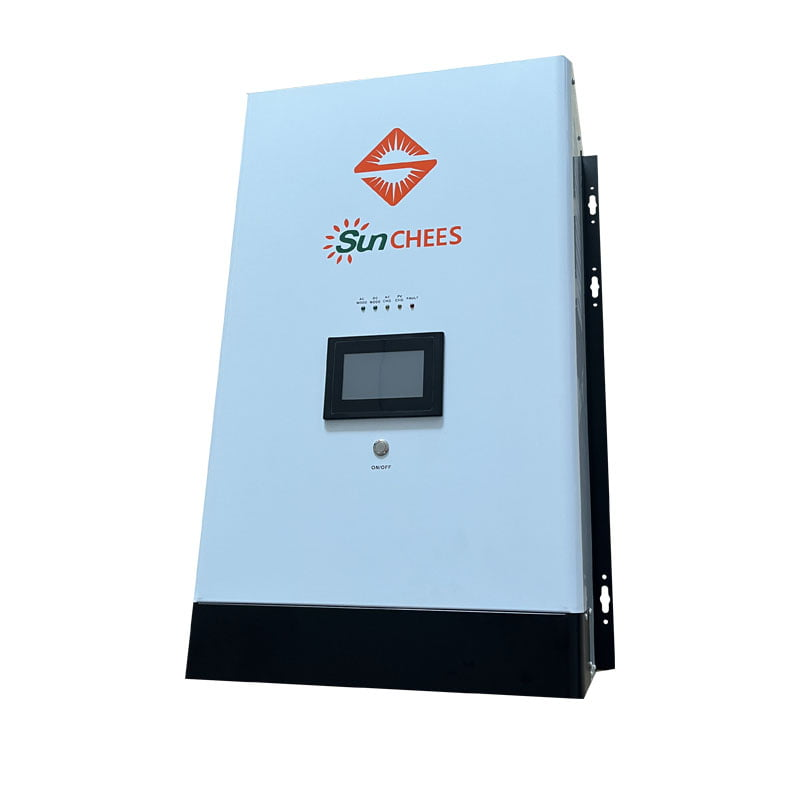
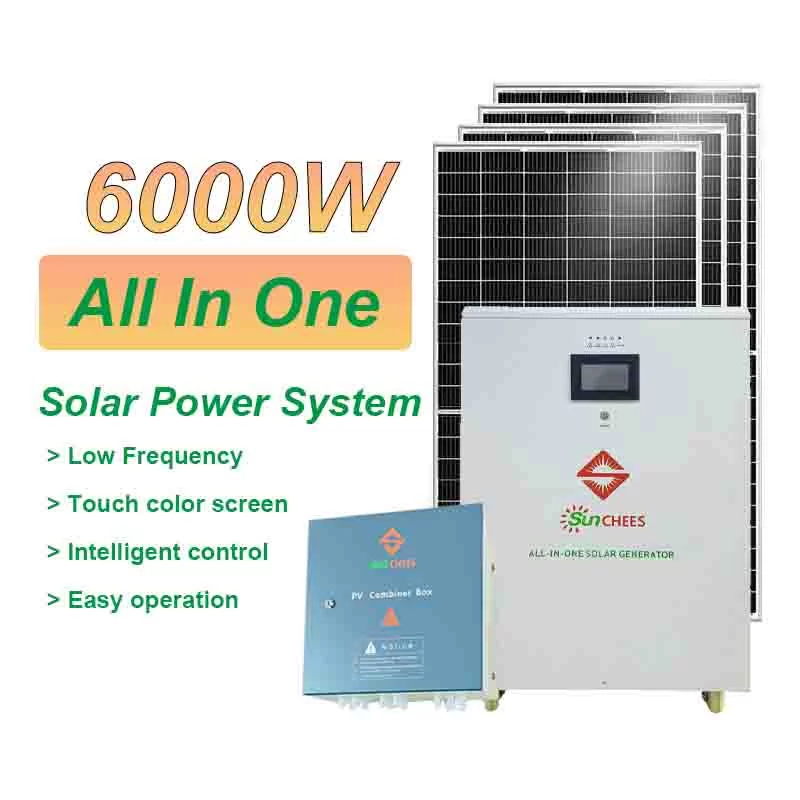
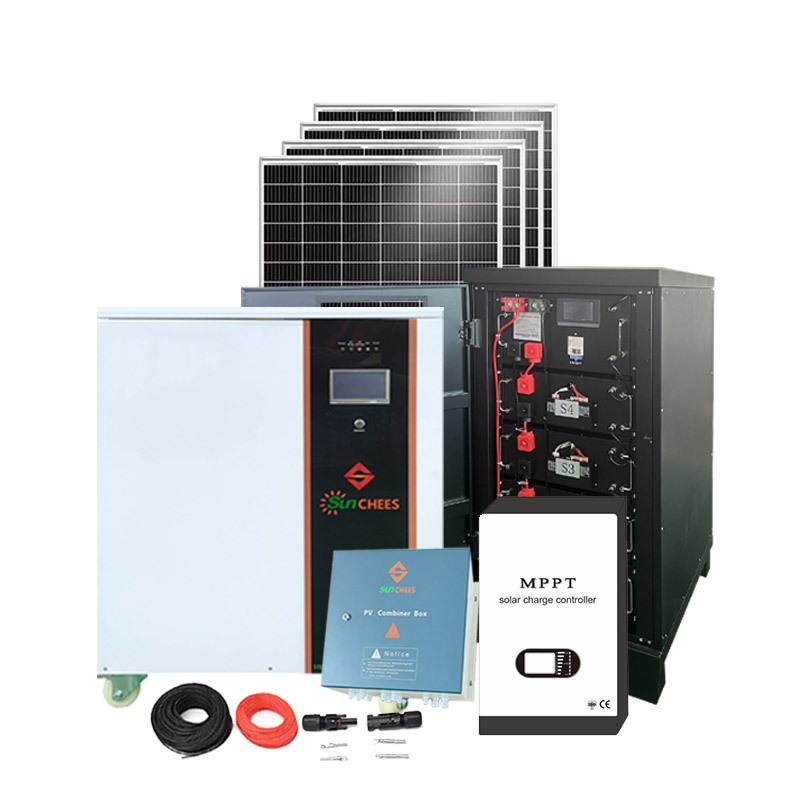
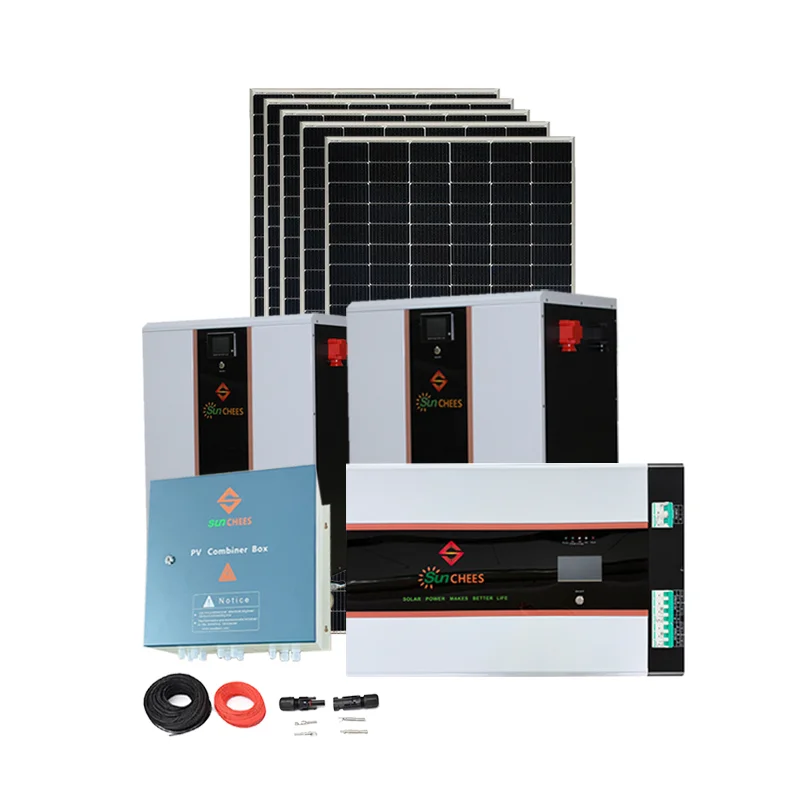
A complete solar system combines the equipment needed to generate, convert, distribute, and optionally store electricity.
|
|
|
|
|
|
|
|
|

|
|
|

Solar panels produce direct-current electricity (DC). The inverter converts that power into alternating-current electricity (AC) used by household appliances.
When battery storage is included, excess solar electricity can be stored for evening use or backup operation.
|
|
|
|
|
|
|
|
|
|
|
|
|
|
|
|
|
|
|
|
|
|
|
|
|
|
|
|
|
|
|
|
|
|
|
|
Many modern solar inverters integrate MPPT charge control, reducing the need for a separate controller.
For residential installations, it is beneficial to choose equipment as a coordinated system. Inverter specifications, battery communication, solar input limits, and electrical protection all need to work together.
Sunchees develops its own solar inverter and lithium battery solutions, allowing these components to be configured as part of an integrated system. This simplifies component matching and provides a consistent basis for system configuration and technical support.
Should You Choose a Hybrid, Off-Grid, or On-Grid Solar System in Jamaica?
The right solar system depends on whether you have access to the electricity grid and how you intend to use solar power.
|
|
|
|
|
|
|
|
|
|
|
|
|
|
|
|
|
|
|
|
Hybrid solar systems: A flexible choice for homes
Hybrid solar systems can manage electricity from solar panels, battery storage, and the utility grid.
During the day, solar energy can supply household appliances while charging the battery.
In the evening, stored energy can be used to reduce grid consumption.
When equipped and configured for backup operation, a hybrid inverter can also supply selected household circuits during a power interruption.
This makes hybrid systems particularly useful for properties that want electricity savings as well as backup power.
For homes with air conditioning, it is important to calculate both the nighttime energy demand and the inverter's available backup output.
Off-grid solar systems: Electricity without the utility grid
Off-grid systems operate independently of the public electricity network.
They are suitable for remote houses, farms, agricultural facilities, and properties without a reliable grid connection.
Because an off-grid system cannot rely on utility electricity, it generally requires adequate battery storage to cover nighttime consumption and periods of reduced solar generation.
Some installations also incorporate a backup generator for additional reliability.
On-grid solar systems: Using solar electricity during the day
On-grid systems are designed to operate with the utility supply.
They can reduce electricity purchased from the grid by supplying household loads from solar energy.
Conventional grid-tied inverters generally stop operating during utility outages unless an appropriate backup arrangement is installed.
Can homeowners sell excess solar electricity in Jamaica?
Jamaica Public Service (JPS) has a Net Billing arrangement for eligible renewable-energy customers.
Under this arrangement, approved customers can use solar electricity for their own consumption and sell eligible excess generation to JPS.
Exported electricity is valued according to the applicable Net Billing terms, rather than automatically receiving the retail electricity rate.
For the current application and connection requirements, homeowners can consult the JPS Net Billing information.
A solar system intended for grid export should be planned around the applicable utility approvals, equipment requirements, and connection conditions.
How to Calculate the Right Solar Inverter Size for Your Home
The inverter is one of the most important components in a household solar system.
Its capacity determines how much electrical power can be supplied to appliances at one time.
A larger inverter can support more simultaneous loads, but it does not automatically produce more solar electricity.
To choose the right inverter, consider both the appliances' normal operating demand and their starting requirements.
Step 1: Calculate simultaneous running power
Consider a household using the following appliances during the evening.
|
|
|
|
|
|
|
|
|
|
|
|
|
|
|
|
|
|
|
|
|
|
|
|
|
|
|
|
|
|
|
|
|
The estimated simultaneous running load is 5.6kW.
Allowing a 20% planning margin:
5,600W × 1.2 = 6,720W
An 8kW inverter is therefore a reasonable capacity to evaluate for this operating scenario.
Step 2: Calculate appliance starting requirements
Some electrical appliances briefly require higher current when starting.
This is especially relevant to motor-driven equipment such as water pumps, refrigerators, and older fixed-speed air conditioners.
|
|
|
|
|
|
|
|
|
|
|
|
|
|
|
|
|
|
|
|
|
|
|
|
|
|
|
|
These values illustrate common differences between running and starting requirements. Actual figures should be taken from the appliance specifications wherever available.
Step 3: Check inverter surge capacity
Suppose the household's normal running load is 5,600W.
A water pump then starts, requiring approximately 2,500VA during startup.
With the other loads assumed to operate close to unity power factor, the combined short-duration demand may approach 8.1kVA.
A suitable inverter must support both:
- Continuous output: The normal operating load.
- Surge output: The additional short-duration demand during appliance startup.
The inverter's overload capacity is normally specified for particular durations, such as several seconds.
The actual requirements depend on the inverter model, load characteristics, and connected battery system.
Should every appliance's startup power be added together?
Not always.
A practical inverter-sizing calculation considers the highest likely simultaneous running load and the most demanding credible starting event.
For example, a refrigerator, water pump, and air conditioner may not normally start at exactly the same moment.
However, systems designed for backup use should also consider possible simultaneous restarts after a power interruption.
The objective is to provide sufficient operating capacity without selecting a significantly oversized inverter.
What Does a Higher-Capacity Solar Inverter Actually Provide?
A larger inverter primarily increases the amount of electrical power available for simultaneous appliances.
However, several other inverter specifications also influence system performance.
|
|
|
|
|
|
|
|
|
|
|
|
|
|
|
|
|
|
|
|
|
|
|
|
For example, an 8kW inverter may comfortably support a home with a maximum normal load of 5kW–6kW.
A household regularly operating multiple air conditioners, a water pump, and electric cooking equipment may benefit from the additional output capacity of a 10kW inverter.
However, inverter selection should also account for efficiency, battery compatibility, and actual operating requirements.
What voltage and frequency are suitable for Jamaica?
Jamaica generally uses a 110V, 50Hz electrical supply, with other service configurations, including 110/220V arrangements, present at some properties.
This distinction matters because equipment designed for the US market commonly operates at 60Hz.
The selected inverter must match the actual electrical service and appliance requirements of the property.
Check the required output voltage, 50Hz compatibility, electrical phase arrangement, and applicable installation requirements before finalizing the system.
How Many 600W Solar Panels Should Be Paired with a 10kW Inverter?
A 600W solar module has a rated output capacity of 0.6kW.
The total solar array capacity is calculated by multiplying the number of panels by the wattage of each module.
For a 10kW inverter, several array sizes may be considered.
|
|
|
|
|
|
|
|
|
|
|
|
|
|
|
|
|
|
|
|
|
|
|
|
|
|
|
|
|
|
Illustrative generation using four peak-sun-hours and a 75% performance factor, before detailed modeling of clipping or other design-specific limits.
Why can a 10kW inverter use more than 10kW of solar panels?
A solar panel's rated power is measured under standard test conditions.
Its actual output changes throughout the day because of sunlight intensity, module temperature, and other operating conditions.
For this reason, designers may select a solar array with a DC rating higher than the inverter's nominal AC output.
For example:
20 × 600W = 12,000W
12,000W ÷ 10,000W = 1.2 DC/AC ratio
A 12kW solar array paired with a compatible 10kW inverter may provide additional generation during certain periods, particularly when individual panels are operating below their rated output.
However, the inverter must support the selected solar array's power, voltage, and current characteristics.
Why do solar panel connections matter?
Solar panels are connected in series and parallel to achieve the electrical characteristics required by the inverter.
When modules are connected in series, their voltages add together.
For example, a panel with a 45V open-circuit voltage produces a nominal string open-circuit voltage of:
10 × 45V = 450V
The design must account for voltage changes with temperature and remain within the inverter's maximum DC input voltage.
Other important considerations include:
- MPPT operating voltage.
- Maximum solar input current.
- Maximum short-circuit current.
- Supported photovoltaic capacity.
- Number of MPPT inputs.
- Panel specifications and cable arrangement.
The best panel quantity is therefore determined by both energy demand and electrical compatibility.
How Much Roof Space Is Needed for 600W Solar Panels?
Large-format 600W solar panels generally occupy approximately 2.5–2.8m² per module, depending on the model.
Using 2.7m² per panel as a planning reference:
|
|
|
|
|
|
|
|
|
|
|
|
|
|
|
|
|
|
|
|
|
|
|
|
These figures represent panel area. The roof may require additional space for mounting clearances, roof edges, access, and obstructions.
Important considerations for Jamaican rooftops
Hurricane and wind exposure
Solar mounting structures should be selected for the property's applicable wind-loading requirements.
The roof condition, mounting method, and structural attachment points are important parts of the installation design.
Coastal corrosion
Properties near the sea may require particular attention to corrosion resistance, including the selection of mounting hardware and electrical enclosures.
Roof shading
Nearby buildings, trees, water tanks, and other obstacles can affect panel performance.
Roof structure
The roof must provide adequate support for the solar modules and mounting equipment.
Maintenance access
Solar installations should allow safe inspection, cleaning, and servicing.
For properties with adequate land, ground-mounted arrays may offer additional flexibility in panel positioning and maintenance.
How Much Battery Storage Does a Home Solar System Need?
Battery capacity determines how much electricity can be stored and used after sunset or during outages.
It is measured in kilowatt-hours (kWh).
Inverter power and battery storage should be sized separately.
A 10kW inverter describes available output power. A 10kWh battery describes the amount of energy stored.
Battery backup duration examples
|
|
|
|
|
|
|
|
|
|
|
|
|
|
|
|
|
|
|
|
The calculation uses a 90% usable depth of discharge and 90% conversion efficiency.
Actual battery performance depends on the equipment, operating settings, and connected loads.
How to calculate nighttime electricity consumption
Consider the following household appliances operating after sunset.
|
|
|
|
|
|
|
|
|
|
|
|
|
|
|
|
|
|
|
|
|
|
|
|
|
|
|
|
|
|
|
|
|
The home needs approximately 9.5kWh for these nighttime loads.
With the assumed battery utilization and conversion factors:
9.48kWh ÷ (0.9 × 0.9) = 11.7kWh
A 15kWh battery bank would therefore be a useful option to evaluate.
Battery selection must also account for the maximum output power required by the appliances.
Is a 10kWh battery enough for a 10kW inverter?
It can be, depending on the household's usage.
For example, a 10kWh battery with approximately 8.1kWh of usable AC energy could support:
- A 500W load for approximately 16 hours.
- A 1,000W load for approximately 8 hours.
- A 2,000W load for approximately 4 hours.
- A 4,000W load for approximately 2 hours.
These examples assume that the battery and inverter can deliver the required power.
For homes with substantial nighttime cooling demand, larger battery capacity may be beneficial.
Example: Sizing a Solar System for a Four-Bedroom House in Jamaica
Consider a four-bedroom family home in Kingston with the following electricity requirements.
|
|
|
|
|
|
|
|
|
|
|
|
|
|
|
|
|
|
|
|
|
|
|
|
|
|
|
Step 1: Calculate daily electricity needs
900kWh ÷ 30 days = 30kWh per day
The solar array should be evaluated against this average consumption, with consideration for daytime self-consumption, available battery storage, and seasonal production.
Step 2: Estimate the required solar panel capacity
Using the earlier planning assumptions:
Required solar capacity = 30kWh ÷ (4 × 0.75)
= 10kW
A 10kW solar array could therefore be a suitable starting point for this example.
A configuration using 18 × 600W panels would provide:
18 × 600W = 10.8kW
With 20 panels, the solar array would increase to 12kW.
The additional capacity may be useful depending on daytime consumption, roof area, expected annual production, and the inverter's permitted PV input.
Step 3: Evaluate the inverter capacity
The household uses three air conditioners, but the inverter does not need to be sized solely according to the number of units.
Instead, calculate the highest likely simultaneous appliance load.
If the home reaches approximately 6kW of continuous demand during busy periods, an 8kW–10kW inverter could be evaluated.
The selected model must also accommodate appliance starting requirements.
Step 4: Calculate the required battery storage
If nighttime electricity requirements are approximately 10kWh, the nominal battery requirement using an 81% usable AC energy assumption is:
10kWh ÷ 0.81 = 12.35kWh
A 15kWh battery would be a reasonable starting configuration.
A larger battery bank may be appropriate if the homeowner wants to operate multiple air conditioners for extended periods during grid outages.
Example system configuration
|
|
|
|
|
|
|
|
|
|
|
|
|
|
|
|
|
|
|
|
|
This example demonstrates how solar panels, inverter capacity, and battery storage are calculated from different requirements.
A complete system configuration can then be developed according to the property's electrical service, roof layout, and actual appliance specifications.
For customers in Jamaica, Sunchees can prepare a customized system configuration using household electricity consumption, available installation space, and preferred battery capacity.
Can a 10kW Solar System Run Multiple Air Conditioners?
Yes. A suitable 10kW inverter can supply several air conditioners together with other household appliances, provided their combined electrical demand remains within the system's capacity.
For example:
Three inverter air conditioners × 1,100W = 3,300W
Other household appliances = 1,200W
Total estimated running demand = 4,500W
A properly specified 8kW–10kW inverter can be considered for this load.
However, solar panel generation and battery output must also be sufficient for the required operation.
What happens when three air conditioners run overnight?
Suppose the three air conditioners consume an average of 3.3kW combined for eight hours.
3.3kW × 8 hours = 26.4kWh
This is the electricity required by the air conditioners alone.
A home relying on battery electricity for this level of nighttime cooling would need a substantially larger battery bank than one designed only for lighting, refrigeration, and essential household appliances.
A hybrid solar system can provide greater flexibility by combining available battery electricity with utility supply.
Are Double-Glass Bifacial Solar Panels Better for Jamaica?
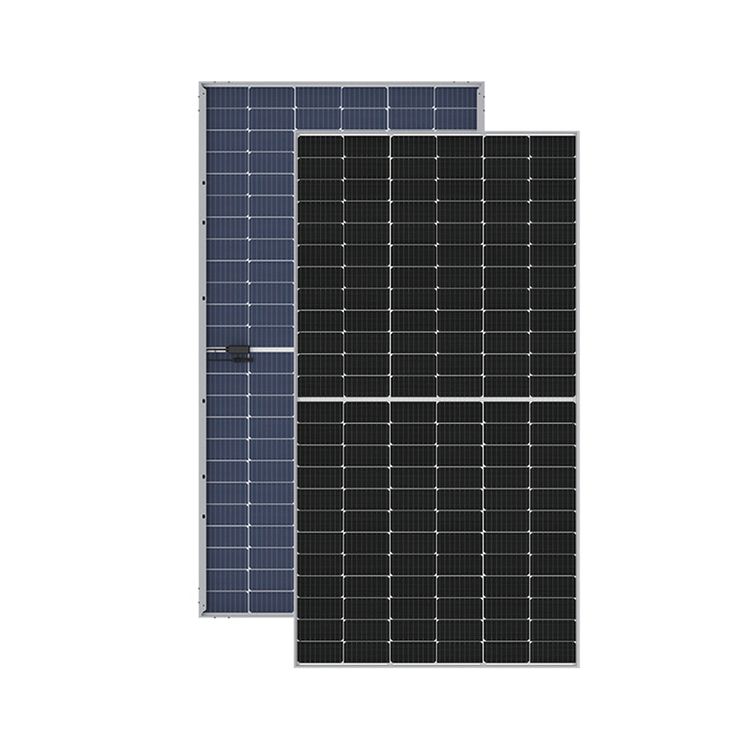
Double-glass bifacial solar modules generate electricity from sunlight reaching both their front and rear surfaces.
Unlike conventional monofacial modules, bifacial panels can also collect sunlight reflected from surrounding surfaces.
This can increase total energy generation when the installation allows sufficient light to reach the rear side of the panels.
The benefit depends on:
- Ground or roof surface reflectivity.
- Mounting height.
- Rear-side shading.
- Panel orientation.
- Installation layout.
Bifacial technology can be particularly useful for ground-mounted installations and suitable elevated mounting arrangements.
Complimentary bifacial solar panel upgrade
Sunchees offers a free upgrade to double-glass bifacial solar panels for eligible system configurations.
These modules combine dual-sided energy collection with glass-glass construction.
Available upgraded module specifications include efficiency improvements exceeding 1.5% compared with the corresponding reference specifications.
The specific module selection and expected energy benefit depend on the project configuration.
For customers considering a complete solar system in Jamaica, the available upgrade can be included in the equipment selection process.
Proper array design, ventilation, and shading management remain important for long-term module performance.
Where Should the Solar Inverter and Battery Be Installed?
Solar inverter and battery placement should consider ventilation, maintenance access, environmental conditions, and electrical safety.
Equipment should be installed on a suitable supporting structure with adequate clearance for operation and servicing.
Movable integrated solar equipment cabinets
Sunchees offers integrated equipment cabinets fitted with wheels, allowing the cabinet to be repositioned when necessary.
The solar panels remain installed on the roof or ground, while the equipment cabinet can provide a more flexible arrangement for selected applications.
This design can simplify access to the system and accommodate installations where equipment positioning may need to change.
Any repositioning should follow the equipment's electrical isolation and movement requirements.
What about properties in flood-prone areas?
In locations exposed to flooding, electrical equipment placement deserves particular attention.
Locating equipment above expected floodwater levels, where practical, can help reduce exposure to water.
Depending on the equipment model, an elevated floor-supported structure or an approved wall-mounted configuration may be suitable.
Sunchees' wheeled integrated cabinets use a floor-supported design. For properties requiring elevated equipment placement, an appropriate installation configuration can be considered during the system planning stage.
Equipment weight, structural support, ventilation, and maintenance clearance are important considerations.
How Long Does Solar Panel Installation Take in Jamaica?
Installation time depends on the system size, roof structure, electrical connections, and site conditions.
For suitable projects in Jamaica, Sunchees' cooperating local installers can complete installation and commissioning in approximately five days, once the equipment and site are ready.
The work typically includes solar panel installation, electrical connections, inverter configuration, battery integration, operational testing, and commissioning.
|
|
|
|
|
|
|
|
|
|
|
|
|
|
|
|
|
|
Additional time may be required for shipping, structural work, or external grid approvals where applicable.
Tell us your specific location in Jamaica when requesting a quotation so we can confirm the available installation arrangements.
What Should You Compare Before Buying a Solar System?
Two solar systems advertised with the same inverter capacity can have different solar panel quantities, battery storage capacities, and equipment specifications.
For example, a 10kW inverter paired with a 6kW solar array and 5kWh battery provides a different experience from a 10kW inverter paired with 12kW of solar panels and 20kWh of storage.
The complete equipment configuration is therefore more useful than the inverter rating alone.
Solar system buying checklist
|
|
|
|
|
|
|
|
|
|
|
|
|
|
|
|
|
|
|
|
|
|
|
|
|
|
|
|
|
|
|
|
|
|
|
|
|
|
|
A complete bill of materials helps buyers compare systems on a consistent basis.
Why Choose Sunchees for a Solar System in Jamaica?
Sunchees is a solar equipment manufacturer based in Foshan, Guangdong, China, established in 2008.
We develop and supply solar energy solutions for residential, commercial, agricultural, and industrial applications, including off-grid and hybrid solar systems.
Our international market coverage extends to more than 200 countries and territories, with an established focus on the Caribbean and Latin America.
Integrated solar inverter and lithium battery technology
Sunchees develops its own inverter and lithium battery solutions.
By coordinating major system components within an integrated configuration, we can provide matched equipment specifications, battery communication settings, and system operating parameters.
This approach supports consistent system integration and simplifies technical coordination.
We also offer customized solar system configurations, OEM manufacturing, solar panel brand selection, and solar air-conditioning solutions.
Our system offering includes residential configurations as well as larger-capacity solutions, with expandable projects ranging from approximately 30kW to 1MW, depending on application requirements.
Installation support across the Caribbean
Sunchees provides remote technical installation guidance and works with installation partners in several markets, including:
- Jamaica
- Trinidad and Tobago
- Sint Maarten
- Guam
- Saipan
Our installation network has supported solar projects for hundreds of residential and business customers.
For suitable Jamaican projects, cooperating local installers can complete installation and commissioning in approximately five days after the equipment and site are ready.
For qualifying individual systems above 50kW, Sunchees also offers complimentary on-site engineer installation support under the relevant project arrangements.
Manufacturing and delivery
Our standard production schedules are organized according to order quantity and equipment requirements.
|
|
|
|
|
|
|
|
|
We provide production progress updates during manufacturing, giving customers visibility into order preparation and fulfillment.
Our contracts can include a delivery-delay compensation provision of 5% of the contract value, subject to the agreed terms.
Equipment is packed according to its transport requirements, including carton and pallet packaging for solar modules, protective wooden cases for designated electrical equipment, and suitable packaging for batteries, cables, controllers, and mounting accessories.
International shipping and destination delivery are coordinated according to the project location.
Warranty and after-sales service
Sunchees provides warranty support for major system components.
|
|
|
|
|
|
|
|
|
|
|
|
|
|
|
|
|
|
|
|
The applicable warranty scope and procedures are provided with the equipment.
Solar systems are designed for long-term use, with properly selected solar modules commonly having expected operating lives of 25 years or more. Other components have their own maintenance and replacement considerations.
We also conduct customer satisfaction follow-ups after contract fulfillment to support ongoing service quality.
Explore Sunchees
You can learn more about our manufacturing activities, products, and solar projects through our official social media channels:
What Information Is Needed for a Solar System Quotation in Jamaica?
A customized system starts with your property's actual electricity requirements.
The following information helps determine the appropriate solar panel capacity, inverter rating, battery storage, and installation arrangement.
|
|
|
|
|
|
|
|
|
|
|
|
|
|
|
|
|
|
|
|
|
|
|
|
|
|
|
|
|
|
For example, you can send us the following information:
I need a hybrid solar system for a four-bedroom house in Montego Bay, Jamaica. My monthly electricity use is approximately 900kWh. I have three air conditioners, a refrigerator, a water pump, and normal household appliances. I want to reduce my electricity bill and maintain backup power during outages. Please recommend the solar panel capacity, inverter size, battery storage, and installation options.
With these details, our team can help configure a solar system around your actual requirements.
Frequently Asked Questions About Solar Panel Kit with Inverter Jamaica
1. What is the best solar panel kit with inverter Jamaica for a three-bedroom house?
A 5kW–6kW solar system with a compatible inverter and approximately 10–15kWh of battery storage may be suitable for a three-bedroom house with moderate electricity consumption.
Homes using multiple air conditioners or other high-power appliances may benefit from a larger configuration.
Monthly electricity usage and maximum simultaneous appliance demand provide the most useful basis for sizing.
2. Can a solar panel kit with inverter Jamaica power a whole house?
Yes. A complete solar system can support whole-house electricity use when its solar panels, inverter, batteries, and electrical connections are designed for the property's requirements.
The inverter must supply the required simultaneous power, while the solar array and battery bank must provide sufficient energy throughout the intended operating periods.
3. How many 600W solar panels do I need for a 10kW inverter?
Eighteen 600W panels provide 10.8kW of solar capacity, while 20 panels provide 12kW.
Both are useful configurations to evaluate with a compatible 10kW inverter.
The final quantity depends on the inverter's PV input limits, available roof space, and required energy production.
4. Do I need a battery with a solar panel kit with inverter Jamaica?
Not every solar system requires batteries.
Grid-tied systems can supply solar electricity while the utility grid is operating.
However, batteries are useful for nighttime solar energy use and backup electricity during power interruptions.
Hybrid and off-grid configurations can include lithium battery storage sized for the household's requirements.
5. Is an 8kW or 10kW inverter better for a four-bedroom house?
An 8kW inverter may be appropriate when the home's maximum simultaneous appliance load is comfortably within its continuous output rating.
A 10kW inverter provides additional output capacity for larger appliance combinations.
The correct choice depends on running power, starting demand, electrical compatibility, and backup requirements.
6. Can a 10kW solar system run three air conditioners?
Yes, depending on the air conditioners' actual electrical input and the home's other loads.
For example, three air conditioners averaging 1,100W each consume approximately 3.3kW while running.
A properly specified 10kW inverter can supply this load alongside other appliances within its output limits.
Available solar generation and battery storage determine how long the appliances can operate without drawing power from the grid.
7. What battery size is best for a 10kW solar inverter?
A 10kW inverter may be paired with 10kWh, 15kWh, 20kWh, or larger battery storage, depending on the required operating duration.
For moderate nighttime consumption, 10–15kWh may be a starting point.
Homes requiring extended cooling or longer blackout protection may benefit from larger storage capacity.
Battery discharge power must also be compatible with the required electrical loads.
8. Can a solar system in Jamaica generate electricity during cloudy weather?
Yes. Solar panels generate electricity from diffuse sunlight as well as direct sunlight.
Generation is generally lower during heavily cloudy conditions.
A hybrid system can use battery storage and utility supply to help manage periods of reduced solar production.
9. Are double-glass bifacial solar panels available from Sunchees?
Yes. Sunchees offers complimentary upgrades to double-glass bifacial solar modules for eligible system configurations.
Bifacial panels can capture reflected sunlight on their rear surface, providing additional generation opportunities under suitable installation conditions.
The available module specifications and upgrade arrangements can be confirmed during system selection.
10. How long does it take to install a solar panel kit with inverter Jamaica?
For suitable projects, Sunchees' cooperating local installers can complete installation and commissioning in approximately five days once the equipment and site are ready.
Installation arrangements depend on the property's location and project requirements.
Provide your specific location in Jamaica to confirm local installation support.
11. Can Sunchees customize a solar system for a house in Jamaica?
Yes. Sunchees offers customized solar panel, inverter, and lithium battery configurations for residential and commercial applications.
Configurations can be developed around household electricity consumption, appliance requirements, available installation space, and desired backup duration.
We also support selected solar panel brand preferences and OEM customization.
12. How can I get a quotation for a solar panel kit with inverter Jamaica?
Contact Sunchees with your location, monthly electricity consumption, major appliances, installation area, and required battery backup duration.
Our team can recommend an appropriate system configuration and confirm equipment availability, production scheduling, and local installation arrangements.
Choose a Solar System That Matches Your Home's Electricity Needs
For a three- to five-bedroom home in Jamaica, a 5kW–10kW solar system can be a useful starting point. However, solar panel capacity, inverter output, and battery storage should be selected according to the property's actual requirements.
The key is to match three different measurements:
- Solar capacity (kW): Determines how much electricity the panels can generate.
- Inverter capacity (kW): Determines how much power can be delivered to appliances simultaneously.
- Battery capacity (kWh): Determines how much electricity can be stored for nighttime use or backup.
A correctly configured system provides a better balance of performance, usable energy, installation requirements, and long-term value.
Sunchees supplies integrated solar inverter and lithium battery solutions, customized solar system configurations, and local installation support for eligible projects in Jamaica.
Request a Customized Solar System for Your Home in Jamaica
Tell us your specific location, monthly electricity consumption, major appliances, and preferred backup duration.
Our team will help you identify an appropriate solar panel capacity, inverter rating, and battery configuration, and confirm the available installation arrangements for your property.
 20 kw ground mount solar system: Cost, Land Requirements & Installation Guide
 You May Also Like



 Tel
 Email
 Address
6th Floor, Zhonghe Zinan Industrial Park, No. 1 Zinan Changang West Road, Nanzhuang Town, Chancheng District, Foshan City, Guangdong Province. China (Mainland)