


 Whatsapp :
 Home
HomeHow to Ship a 15kW Solar System to the Cayman Islands
 Aug 05,2026
 0
0
 sunchees solar system
A 15kW solar system can be shipped from China to George Town, but the number “15kW” is not enough to place a safe order. Before paying a deposit, a buyer should confirm three separate capacities: the solar-array rating in kWp, the inverter rating in kW and the battery’s usable storage in kWh. The equipment must then be matched to the site’s 60Hz electrical service and reviewed by the relevant Cayman professionals.
Once those inputs are settled, the project becomes a manageable chain: define the load, complete the local technical review, freeze the bill of materials, prepare export packaging and battery documents, book the shipment, clear Cayman Customs & Border Control, and hand the equipment to the local installation team.
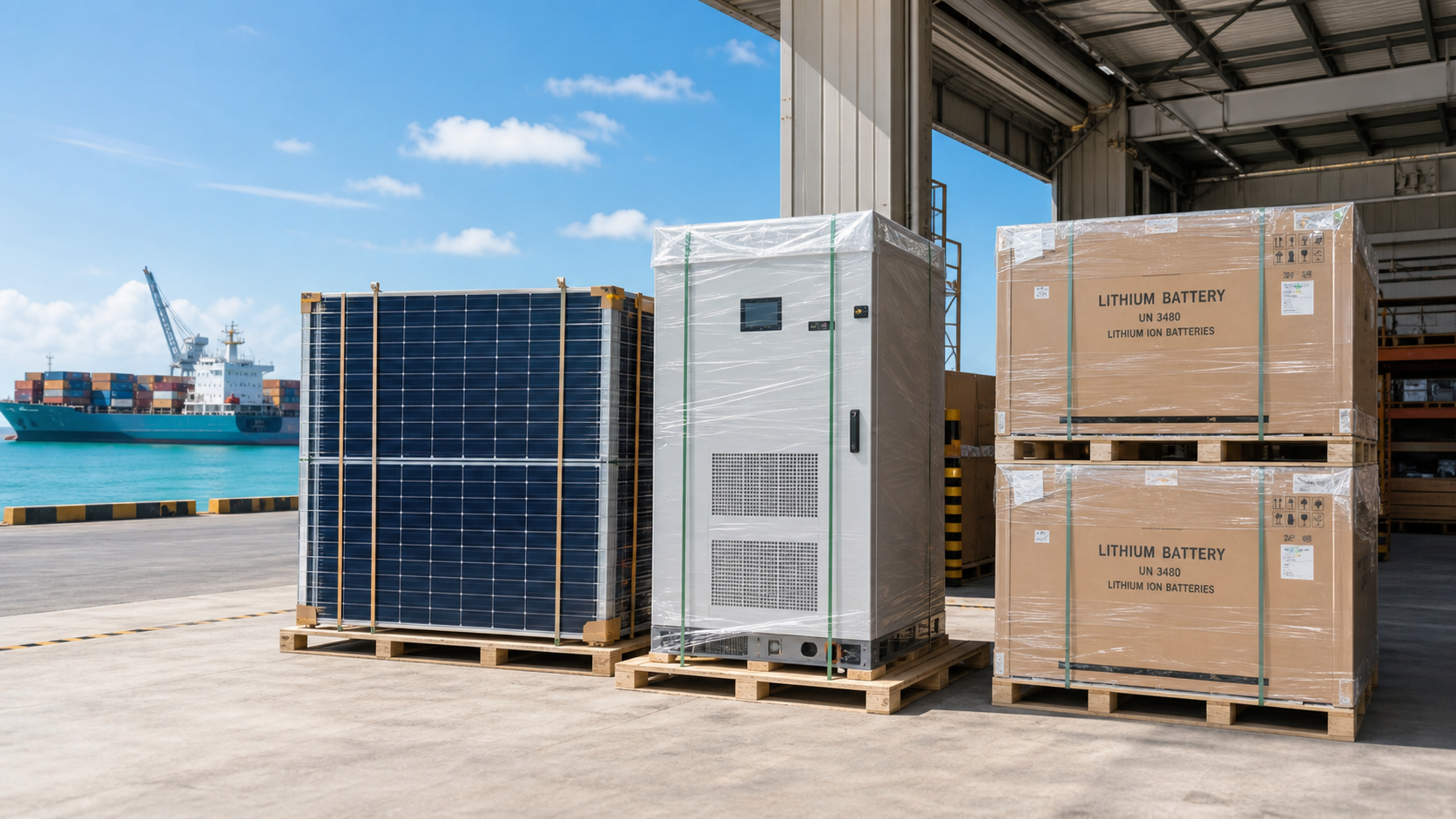
Educational illustration of a project shipment. The actual equipment, labels and port handling depend on the confirmed order and carrier requirements.
First, define what “15kW” means
Solar projects use several capacity figures that are easy to confuse:
|
|
|
|
|
|
|
|
|
|
|
|
|
|
|
|
The current Sunchees 15kW candidate configuration lists a 15kW inverter, a 30.6kWh battery and sixteen 600W modules. Those modules total 9.6kWp, so “15kW” on that page describes the inverter rating, not a 15kWp array.
That page also lists 220V/50Hz. Caribbean Utilities Company (CUC) states that Grand Cayman operates at 60Hz. Its common residential and small-commercial service is 240/120V single-phase, three-wire, while commercial sites may use 120/208V or 277/480V three-phase service. The catalogue configuration should therefore be treated as a starting point only. The final inverter and balance-of-system design must match the property’s actual service and receive local review.
Complete a Cayman technical review before ordering
A useful project brief should include:
- the most recent 12 months of CUC bills and monthly kWh use;
- daytime loads and any demand peaks;
- the refrigeration, lighting, pumps, communications, air-conditioning or other loads that must remain on during an outage;
- nameplate details and starting current for large motors or compressors;
- the property’s service voltage, phase and frequency, plus clear photographs of the meter and main panel;
- roof type, dimensions, pitch, age, shading and available structural information;
- the installation address, equipment-room location and any truck or crane restrictions; and
- whether the project will operate in parallel with CUC, export surplus energy, use zero export, or operate as a backup/off-grid system.
If the system will connect to the grid, check the current CUC customer-sited renewable programme capacity and terms before freezing the equipment. A Cayman-licensed professional should confirm the application route, drawings, protection, metering, battery requirements and Department of Planning inspections. An off-grid or non-export design still has to meet local electrical, structural and building-safety requirements.
Freeze the final bill of materials and responsibility matrix
Every important component should have one confirmed model number across the quotation, data sheet, commercial invoice, packing list and arrival labels.
|
|
|
|
|
|
|
|
|
|
|
|
|
|
|
|
|
|
|
|
|
The same order file should state what Sunchees, the freight forwarder, Cayman customs broker, local engineer, electrician, trucking or crane company and buyer will each provide. Equipment supply, ocean freight, customs clearance, permitting, installation and interconnection are connected work packages, but they are not the same service.
Compare FCL and LCL on landed cost, not freight alone
For early planning, the following ranges can help a buyer build a working budget. They are not a live quotation. The final price and transit plan must be recalculated from the confirmed origin port, Incoterm, cargo dimensions and weight, battery classification and destination scope.
|
|
|
|
|
|
|
|
|
|
|
|
|
|
|
FCL is not automatically the better answer. Compare the total cargo CBM and gross weight, module-handling risk, LCL dangerous-goods acceptance, deconsolidation fees, storage, demurrage or detention, trucking and the buyer’s ability to unload a container and return it on time. Allow schedule contingency for transshipment, feeder services and weather; the carrier’s booking confirmation and voyage updates govern the actual ETA.
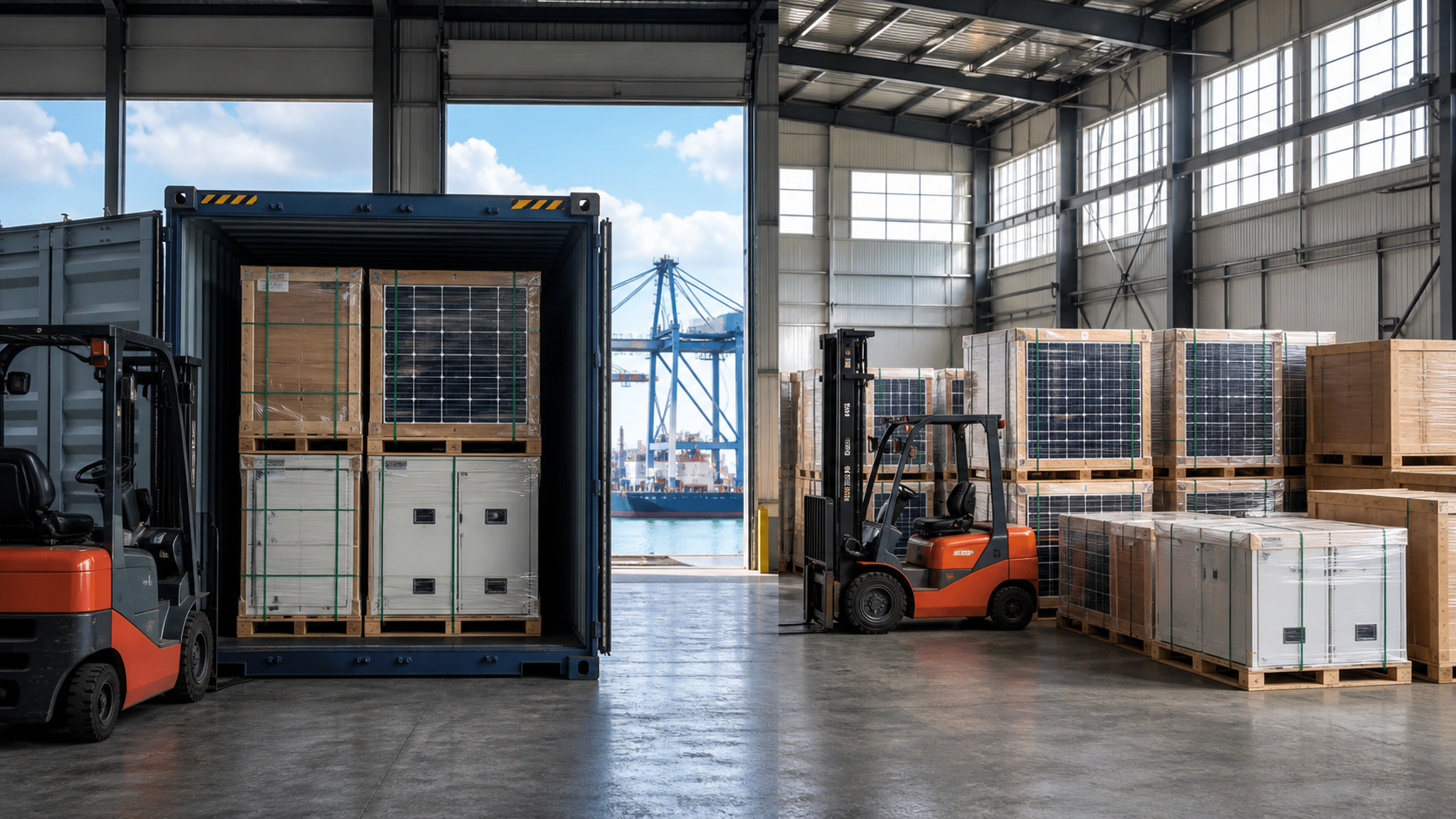
FCL and LCL differ in handling, routing, cost and risk. Compare current quotations for the same confirmed cargo and delivery scope.
Prepare export packaging and lithium-battery documents
Solar modules need rigid pallet or crate support, corner protection, moisture control and restraint against tipping. Inverters, combiners and fragile accessories should be packed for their weight and shock sensitivity. Before loading, record each package number, quantity, dimensions, gross and net weight, equipment serial numbers, securing points and container seal. Keep photographs of the empty container, loading sequence, final restraint and sealed doors.
Solid-wood pallets, crates and dunnage should comply with ISPM 15 and carry the recognized official mark. Photograph the marks before loading and retain the packaging supplier’s treatment and traceability records.
If the system includes lithium batteries, the battery-document chain must be reviewed separately from the modules. Once the model is frozen, the dangerous-goods forwarder and carrier should check:
- the model-specific UN 38.3 test summary;
- the SDS or MSDS;
- chemistry, watt-hours, quantity, net weight and packaging method;
- the correct UN number and proper shipping name;
- packaging, marking, labelling, dangerous-goods declaration and stowage requirements; and
- any China-side dangerous-goods packaging documentation required for the booked route.
Acceptance can differ depending on whether batteries are shipped alone, packed with equipment or contained in equipment, as well as their capacity, weight and route. Booking should not be treated as confirmed until the carrier accepts the actual battery model and packing arrangement.
Plan Cayman customs clearance before the vessel arrives
Cayman Customs & Border Control says a commercial importer needs a Trader Identification Number (TIN) and uses the Customs Online System (COLS). An importer may appoint a customs broker, but remains responsible for correct classification, customs value and supporting documents. The applicable entry must be completed within seven days after the goods arrive.
The current Customs Tariff Act is the 2026 Revision. Panels, inverter, batteries, mounting, cables and accessories should be reviewed under their respective commodity codes, quantities and customs values. Do not assume that one duty conclusion applies automatically to the complete kit.
A preliminary US$1,200–1,700 allowance can be used for destination customs and related charges while the broker prepares an itemized estimate. The final landed-cost sheet should separate duty or tax, brokerage/COLS processing, terminal handling, examination or storage, LCL deconsolidation, demurrage/detention, local trucking and any crane or unloading service.
From customs release to project handover
After release, the buyer still needs a controlled local handover:
- the broker sends release and pickup instructions to the trucking team;
- the pickup team records the container seal, packaging condition and visible impact or tilt damage;
- any exception is reported to the carrier, insurer and Sunchees within the contractual notice period;
- the local licensed team verifies models, quantities, serial numbers and approved drawings;
- installation follows the locally approved structural and electrical design;
- applicable Planning/CUC procedures, inspection, commissioning and owner training are completed; and
- the buyer receives as-built information, settings, test records, warranty documents and a spare-parts list.
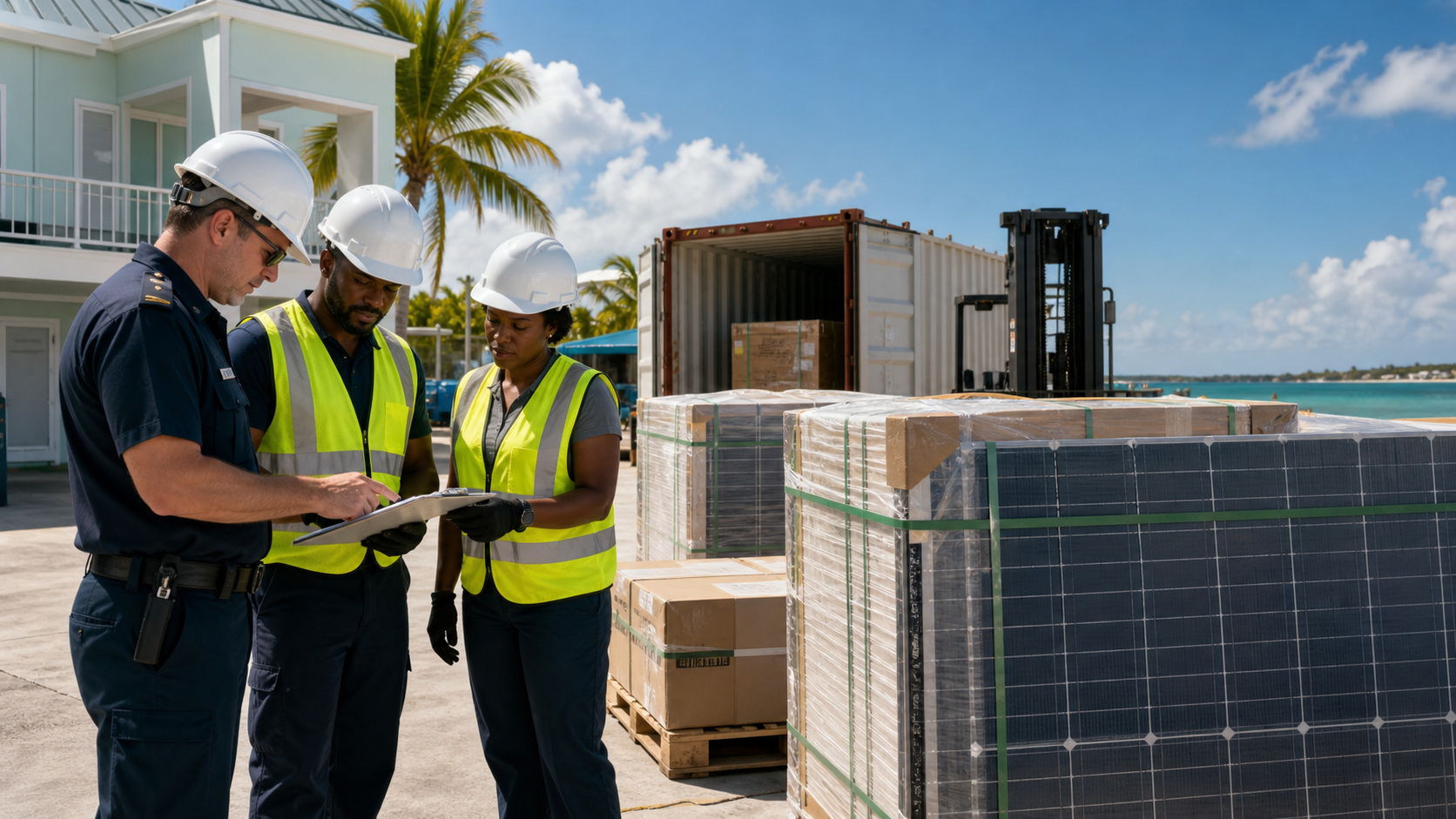
Illustrative handover scene. Local permitting, installation, inspection and commissioning remain project-specific responsibilities.
What Sunchees provides in this process
At Sunchees, we can use your electricity bills, critical-load schedule, service details, backup target, roof information and Cayman delivery address to prepare a candidate system, model data, bill of materials, drawing inputs, packing list and shipping-document package. When batteries are included, we provide the model documents for review by the dangerous-goods forwarder and carrier.
The final 60Hz voltage and phase selection, Cayman structural and electrical engineering, commodity classification, taxes, local construction, inspection and CUC interconnection must be confirmed by the relevant local professionals. Before payment, we work with the buyer and local team to freeze one final equipment list and a clear responsibility matrix.
You can also review the Sunchees Cayman Islands solar overview, 15kW candidate configuration, off-grid solar-system range and delivery terms.
Buyer checklist before payment
- PV kWp, inverter kW and battery kWh are stated separately.
- A Cayman professional has confirmed 60Hz, site voltage and phase.
- The grid-connected, export, zero-export, backup or off-grid role is defined.
- Every major component has one model number and matching data sheet.
- The broker has reviewed item-level classification under the current tariff.
- FCL and LCL have been compared on total landed cost, timing and handling risk.
- Wood packaging bears traceable ISPM 15 marks.
- For lithium batteries, the UN 38.3 summary, SDS and DG booking are accepted for the actual route.
- Incoterm, destination port, insurance, risk transfer, destination charges and local delivery are written into the quotation.
- The Cayman installation, inspection, commissioning and service parties are identified.
Frequently asked questions
How long does it take to ship a 15kW solar system to George Town?
For preliminary planning, allow about 55–65 days for FCL or 70–80 days for LCL. The confirmed ETA depends on the origin port, transshipment, feeder connection, dangerous-goods approval, weather and destination handling.
Is FCL or LCL better for a 15kW system?
FCL is faster in this preliminary comparison and can reduce handling stages. LCL has a lower headline estimate but may add consolidation, deconsolidation and waiting charges. The better choice depends on cargo volume, battery acceptance, module-handling risk, destination fees and unloading arrangements.
Can the current Sunchees 15kW catalogue system connect directly to the Cayman grid?
Not without project-specific selection and review. The current page lists 220V/50Hz, while CUC uses 60Hz and several service voltages. The site service and operating role must be confirmed before the final inverter and system are selected.
Are solar-system imports duty-free in the Cayman Islands?
Do not assume the complete kit has one duty treatment. Panels, inverter, batteries, racking and accessories should be classified separately under the current Cayman tariff and confirmed by CBC or the appointed broker.
What is required for wooden pallets and crates?
Solid-wood packaging should comply with ISPM 15 and display the official mark. Photograph the marks and packaging condition before loading, and retain supplier traceability records.
What documents are needed when the system includes lithium batteries?
Core inputs include the model-specific UN 38.3 test summary, SDS, watt-hours, quantity, weight, correct UN number and proper shipping name. The dangerous-goods forwarder and carrier decide the final packaging, marking, labelling, declaration and route-acceptance requirements.
Sources
- Cayman CBC import regulations
- Cayman Customs Tariff Act 2026 Revision
- CUC power specifications
- CUC customer-sited renewable programmes
- IPPC guide to wood packaging material
- UNECE UN 38.3 resources
- Sunchees 15kW candidate configuration
{ "@context": "https://schema.org", "@type": "FAQPage", "mainEntity": [ {"@type":"Question","name":"How long does it take to ship a 15kW solar system to George Town?","acceptedAnswer":{"@type":"Answer","text":"For preliminary planning, allow about 55–65 days for FCL or 70–80 days for LCL. The confirmed ETA depends on the origin port, transshipment, feeder connection, dangerous-goods approval, weather and destination handling."}}, {"@type":"Question","name":"Is FCL or LCL better for a 15kW system?","acceptedAnswer":{"@type":"Answer","text":"FCL is faster in this preliminary comparison and can reduce handling stages. LCL has a lower headline estimate but may add consolidation, deconsolidation and waiting charges. The better choice depends on cargo volume, battery acceptance, module-handling risk, destination fees and unloading arrangements."}}, {"@type":"Question","name":"Can the current Sunchees 15kW catalogue system connect directly to the Cayman grid?","acceptedAnswer":{"@type":"Answer","text":"Not without project-specific selection and review. The current page lists 220V/50Hz, while CUC uses 60Hz and several service voltages. The site service and operating role must be confirmed before the final inverter and system are selected."}}, {"@type":"Question","name":"Are solar-system imports duty-free in the Cayman Islands?","acceptedAnswer":{"@type":"Answer","text":"Do not assume the complete kit has one duty treatment. Panels, inverter, batteries, racking and accessories should be classified separately under the current Cayman tariff and confirmed by CBC or the appointed broker."}}, {"@type":"Question","name":"What is required for wooden pallets and crates?","acceptedAnswer":{"@type":"Answer","text":"Solid-wood packaging should comply with ISPM 15 and display the official mark. Photograph the marks and packaging condition before loading, and retain supplier traceability records."}}, {"@type":"Question","name":"What documents are needed when the system includes lithium batteries?","acceptedAnswer":{"@type":"Answer","text":"Core inputs include the model-specific UN 38.3 test summary, SDS, watt-hours, quantity, weight, correct UN number and proper shipping name. The dangerous-goods forwarder and carrier decide the final packaging, marking, labelling, declaration and route-acceptance requirements."}} ] }
 How to Ship a 12kW Solar System to Costa Rica
 You May Also Like



 Tel
Tel
 Email
Email
 Address
6th Floor, Zhonghe Zinan Industrial Park, No. 1 Zinan Changang West Road, Nanzhuang Town, Chancheng District, Foshan City, Guangdong Province. China (Mainland)