


 Whatsapp :
 Home
HomeSolar Companies in Nassau, Bahamas: A Practical Buyer’s Guide
 Aug 03,2026
 0
0
 sunchees solar system
Choosing among solar companies in Nassau, Bahamas involves more than comparing panel brands or headline prices. A useful proposal should show who will survey the property, complete the structural and electrical design, manage the BPL and regulatory process, supply the equipment, install and commission the system, and provide support after handover.
Local installers are generally best placed to handle site work, approvals and on-island service. Equipment suppliers and manufacturers can add value through product selection, custom configuration and coordinated supply. These roles can work together, but they should be defined clearly before a buyer signs a contract.
This guide compares the public evidence available for Nassau solar businesses and Sunchees supply options. It does not name a universal “best” company. The right choice depends on the property, load profile, resilience objective, approval route, contract and quality of the proposed delivery team.
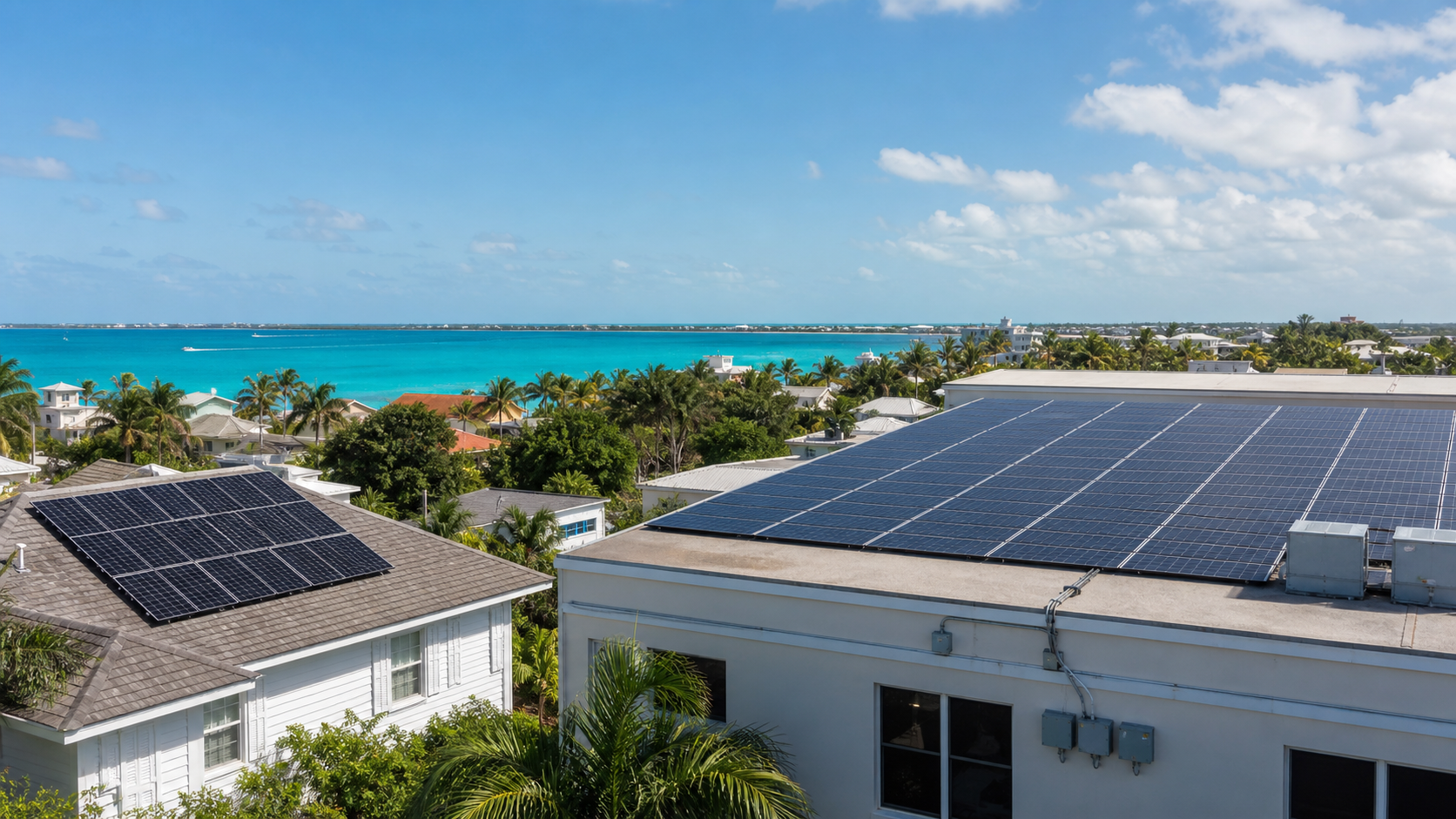
Residential and commercial projects share the same market, but their load, approval and resilience requirements differ. Illustrative image; not a claimed project site.
The Nassau Solar Market Is Active, but Every Connection Still Requires Review
URCA’s 2024 reporting recorded 393 renewable self-generation systems on New Providence with a combined capacity of 9,886kW. The Bahamas National Energy Policy 2025–2030 also states that New Providence accounted for about 90% of private renewable systems in its market assessment.
These figures indicate that Nassau has practical solar experience. Connection capacity and the approval route still need to be confirmed for the specific BPL circuit and proposed system size.
Under the Electricity Act 2024, a grid-connected residential project requires a permit, a grid-interconnection agreement and compliance with applicable URCA measures. Small commercial and government self-generation also requires written approval and must satisfy grid-impact requirements. BPL’s published Level 1 SSRG documents remain useful for understanding applications, inspection, anti-islanding and insurance, but they predate the 2024 Act. Buyers should confirm the current programme, capacity limit, fees and circuit headroom with BPL and URCA before ordering equipment.
Comparing Solar Companies and Supply Options in Nassau
Google Maps ratings below are a dated snapshot from Aug 1, 2026. A score should always be read together with the number, age and subject of its reviews.
Bahamas Energy & Solar Supplies (BESS)
Public service and project evidence: Publishes named commercial and residential work. Its client references include an 840kW Highbourne Cay system and a 36kW Nassau Container Port system.
Google Maps snapshot: One listing showed 4.0/5 from two reviews; a second listing using the same website showed no reviews.
Buyer fit and questions: A strong local EPC candidate for buyers who value named commercial references. Confirm the current business address, recent comparable Nassau work, workmanship coverage and response process.
Island Solar
Public service and project evidence: Publishes a Nassau base, named technical credentials, grid-tied/off-grid services and projects including a 75kW Nassau system and Pinder Tile work.
Google Maps snapshot: No numerical rating or review count was displayed on the exact listing.
Buyer fit and questions: Suitable for buyers seeking local survey, design, installation and interconnection support. Ask for current BPL procedures and two recent references matching the proposed system type.
Bahama Solar
Public service and project evidence: Offers turnkey installation and monitoring and publishes older named projects, including Paradise Island residential arrays and a 50kW Nassau warehouse system.
Google Maps snapshot: No reviews were shown.
Buyer fit and questions: Useful for buyers who want a local installer with visible project history. Confirm that the current team, equipment and service terms match the published 2018 projects.
Smart Energy Bahamas
Public service and project evidence: Shows a Nassau team and a catalogue of modules, hybrid inverters and storage products. Its public customer descriptions are broad but provide limited named, dated and sized recent cases.
Google Maps snapshot: No reviews were shown.
Buyer fit and questions: A local option for comparing storage and equipment choices. Request a precise bill of materials and recent Nassau references before assessing the proposal.
SuperGreen Solar / Super Green Solutions
Public service and project evidence: States that it supports BPL/AHJ permitting and publishes work including Bahamas Red Cross solar-plus-storage, a 6.5kW Lyford Cay residence and a 53kW Guana Cay system.
Google Maps snapshot: No reviews were shown.
Buyer fit and questions: Relevant for residential storage and buyers seeking public project examples. Confirm the scope of its stated workmanship coverage and the local response process for battery or inverter faults.
HBS-SYSTEM
Public service and project evidence: Offers solar, storage and generator systems. Its public catalogue should be reconciled carefully because some system titles, module quantities and stated capacities are inconsistent.
Google Maps snapshot: 4.4/5 from five reviews. Positive themes included consultation, battery systems, reduced generator use and telephone support. The set also included a recently edited 2-star after-sales complaint.
Buyer fit and questions: A local installer with the most substantive Maps review set in this comparison. Ask for a corrected project-specific equipment schedule, serialised warranty responsibilities and evidence that any recent service issue has been addressed.
Sky Solar Power Bahamas
Public service and project evidence: Operates a visible local equipment store with panels, 120/240V inverters, batteries, controllers, protection products and maintenance. It publishes limited named EPC project evidence.
Google Maps snapshot: 5.0/5 from one review describing professional service and a smooth installation.
Buyer fit and questions: Useful for local equipment sourcing. Confirm who will complete engineering, approval, installation, commissioning and workmanship support.
A.C.W. Electronics
Public service and project evidence: Focuses on UPS systems, batteries, voltage regulation, split-phase inverters, panels and solar consultation. Its site provides limited named installation evidence.
Google Maps snapshot: 3.0/5 from three reviews. Only one old review specifically mentioned selling and installing solar.
Buyer fit and questions: Better assessed as an equipment and consultation supplier unless its proposal includes a documented full EPC team.
Mac Electrical & Power Generation
Public service and project evidence: Offers electrical contracting, generators and residential/commercial solar-plus-storage. Its website states relevant three-phase and power-generation experience but provides limited named solar cases.
Google Maps snapshot: One listing showed 2.8/5 from four older reviews; another listing with the same phone showed no reviews. Most review evidence concerned generators or general electrical work rather than Nassau solar.
Buyer fit and questions: Relevant where solar must integrate with generators or wider electrical work. Ask for current licensing and solar-specific Nassau references rather than relying on the general Maps score.
Sonowatt Energies
Public service and project evidence: Promotes Solar Energy as a Service and commercial or large-scale projects. Its public website provides limited attributable Nassau case detail.
Google Maps snapshot: 5.0/5 from one review without written detail.
Buyer fit and questions: A commercial financing or service-model option requiring careful contract review. Request operating references, financing counterparties, performance terms, insurance and the full long-term service obligation.
Eco Energy Bahamas
Public service and project evidence: Promotes residential, commercial and government solutions. A Bahamas government source independently describes the planned 20MW Coral Harbour solar facility with 5MWh of storage.
Google Maps snapshot: Its facility listing showed no reviews.
Buyer fit and questions: Most useful as utility-scale market evidence. A home or small-business buyer should ask whether a separate team and contract support that customer segment.
Sunchees
Public service and project evidence: A Foshan-based PV and storage manufacturer/system supplier with grid-tied, off-grid, hybrid, split-phase, battery, mounting and coordinated system options.
Google Maps snapshot: No Nassau installation-service review profile was used.
Buyer fit and questions: Suitable where a buyer or developer has, or will appoint, a qualified Bahamian engineering and installation partner and wants manufacturer-side system coordination.
Additional Maps Listings That Need More Evidence
The exact search also produced several entries with limited public information:
- Madeleine Solar Power showed two very recent 5-star ratings but little review detail, no attached website and an unclaimed listing. Government material links Madeleine Solar to a planned utility-scale Blue Hills project, so it should not automatically be treated as a retail home installer.
- Caribbean Green Energy Specialists Ltd, PM Solar Bahamas and Solar Panel System at 31 Tywnam Height showed no reviews and insufficient website or case evidence for a detailed comparison.
- Duplicate Maps pins for BESS and Mac/MEPG should be resolved by business identity, address and telephone rather than counted as separate companies.
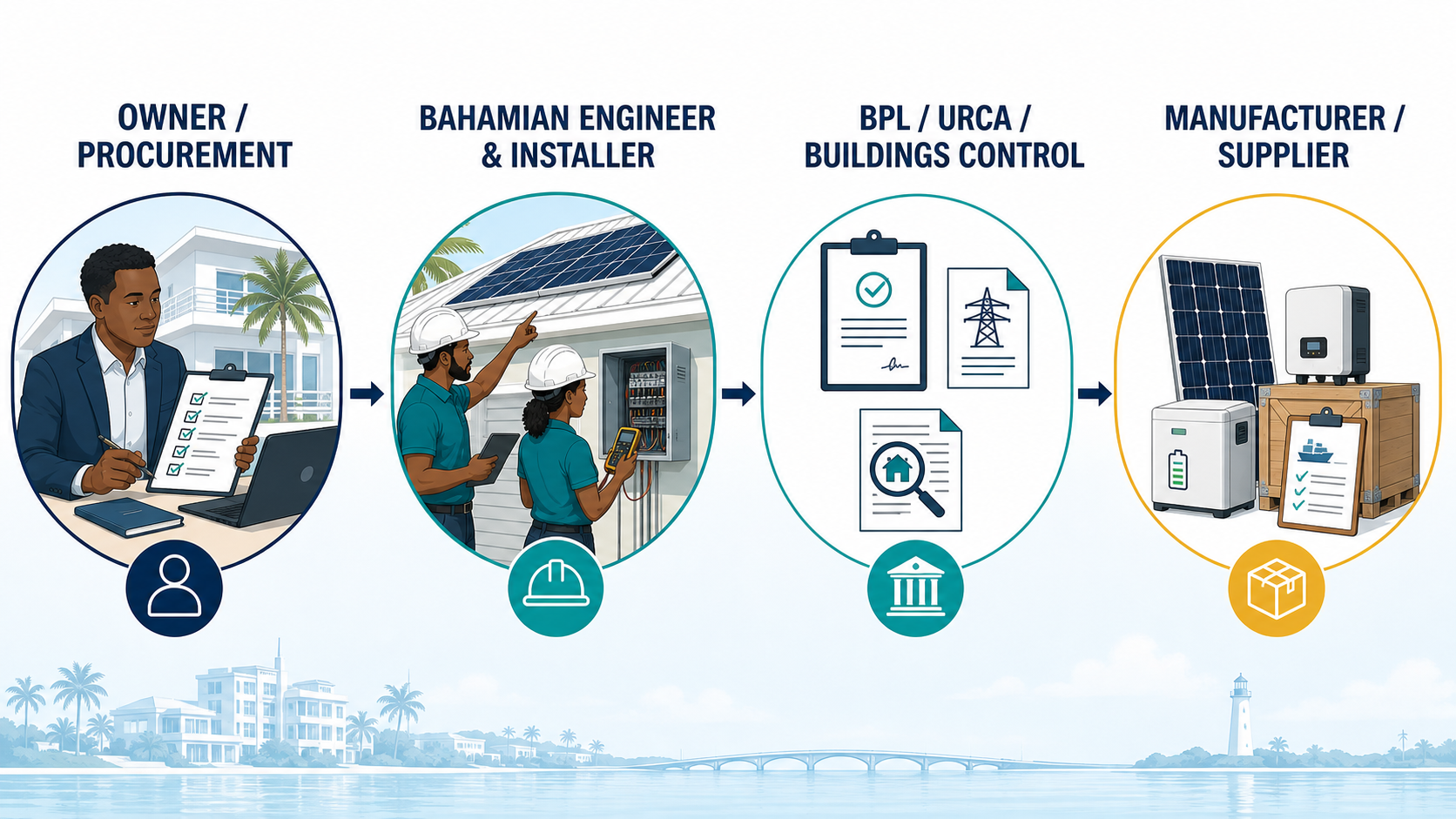
A bankable delivery chain assigns local design and approval work separately from equipment supply. The diagram describes responsibilities and does not imply agency endorsement.
How Procurement Teams Should Use Online Reviews
Maps and social reviews can reveal communication, installation and service themes, but the Nassau sample is small. Many exact listings had zero to five reviews. A 5.0 score based on one review is not equivalent to a long service record, and a generator-service review does not automatically measure solar engineering quality.
For each shortlisted company, check:
- how recent the reviews are;
- whether they describe solar design, permitting, installation, commissioning or after-sales work;
- whether the project was in Nassau or another island;
- how the company responds when service problems arise;
- whether the reviewer’s project can be matched to a similar property and system type; and
- whether the company will provide two recent customer references that can be contacted directly.
A reference call should cover the original scope, approval process, installation quality, system performance, monitoring, warranty claims and response time after commissioning.
Residential Solar in Nassau: Local Design and Buying Considerations
Decide Whether the Goal Is Savings, Backup or Both
A standard grid-tied solar array normally shuts down during a utility outage because of anti-islanding protection. A homeowner who needs refrigeration, lighting, internet, security, pumps or selected air-conditioning during an outage should request compatible storage, controlled isolation or transfer, and a defined critical-load panel.
The PV array size, inverter output and usable battery capacity should be listed separately. “10kW solar” describes the array; it does not by itself promise 10kW of outage power or a particular backup duration.
Size the System from Real Usage
A residential proposal should use at least 12 months of electricity bills and account for daytime and evening demand. Air-conditioning, water heating, pool pumps, water pumps and future electric vehicles can materially affect the design.
Battery sizing should start with the actual essential loads, their starting currents, the required operating hours, usable depth of discharge and conversion losses. This produces a more useful design than a general “whole-home backup” label.
Model BPL Net Billing Correctly
BPL’s published agreement describes bi-directional metering and net billing. Imported electricity is charged at the applicable tariff, while exported electricity is credited at the feed-in tariff. A financial model should therefore separate self-consumed solar energy, exported energy, battery losses, maintenance, future equipment replacement and financing.
Ask every bidder to state the tariff date, export-credit assumption and annual load-growth assumption used in its savings model.
Require Property-Specific Wind and Roof Design
Terms such as “hurricane rated” or “Cat-5 mounting” are not complete specifications. A responsible design should identify the applicable code basis, site conditions, roof edge and corner zones, rails and clamps, attachment spacing, fasteners, structural load path and waterproofing method.
The roof’s remaining service life also matters. If replacement is likely within the solar system’s operating period, the buyer should include removal and reinstallation responsibility in the commercial evaluation.
Specify Complete-System Corrosion Control
IEC 61701 is a salt-mist test for PV modules. Coastal suitability also depends on racking, fasteners, connectors, cable management, enclosures, coatings, dissimilar-metal control, drainage and inspection.
Request exact materials and enclosure ratings for every outdoor component. Inverter and battery locations should also comply with the manufacturer’s temperature, ventilation, clearance and water-exposure requirements.
Address Flood and Drainage Exposure
Site surveys should record drainage paths, historic water levels and possible coastal or stormwater flooding. Sensitive equipment may need to be elevated, while conduit routes should be designed to reduce water entry. The final elevation and enclosure requirements should be set by the project engineer, equipment instructions and local authority review.
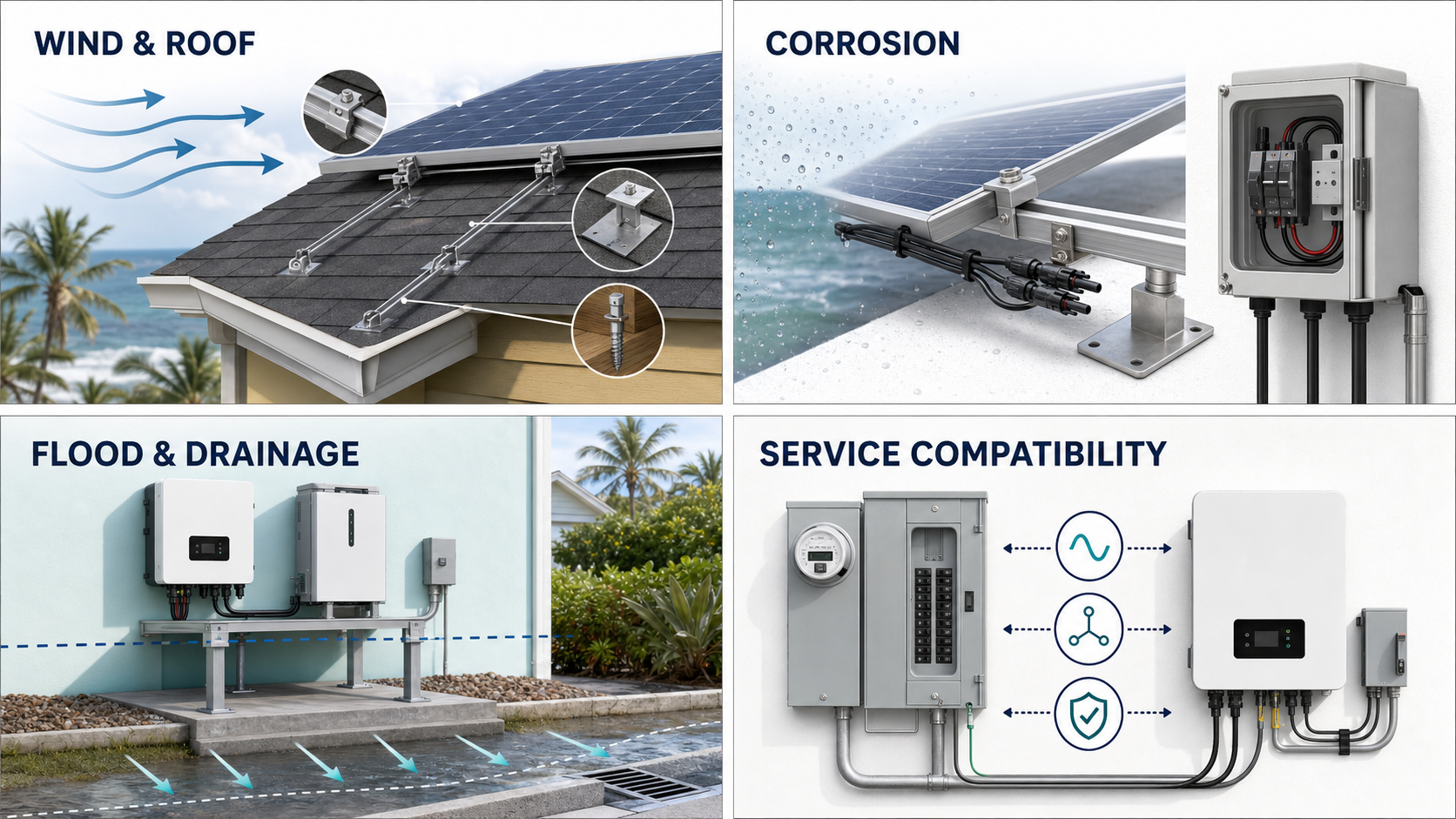
Wind, corrosion, flood exposure and electrical service compatibility should be checked at project level. The illustration is a procurement checklist, not a completed engineering design.
Commercial Solar in Nassau: Procurement Priorities
Confirm Approval and Connection Capacity Early
Commercial self-generation is subject to the written-approval and grid-impact provisions of the Electricity Act 2024. Older BPL Level 1 material included a New Providence small-commercial formula and a 100kW ceiling, but buyers should treat those figures as historical guidance and confirm the current route with BPL and URCA.
Warehouses, hotels, offices, retail sites and multi-meter properties should establish the customer class, service size, transformer or feeder constraints, metering arrangement and approval responsibility before procurement reaches the equipment-order stage.
Analyse Interval Demand as Well as Monthly Energy
A business with stable daytime demand may achieve a higher self-consumption rate than a site dominated by evening loads. However, the reduction in monthly kWh and the reduction in maximum demand may differ.
Commercial proposals should use interval data where available and show energy charges, demand charges, exported energy and any battery strategy as separate line items.
Coordinate Roof, Operations and Construction
Large roofs require review of structural capacity, corrosion, roof warranty, drainage, fire and service access, edge zones and future reroofing. The construction plan should also cover lifting, temporary closures, outage windows, tenant or hotel operations, weather delays and site safety.
A past Nassau metal-roof project is useful experience, but the current building still needs its own survey and calculations.
Give the Battery a Defined Business Case
Commercial storage may support critical loads, increase solar self-consumption, coordinate with generators or address a specific demand-management objective. Each use case produces different power, energy, controls, protection and operating requirements.
Define the equipment to be supported, starting currents, required hours, acceptable downtime and existing generator sequence before comparing battery proposals.
Contract for Service, Data and Spare Parts
Commercial contracts should define remote monitoring, alert handling, preventive inspections, cleaning decisions, corrosion checks, firmware management, spare parts, response times and ownership of performance data.
When an overseas manufacturer supplies equipment and a local company installs it, state who is responsible for diagnosis, warranty approval, replacement shipping, removal and reinstallation labour, recommissioning and temporary power.
Where Sunchees Fits in a Nassau Project
Sunchees can coordinate modules, grid-tied/off-grid/hybrid inverters, LiFePO4 storage, mounting, protection, cables and monitoring from the manufacturer side. We can also discuss project-specific electrical configuration and documentation before production.
Our role does not replace the Bahamian professionals responsible for site survey, structural and electrical design, BPL/URCA coordination, building approval, installation, inspection and local service. A sound procurement plan assigns those responsibilities by name.
Electrical compatibility is a critical gate. For example, a published Sunchees 30kW off-grid package uses 50 × 600W modules, a 192V/300Ah battery and a 220/380Vac three-phase inverter. The component arithmetic is useful as a product example, but that standard inverter configuration should not be assumed to match a Nassau service.
Before a model is selected, verify the property’s voltage, frequency, phase, service capacity, grounding and protection arrangement from the equipment nameplates and utility records.
Sunchees also publishes a Jamaica resort example using 15kW of PV, 110/220V split phase and 30kWh of storage. It demonstrates that a Caribbean split-phase configuration can be discussed at project level. The customer name is a pseudonym and the project is not in Nassau, so it does not establish Nassau approval, savings, performance or local service history.
The audited material did not establish a completed, named and independently verifiable Sunchees project in Nassau. We disclose that directly. A Nassau buyer considering Sunchees should complete a three-party technical review: Sunchees confirms the equipment and documentation, the Bahamian engineer/installer confirms local design and installation, and the buyer confirms approvals, acceptance and service responsibilities.
Import Costs and Tax Treatment
The Bahamas’ standard VAT rate is 10%. Government concession programmes may include eligible solar equipment, but eligibility depends on the applicant, location, purpose, approval and retention conditions. Buyers should not assume that every Nassau solar shipment is automatically exempt.
An imported-system quotation should separate:
- equipment and packaging;
- ocean freight and insurance;
- HS classification, possible duty and VAT;
- customs brokerage and port charges;
- local transport and lifting;
- permits, engineering and installation;
- commissioning, spares and monitoring; and
- warranty and replacement logistics.
Final treatment should be confirmed for the exact shipment with Bahamas Customs, the Department of Inland Revenue and a qualified customs or tax adviser.
A 100-Point Solar Supplier Evaluation Framework
Procurement teams can adapt this scorecard to the project rather than relying on the lowest price or highest star rating.
|
|
|
|
|
|
|
|
|
|
|
|
|
|
|
|
|
|
|
|
|
|
|
|
|
|
|
|
What Every Nassau Solar Quotation Should Include
- Twelve months of bills, interval data where available and future-load assumptions.
- The project objective: savings, backup, off-grid operation, generator coordination or a combination.
- Confirmed voltage, frequency, phase, service capacity and distribution conditions.
- PV kW, inverter kW and battery kW/kWh shown separately.
- Exact module, inverter, battery, mounting, protection and monitoring models.
- Code basis, structural calculations, roof zones, attachments and waterproofing.
- Corrosion, enclosure, temperature, drainage and flood provisions.
- A responsibility matrix for BPL, URCA, Buildings Control and other approvals.
- Operating logic for normal conditions, outages, low battery, generators and grid restoration.
- Equipment warranty, workmanship warranty, exclusions and RMA/freight responsibility.
- Monitoring, maintenance, spares, alerts and on-island response arrangements.
- The landed and installed total, with dated tariff, tax and savings assumptions.
Frequently Asked Questions
Which is the best solar company in Nassau, Bahamas?
There is no universal best company for every project. Local installers may be strongest in survey, approval, installation and on-island support, while specialist suppliers or manufacturers may offer broader equipment and customisation options. Compare relevant cases, engineering documents, contract scope and after-sales responsibility.
Does residential solar in Nassau require BPL approval?
A grid-connected residential project must follow the applicable permit and interconnection process and comply with URCA and BPL requirements. An off-grid project may still require notification and building or electrical approvals. Confirm the route before equipment is ordered or installed.
Does BPL offer one-for-one net metering?
BPL’s published agreement describes net billing. Imported electricity is charged at the applicable tariff and exported electricity is credited at the feed-in tariff. Confirm the current agreement and credit value with BPL and URCA.
Will a grid-tied solar system power my property during an outage?
A basic grid-tied system normally shuts down during an outage. Backup requires compatible storage or another approved source, controlled isolation or transfer, and a clearly defined critical-load distribution system.
How should a Nassau solar system address hurricanes and salt air?
Require project-specific wind and attachment design and verify corrosion control for the complete system, including racking, fasteners, connectors, enclosures and cabling. A general hurricane claim or a module salt-mist test does not cover the whole installation.
Can a commercial buyer assume that 100kW will be approved?
No fixed project size should be assumed from an older programme document. Confirm the current customer category, service capacity, circuit conditions and approval route with BPL and URCA. Larger or grid-sensitive projects require project-specific assessment.
Is Sunchees a local Nassau installation company?
No. Sunchees is a Foshan-based PV and storage manufacturer/system supplier. A Nassau project needs clearly appointed Bahamian professionals for engineering, approvals, installation, commissioning and local service.
Does Sunchees have a verified completed project in Nassau?
The material audited for this guide did not establish a completed, named and independently verifiable Sunchees project in Nassau. Caribbean examples are presented only as configuration references, not as proof of Nassau delivery or performance.
Request a Project-Specific Review
If you are planning a residential or commercial project in Nassau, send us twelve months of electricity bills, the property’s service voltage and phase, roof or site information, essential loads, backup objective and intended schedule.
Sunchees can provide a manufacturer-side equipment and system review. The final design, BPL/URCA process, building approval, installation and acceptance should be completed with the appointed Bahamian professional team.
Internal Links
- Solar by Country
- Caribbean Solar Solutions
- Commercial Solar in the Caribbean
- 30kW Off-Grid Solar System Example
- Caribbean Split-Phase Resort Example
Sources
- Bahamas Electricity Act, 2024
- Bahamas National Energy Policy 2025–2030
- URCA 2024 Annual Report and 2025 Annual Plan
- BPL Level 1 SSRG Requirements
- BPL Level 1 SSRG Interconnection Agreement
- Bahamas Building Code, Third Edition
- Department of Inland Revenue — VAT
- Ministry of Finance — Special Tax Concessions Guide
- U.S. DOE — Severe Weather Resilience in Solar PV System Design
- IEC 61701:2020
- Bahamas Energy & Solar Supplies Projects
- Island Solar
- Bahama Solar
- Smart Energy Bahamas
- SuperGreen Solar Projects
- HBS-SYSTEM
- Sky Solar Power Bahamas
- A.C.W. Electronics
- Mac Electrical & Power Generation
- Sonowatt Energies
- Eco Energy Bahamas
- Office of the Prime Minister — Eco Energy Solar Microgrid
 How to Ship a 15kW Solar System to the Cayman Islands
 You May Also Like



 Tel
Tel
 Email
Email
 Address
6th Floor, Zhonghe Zinan Industrial Park, No. 1 Zinan Changang West Road, Nanzhuang Town, Chancheng District, Foshan City, Guangdong Province. China (Mainland)