


 Whatsapp :
 Home
HomeSolar Swimming Pool Pump and Swimming Pool Solar System: How to Size, Power, and Heat Your Pool
 Jun 23,2026
 0
0
 sunchees solar system
A pool pump runs 6 to 8 hours a day, every day, which makes it one of the hungriest loads in any home. This guide shows how to size a solar swimming pool pump, specify the right inverter, and grow into a complete swimming pool solar system that can clean, light, and heat the water around the clock.
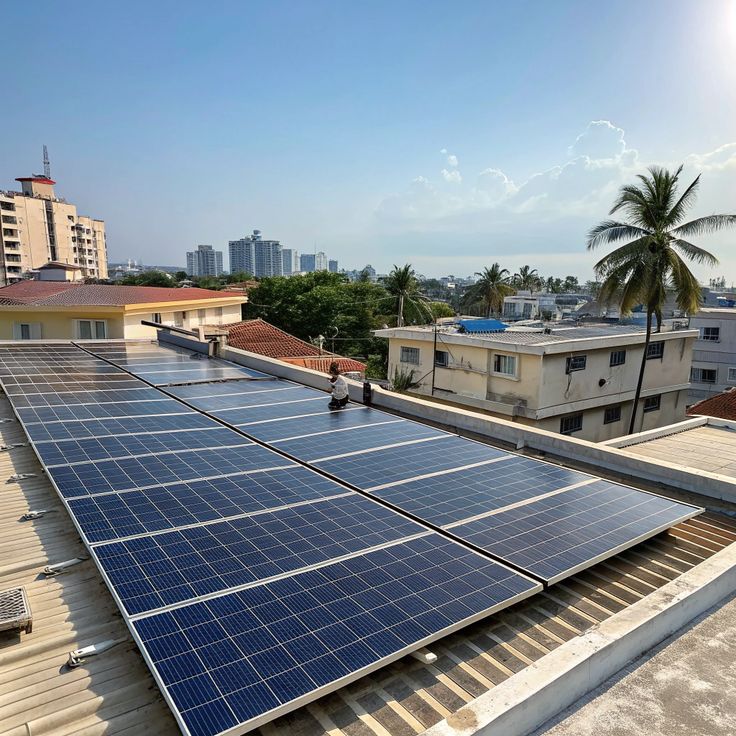
Who Needs a Solar Swimming Pool Pump?

A pool pump has to circulate the entire body of water every single day, so its electricity bill never stops. That is exactly why a solar swimming pool pump — running on free sunlight and cutting or removing grid charges — has such a precise, sizeable market. Demand concentrates in three kinds of places.
1. Sunny, high-pool-density developed regions
This is the largest and most mature market: strong sunshine, private backyards and pools, and steep tiered or commercial electricity prices.
- Australia — one of the highest per-capita pool ownership rates in the world (especially Queensland and New South Wales), abundant sun, high power prices, and strong green-energy culture — one of the largest markets for a solar swimming pool pump.
- US South & Southwest — California, Arizona, Texas, Florida. These Sun Belt states maintain pools most of the year, electricity (in California especially) is expensive, and rooftop solar adoption is already high.
- Mediterranean Europe — Spain, Italy, Greece. Hot summers, heavy tourism, many villas and holiday homes, and high European energy prices that make power savings urgent.
2. Regions with unstable grids, frequent outages, or very high tariffs
Here a solar swimming pool pump is not only about saving money — it keeps the pool from going green and foul during blackouts.
- South Africa — many private pools but severe national load shedding. A direct-drive solar swimming pool pump keeps the water circulating and clean through daytime outages.
- Middle East (Dubai, Saudi Arabia) — wealthy but extremely hot, with heavy pool circulation loads. High-end villas are converting to solar pool systems as part of green-building and de-carbonization goals.
3. Off-grid resorts and high-end islands
Eco-resorts and island villas that protect the environment or sit too far from the grid rely on independent power.
- Southeast Asian islands — standalone villas in Bali and Phuket.
- Caribbean & Latin America — resort zones such as Cancun (Mexico) and coastal Brazil.
Where the grid does not reach or diesel generators are costly, a pairing of swimming pool solar panels with a DC brushless pump delivers 24-hour self-sufficient circulation and doubles as a zero-carbon selling point.
Target buyer profile for a solar swimming pool pump
|
|
|
|
|
|
|
|
|
|
|
|
How to Size a Solar Swimming Pool Pump
Sizing follows one chain: pool volume → daily turnover → flow and head → pump power → inverter and panel power. Each step feeds the next.
Step 1 — Pool volume
Volume (m³) = Length (m) × Width (m) × Average depth (m) Average depth = (shallowest + deepest) / 2
Example: a standard family pool 8 m long, 4 m wide, 1.5 m average depth = 8 × 4 × 1.5 = 48 m³.
Step 2 — Required flow rate
To keep water clear, a private pool should complete one full turnover every 6 to 8 hours.
Flow (m³/h) = Pool volume (m³) ÷ Turnover time (h) 48 m³ ÷ 6 h = 8 m³/h
So you need a pump rated for at least 8 m³/h.
Step 3 — Head and power
The pump must also overcome resistance from pipes, elbows, the sand filter, and any heater. That resistance is head (in metres). For typical above-ground or semi-inground home pools, effective head lands between 10 m and 15 m. Cross your flow (8 m³/h) and head (say 10 m) on the manufacturer's pump curve to read off the matching horsepower or wattage. A 48 m³ pool generally fits a 0.75 HP (~550 W) to 1.0 HP (~750 W) solar swimming pool pump.
Matching the Inverter to Your Solar Swimming Pool Pump
This is the most decisive part of any swimming pool solar system, and it depends on whether you run an AC or DC pump.
If you use a traditional AC pump
An AC induction motor draws a huge inrush current at start-up — typically 3 to 5 times running current. Two rules follow:
- Power: the inverter's rated output should be at least 2 to 3 times pump power, with surge capacity to absorb the inrush.
- Waveform: use a pure sine wave inverter only. A modified-sine (square wave) inverter makes the motor overheat, buzz, and eventually burn out.
Worked example: a 750 W (1 HP) AC pump wants roughly a 1,500 W rated inverter able to surge to ~3,000 W for a few seconds.
If you use a modern DC brushless pump (recommended)
Today's purpose-built solar pumps use DC brushless motors with their own solar pump controller / inverter:
- Soft start: current ramps from zero, so there is no inrush spike.
- 1:1 matching: a 500 W DC pump simply takes a 500 W controller — no oversizing.
- MPPT is mandatory: sunlight changes constantly, and Maximum Power Point Tracking adjusts voltage and current in real time so the pump keeps turning slowly on cloudy days and at dusk, squeezing the most from your swimming pool solar panels.
Configuration checklist for a 48 m³ pool
|
|
|
|
|
|
|
|
|
|
|
|
|
|
|
|
|
|
|
|
One-line advice: For a new build, buy a DC brushless solar swimming pool pump bundled with a dedicated MPPT controller. It removes all the start-surge math and runs about 20% more efficiently than panels → inverter → AC pump.
Typical Pool Sizes by Country and the Solar Swimming Pool Pump That Fits
"Standard" pool size varies sharply by country, which changes the solar swimming pool pump you should specify.
- USA — spacious family pools. Golden standard 16 × 32 ft (~5.0 × 10.0 m), graded depth ~0.9–1.8 m, typically 55–75 m³.
- Australia — shifting to compact mid-size pools. Sweet spot 7 × 3.5 m or 8 × 4 m, ~1.4–1.6 m deep, 40–50 m³. Plunge pools (~5 × 3 m) are surging.
- Europe (Mediterranean) — smaller, deeper, often constant-depth rectangles. 6 × 3 m to 8 × 4 m, 30–45 m³.
- SE Asian resort islands — villa and infinity pools, 5 × 3 m to 6 × 4 m, 25–35 m³, with long daily run hours under intense sun.
Pool size to solar swimming pool pump power by region
|
|
|
|
|
|
|
|
|
|
|
|
|
|
|
|
|
|
|
|
Inverter Requirements for a Reliable Swimming Pool Solar System
The inverter (or controller) is the brain of the swimming pool solar system: it converts and regulates DC from the swimming pool solar panels into power the pump can use.
- MPPT is non-negotiable. Light, temperature, and cloud cover shift all day; MPPT continually finds the panel's best operating point so the system extracts maximum power even in weak light.
- For DC brushless pumps: 1:1 power match, mandatory soft start, and a wide input range — the controller's maximum open-circuit voltage (VOC) must exceed the combined VOC of your series-connected panels, or it will fail on power-up.
- For AC pumps: pure sine wave only, rated 2–3× pump power, with surge above 3,000 W for a 1 HP pump held 2–3 seconds.
- Protection (all inverters): IP65 outdoors / IP54 in a pump room; dry-run protection to stop the pump before it burns its bearings without water cooling; float-switch / water-level linkage; and standard over-voltage, under-voltage, over-current, overload, short-circuit, and reverse-polarity protection.
Avoid the trap: Choose DC over AC where possible: AC inverters lose 10–15% in conversion and force you to oversize for inrush. Always read the inverter's optimal voltage window first, then string your panels to land inside it.
Running the Pool Around the Clock with a Full Swimming Pool Solar System
A direct-drive pump runs only while the sun is up. For 24-hour cleaning, night lighting, robotic cleaning, or heating, the swimming pool solar system has to grow.
1. Round-the-clock filtration (night circulation)
Add a battery bank. By day, panels run the pump hard and charge a lithium battery; at night the system switches to battery power. A variable-speed pump can drop to ~30% (quiet, low-speed circulation) overnight to keep water clear while sparing the battery.
2. Pool cleaning robot
Robots are low-voltage DC (e.g. 24 V, 100–200 W) and sip power compared with the main pump. Run them in daylight alongside the pump, or add a battery-backed storage inverter so they can work a few hours at night.
3. LED pool lighting
Modern pool lights are 12 V/24 V LEDs, 15–50 W each (~100 W lights a whole pool). They need a battery and a DC output (or AC transformer), switched on by timer or light sensor for 4–6 hours after sunset.
4. Year-round heating — the biggest load
A pool heat pump is the giant of the system, typically 3 to 5 times pump power (3–5 kW+). Direct drive cannot sustain it. The fix is twofold: heat hard during the day with a large PV array, and trap heat at night with a thermal pool cover, since about 80% of overnight loss is surface evaporation. Daytime solar heating plus a cover holds comfortable temperature with minimal pressure on the battery.
The upgrade path: To run everything, move from a solar direct-drive setup to an integrated PV + storage system built around a hybrid inverter that ties together the swimming pool solar panels, the battery, the pool equipment, and (optionally) the grid or a generator — full power by day, battery by night, and seamless grid fallback through long rainy spells.
What Power Rating Does a Full Swimming Pool Solar System Need?
Adding a battery changes the math: daytime panels must now run the pump and bank surplus for the night. Take a mainstream 40–50 m³ (Australian/European) pool as the worked example.
- Pump: 750 W (1.0 HP) variable-speed DC brushless — 100% by day, ~30% (~220 W) for quiet night circulation.
- Cleaning robot: 150 W, 2–3 h/day.
- LED lights: 50 W, ~4 h at night.
- Control electronics: ~10 W, 24 h.
Daily energy: pump 750 W × 8 h = 6,000 Wh by day; (220 + 50) W × 12 h = 3,240 Wh at night → about 9.24 kWh/day. With 4.5 effective sun hours and ~20% line loss: 9,240 ÷ 4.5 ÷ 0.8 ≈ 2,566 W of panels needed.
Golden configuration for an all-day 45 m³ pool
|
|
|
|
|
|
|
|
|
|
|
|
|
|
|
|
|
|
|
|
If a full-size heat pump is added, step the inverter up to 5–8 kW and panels above 6 kW. Without heating, the 3 kW system above is the most economical complete setup.
From 3kW to 10kW: How a Larger Swimming Pool Solar System Transforms the Experience
A 3 kW system is an energy-saving patch for the pool. A 10 kW storage system (usually 10–15 kW of panels and 15–20 kWh of battery) can function more like a small home power system. The difference in capability is substantial.
- True year-round heating. 10 kW drives a heat pump and the pump and filter at once, locking the water at 26–28 °C through spring, autumn, and sunny winter days — the end of a two-month swim season.
- Faster water turnover. A 2.0–3.0 HP variable-speed pump or several devices at once can shorten a 6-hour filtration cycle to 1–2 hours, and powers high-flow backwash after a storm.
- Every water feature on at once. Reversible heating/cooling heat pumps, counter-current swim jets (2–4 kW), spa jets, waterfalls, fountains, and ambient lighting can all run together.
- Whole-home spillover. Surplus power (40–50 kWh/day in sunny regions) backs up the house as a UPS during outages, and feeds air-conditioning, kitchen appliances, or an EV charger.
3kW vs 10kW swimming pool solar system experience
|
|
|
|
|
|
|
|
|
|
|
|
|
|
|
|
|
|
|
|
Comparing Three 10kW Swimming Pool Solar System Kits
All three kits share a 10 kW inverter rating, but their architectures differ like an EV versus a heavy diesel pickup. We label them A, B, and C.
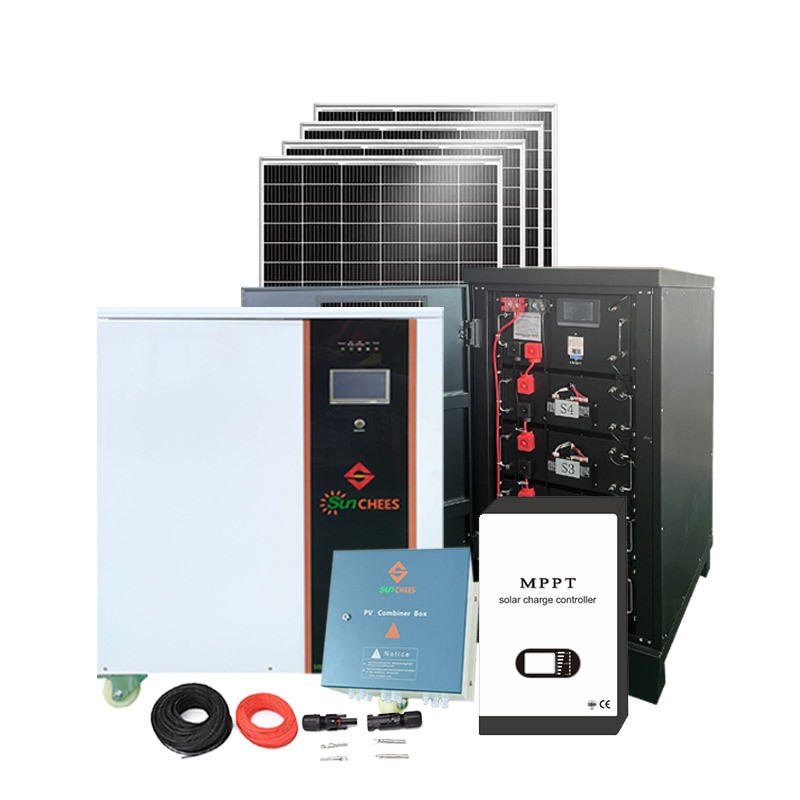
Kit A — Modern lithium / split-phase (North America)
|
|
|
|
|
|
|
|
|
|
|
|
|
|
|
|
|
|
|
|
|
|
|
|
Best for: USA, Canada, Mexico and parts of Latin America on 110 V/220 V split-phase grids — it feeds both 110 V outlets and 240 V heavy appliances with no add-on transformer. Long battery life (15+ years) and simple wiring suit high-labour-cost markets.
Kit B — Heavy low-frequency / gel (off-grid, harsh grids)
|
|
|
|
|
|
|
|
|
|
|
|
|
|
|
|
|
|
|
|
|
|
|
|
|
|
|
|
Best for: Europe, Australia, SE Asia, and Africa on 220–240 V single-phase. The copper-transformer (low-frequency) inverter handles the inrush of old large AC pumps (2–3 HP), and the 38.4 kWh bank gives strong multi-day autonomy. Trade-offs: gel battery life is ~1,000–1,500 cycles, weight nears 1 tonne, and combiner-box wiring is complex. Easy to ship and clear customs where lithium is restricted.
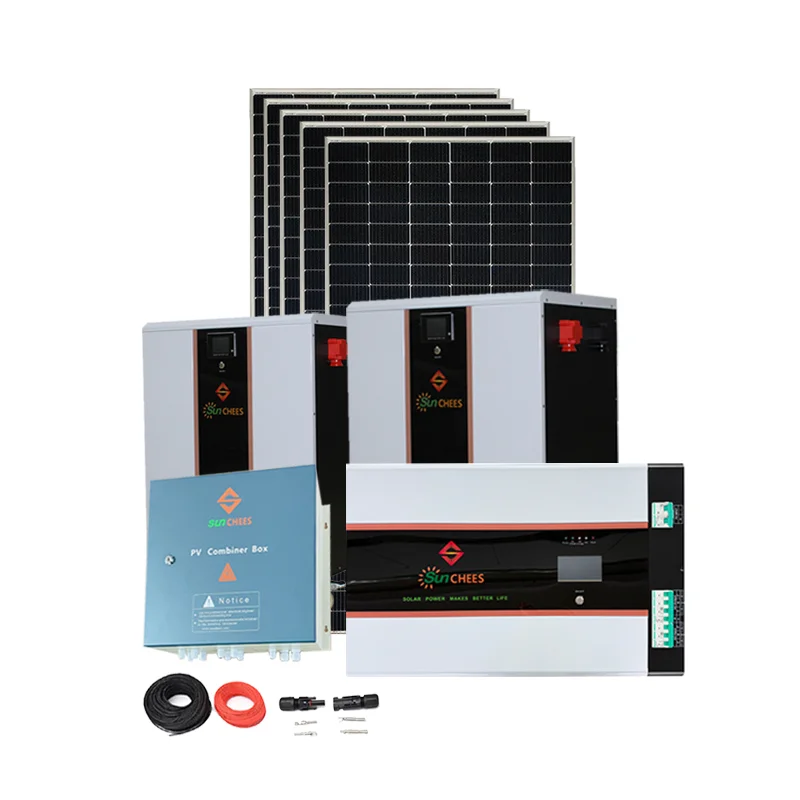
Kit C — Compact lithium upgrade (Europe / Australia)
|
|
|
|
|
|
|
|
|
|
|
|
|
|
|
|
|
|
|
|
|
|
|
|
Best for: Europe (ex-UK), Australia, NZ, China, and SE Asia on 220–240 V / 50 Hz. The big 10 kW frame with a smaller 5.4 kW array and 13.3 kWh battery keeps the entry price low while leaving huge headroom to add panels and battery later without changing the inverter. The generous 800 m of PV cable lets panels sit far from the pump room. Not for the USA, Canada, or Japan without a transformer.
Three 10 kW swimming pool solar system kits, side by side
|
|
|
|
|
|
|
|
|
|
|
|
|
|
|
|
|
|
|
|
|
|
|
|
|
|
|
|
|
|
|
|
|
|
|
Which Swimming Pool Solar System Can Run Your Whole Pool?
All three carry a 10 kW inverter, so all three drive a basic pool pump and cleaner easily. The difference shows up under heavy or night loads.
Load handling across the three 10 kW systems
|
|
|
|
|
|
|
|
|
|
|
|
|
|
|
|
|
|
|
|
|
|
|
|
|
- Kit A — smart whole-home and US-standard appliances; ideal for a 1 HP variable pump plus lights and basic cleaning.
- Kit B — industrial-grade robustness; its copper transformer tolerates high-inrush AC pumps, and its 38.4 kWh bank can sustain heating after dark.
- Kit C — daytime-shift operation; run pump and AC together by day, then drop to low-speed circulation and lights at night.
Powering Only the Pool with a Solar Swimming Pool Pump and Heater
Strip away the house and let 10 kW serve only the pool, and the available capacity rises significantly. The main goal becomes feeding the pool heat pump for four-season comfort — and the ranking of the kits shifts.
- Kit A (pool-only): the balanced year-round choice. 7.2 kW makes 35–40 kWh/day, easily running a ~2 kW heat pump plus a 750 W pump and cleaner while topping up the 28 kWh battery; the long-life lithium then holds temperature for 10+ hours overnight.
- Kit B (pool-only): the cold-climate option. The full 10 kW array makes nearly 50 kWh/day to drive a commercial-grade heat pump (e.g. 3.5 kW input, 15 kW+ output) and fully charge 38.4 kWh of gel — enough to keep heating through a cold winter night so the water can still be around 28 °C at dawn.
- Kit C (pool-only): the value "heat by day, hold by night" option. 5.4 kW comfortably runs a 2 kW heat pump and 750 W pump in daylight; with only 13.3 kWh of battery, the smart play is to reach ~30 °C before sunset, fit a thermal pool cover, and let the battery run only a 220 W low-speed pump overnight, so morning water drops just 1–2 °C.
DIY Solar Heating for Swimming Pools vs a Complete Swimming Pool Solar System
Many owners first try diy solar heating for swimming pools: black solar mats or coils on a roof, plumbed into the existing return line so the pump pushes water through them to warm in the sun. Paired with a thermal cover, this diy swimming pool solar heating approach is cheap and can lift daytime temperature several degrees.
Its limits are real: a passive solar heater swimming pool only warms when the sun is out, has no thermostat, and barely helps in cool or cloudy weather. For dependable, controllable heat across the seasons, an electric heat pump driven by a properly sized swimming pool solar system is far more capable — and the two can be combined, with DIY collectors handling the easy daytime gain and the heat pump finishing the job on demand.
Rule of thumb: Use diy solar heating for swimming pools to cut heating cost in mild seasons; rely on a heat-pump-based swimming pool solar system when you need a guaranteed water temperature year round.
Why Choose Sunchees for Your Swimming Pool Solar System
Specifying the right solar swimming pool pump is half the job; the other half is a manufacturer whose components are designed to work together. Sunchees develops the main parts of the system in-house.
Sunchees at a glance
|
|
|
|
|
|
|
|
|
|
|
|
|
|
|
|
|
|
|
|
|
|
|
|
|
|
|
Practical touches that matter at the pool
- Mobile by default. The system equipment (everything except the panels) sits on wheels and can be repositioned. A wall-mount option is available for owners who want the units raised — useful in flood-prone areas — though floor mounting remains the simpler, safer default.
- Free double-glass bifacial upgrade. A current upgrade to double-glass bifacial modules adds 1.5%+ efficiency, generates from both faces, and resists hot-spot effects — more yield from the same swimming pool solar panels footprint.
Because the inverter, controller, and battery are designed as one system, sizing and integration are more straightforward than assembling components from different brands. Share your location and pool details to get a configuration matched to your site.
FAQ — Solar Swimming Pool Pump and Swimming Pool Solar System
How do I size a solar swimming pool pump for my pool?
Work out volume (length × width × average depth), then the flow needed to turn the water over every 6–8 hours. A 48 m³ pool on a 6-hour turnover needs ~8 m³/h; crossed with a 10–15 m head on the pump curve, a 0.75–1.0 HP (550–750 W) solar swimming pool pump usually fits.
What inverter does a swimming pool solar system need?
Always MPPT. A DC brushless pump takes a 1:1 controller with soft start. A traditional AC pump needs a pure sine wave inverter rated 2–3× pump power with surge near 3,000 W, because every swimming pool solar system has to handle the start-up inrush of an AC motor.
Can a swimming pool solar system run the pool 24 hours a day?
A direct-drive system runs only in daylight. For night filtration, lighting, or heating, the swimming pool solar system needs a battery bank and a hybrid inverter so stored daytime energy runs the equipment after dark.
Do swimming pool solar panels need to be larger than the pump?
Yes. Swimming pool solar panels are sized above pump power to cover losses, clouds, and battery charging — about 1,000–1,200 W of panels for a 750 W direct-drive pump, and several kilowatts once heating and storage are added.
Is DIY solar heating for swimming pools enough, or do I need a full system?
DIY solar heating for swimming pools (solar mats plus a thermal cover) warms the water cheaply by day. For guaranteed year-round temperature, a heat-pump-based swimming pool solar system gives far more control than diy swimming pool solar heating on its own — and the two work well together.
Does a solar heater swimming pool setup work at night and in winter?
A solar heater swimming pool can hold heat overnight by warming hard during the day and covering the pool, since most loss is surface evaporation. For cold climates or large pools, a bigger battery and panel array let the heat pump keep running after sunset.
Which 10kW swimming pool solar system suits my country?
Choose by grid and need: Kit A (split-phase lithium) for the USA, Canada, and Mexico; Kit B (low-frequency gel) for harsh grids, old high-power AC pumps, or where lithium shipping is hard; Kit C (compact lithium) for budget-conscious 220 V/50 Hz buyers in Europe, Australia, or Asia who want an easy-to-upgrade swimming pool solar system.
What information should I provide before requesting a swimming pool solar system quote?
Seven details let a swimming pool solar system be sized accurately for your site: pool size / volume (length, width, average depth, or m³); country and voltage (grid standard and frequency); pump type and power (AC or DC, HP or watts); heating requirement (whether you want a heat pump and a target temperature); night operation (whether circulation, lighting, or heating must run after dark); installation area (available roof or ground space); and scope (pool-only, or also whole-house backup). With these, the panels, inverter, and battery can be matched to your pool and location.
 Solar Panels Jamaica: 5 Real Off-Grid Solar Storage Cases for Homes and Hotels
 You May Also Like



 Tel
Tel
 Email
Email
 Address
6th Floor, Zhonghe Zinan Industrial Park, No. 1 Zinan Changang West Road, Nanzhuang Town, Chancheng District, Foshan City, Guangdong Province. China (Mainland)