


 Whatsapp :
 Home
HomeThe Complete Off-Grid Guide to Choosing a 48V Inverter in Jamaica & the Caribbean
 Jun 15,2026
 0
0
 sunchees solar system
Whether you are trying to escape high JPS bills in Jamaica, setting up a remote eco-resort in the Bahamas, or securing a backup power system in the Dominican Republic, building a reliable solar system is a major priority. At the center of any high-performing setup sits the 48V inverter.
Technical datasheets can be confusing, though. Many buyers get stuck on phase configurations, voltage numbers, and equipment safety. This guide gives clear, practical answers tailored to Caribbean home designs, regional electrical setups, and tropical climate realities.
Why does a "48V" inverter pair with a "51.2V" battery?
When shopping for solar gear, you will notice that some equipment is labeled "48V" while modern lithium batteries are often stamped "51.2V." It can look like the parts won't fit together — but they are fully compatible and belong to the same system class.
Think of it like buying appliances for your home. A standard 220V refrigerator runs perfectly whether your local grid dips to 215V or climbs to 230V, because it has a built-in safety window. In solar, "48V" is simply the traditional name for this power class:
- The old standard: legacy lead-acid or gel battery banks are built from cells that add up to roughly 48V.
- The modern standard: Lithium Iron Phosphate (LiFePO4) batteries use a 16-cell sequence. Sixteen cells × 3.2V = exactly 51.2V.
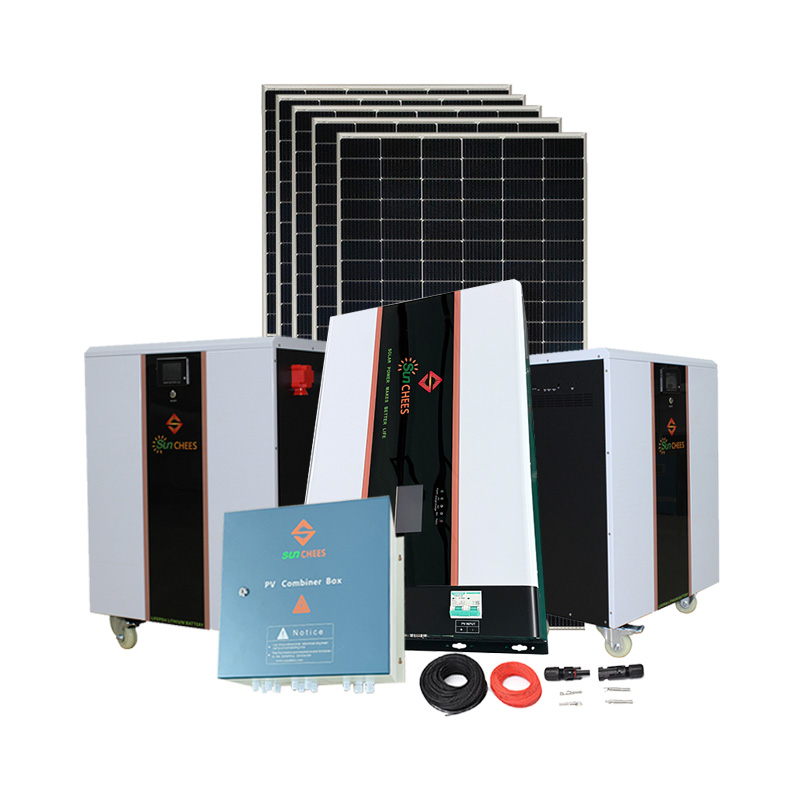
A professional-grade 48V inverter has an internal tolerance window designed to accept DC input between roughly 40V and 60V. So when you plug a 51.2V lithium pack into a Sunchees 48V inverter, the two work together seamlessly — no external converter, adapters, or special wiring required.
How to choose your inverter by country and scenario
Solar systems are never one-size-fits-all. Find your location below, match it to your off-grid goals, and see which configuration fits.
1. Jamaica, the Bahamas, Cayman Islands, or the USA (110V/220V dual-voltage countries)
In these regions, the grid delivers two separate 110V lines that combine to provide 220V for heavy machinery. Match your project to one of these three scenarios:
Scenario A — You're connecting to an existing home breaker panel and want to keep all your US-standard appliances. If your home is already wired with dual-phase lines, and you want to power everyday 110V electronics (microwave, TV, hair dryer) alongside a 220V dryer or stove without changing a single wire in the walls, you need a native split phase solar inverter.
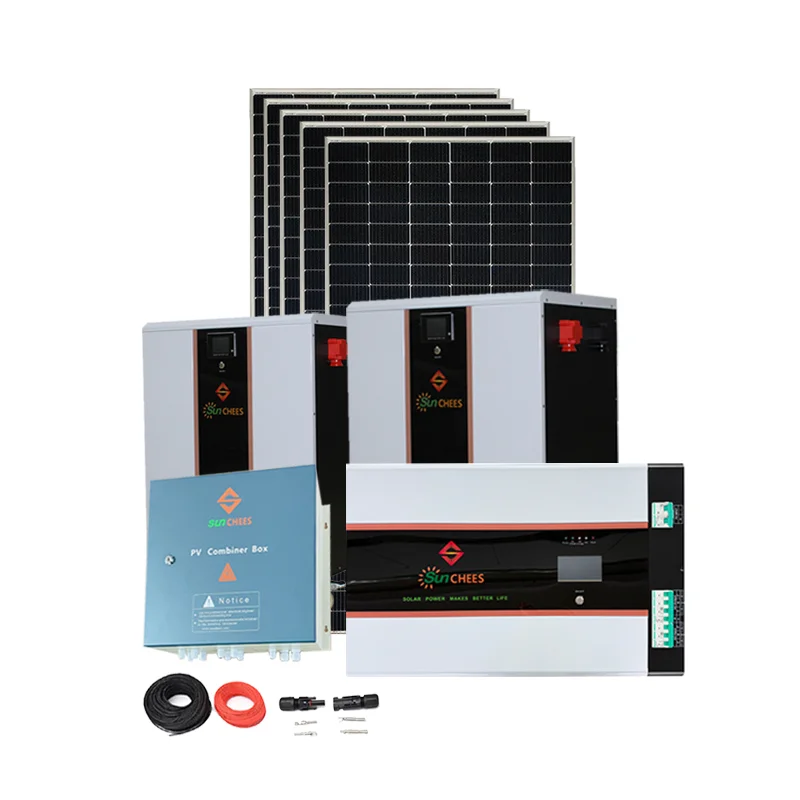
Best choice: Sunchees 10KW Split Phase Inverter. It outputs both 110V and 220V simultaneously from one unit, so your local electrician can wire it straight into your existing distribution panel — often within about five days.
Scenario B — You're building a brand-new off-grid house, cabin, or farm and want to stretch your budget. If you're fully off-grid, you aren't forced into a split-phase setup. You can buy only 220V energy-efficient appliances (variable-frequency inverter air conditioners, 220V refrigerators, 220V deep-well pumps).
Best choice: Sunchees 10KW Low Frequency Hybrid Inverter (HIC-10KW). Because a 220V single-phase system runs at lower current, your electrician can use thinner, cheaper copper wiring throughout the house. That can save a significant amount on installation and wire costs while still delivering strong starting power.
Scenario C — You want an easy, movable system with no complicated installation. If you'd rather not have an electrician drilling into walls, but you still run a mix of 110V and 220V electronics, use an all-in-one cabinet plus a small external auto-transformer.
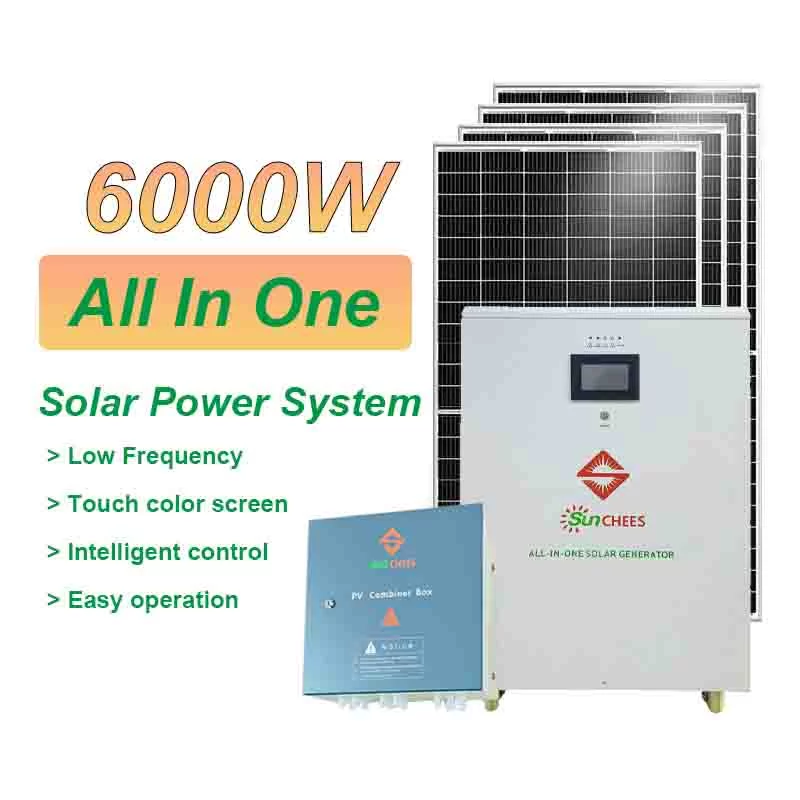
Best choice: Sunchees 6KW All-In-One Solar Generator. This unit outputs 220V. Plug a small 220V-to-110V auto-transformer into its output and you can run a 110V power strip for small electronics while powering heavy 220V tools directly from the cabinet.
2. Europe, the UK, Nigeria, or the Philippines (pure 220V–240V single-voltage countries)
If your country runs entirely on a single-phase 220V–240V standard, the choice comes down to property type and installation access:
Scenario A — You want a neat, hassle-free setup because skilled local labor is scarce or expensive.
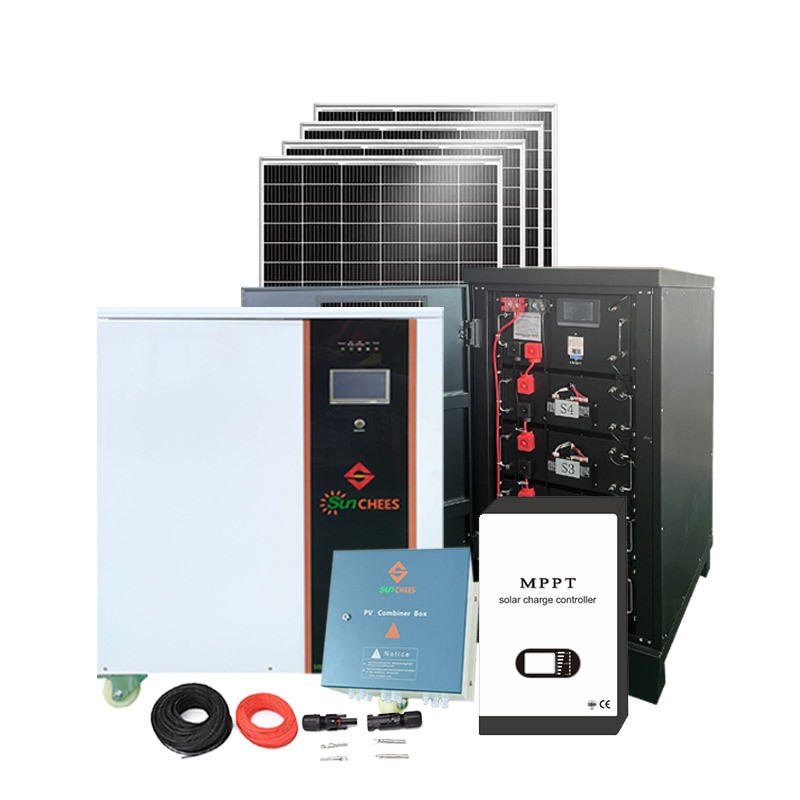
Best choice: Sunchees 6KW All-In-One Solar Generator. It arrives as a fully integrated mobile power station — inverter, charge controller, and a 13.3 kWh lithium battery bank pre-wired and sealed inside one cabinet on wheels. Roll it into place, plug in your solar panels, and switch it on.
Scenario B — You're running an agricultural farm, a workshop, or a large villa with heavy motor loads.
Best choice: Sunchees 10KW Low Frequency Hybrid Inverter (HIC-10KW). This inverter head uses a heavy iron-core transformer built to absorb large surges when big water pumps, power tools, or multiple AC compressors start at once. It also lets you build an ultra-large external 48V battery bank for multiple days of backup.
Technical comparison: the Sunchees 48V lineup
|
|
|
|
|
|
|
|
|
|
|
|
|
|
|
|
|
|
|
|
|
|
|
|
|
|
|
|
|
|
|
|
|
|
|
|
|
|
|
|
|
|
|
|
|
Climate & safety: floods and weight realities
In coastal, tropical regions like Jamaica and the wider Caribbean, physical installation safety matters as much as the wiring.
A note on placement. Some owners ask about high wall-mounting to keep gear above seasonal storms or flash flooding. Elevating electronics is smart — but hanging a massive integrated system like the 6KW All-In-One on a standard residential wall is dangerous. The internal 260Ah lithium pack alone is extremely heavy, and bolting that mass onto a residential wall risks structural anchoring failure.
The safer approach is to keep the floor-standing cabinet on its heavy-duty caster wheels and position it on an engineered, elevated concrete platform or a dedicated ground-level interior mezzanine. That keeps the system dry in heavy weather while keeping the structure stable.
The Sunchees advantage: built for long-term off-grid use
Sunchees has manufactured specialized solar hardware since 2008 from Foshan, China, focusing on off-grid needs across the Caribbean, Latin America, and Africa.
- Native component compatibility. Because Sunchees designs and builds its own inverters, MPPT controllers, and lithium Battery Management Systems (BMS) in one factory, the parts are engineered to communicate natively — reducing the errors, communication drops, and faster degradation that can occur when mixing different component brands.
- Bifacial panel upgrade. Complete Sunchees configurations can be upgraded to double-glass bifacial modules. These capture direct sunlight on the front and reflected ambient light on the rear, which can lift total generation by up to about 25% in ideal high-reflectivity conditions — though typical real-world gains run closer to 5–15%, depending on ground albedo and mounting height (see the U.S. National Renewable Energy Laboratory for field data). The double-glass build also improves durability against hot-spot stress compared with single-glass panels.
- Delivery and factory support. Sunchees backs orders with a 5% contract penalty payout if factory timelines slip. Small sample configurations (1–10 sets) finish in 5–7 working days; bulk commercial systems (20–100 sets) in 10–20 working days. Projects above 50kW qualify for on-site engineering deployment, supported by local installation networks.
Frequently Asked Questions
Can I connect a 48V gel battery bank and a 51.2V lithium pack to the same inverter at once?
No. Never mix battery chemistries or voltage levels on one system — gel and lithium have different charging cycles, voltage cutoffs, and tolerances. A Sunchees inverter lets you switch its internal management profile between lithium, gel, and lead-acid on the touch screen, but the physical battery bank itself must be uniform.
Why is a low frequency hybrid inverter better for running heavy home air conditioners?
It uses a large, copper-wound iron-core transformer that can absorb large surges — up to around three times its continuous rating — when motor-driven appliances like central AC, refrigerators, and pumps start up. High-frequency inverters rely on electronic switching that's highly efficient for lights and laptops but can trip on heavy motor startup surges.
If I'm building a fully off-grid home in Jamaica, do I have to use a split phase inverter?
No. Off-grid and independent of the JPS network, you control your home's layout. Wire the house as a standard 220V single-phase system with native 220V appliances and a standard single-phase 48V inverter works fine. A split phase inverter is only mandatory if you want US-style 110V appliances without external transformers, or if you're connecting to a home already wired with dual-voltage lines.
To find the right solar footprint for your property or connect with a local Caribbean installation partner, contact Sunchees with your address and location. You can also browse the full 48V inverter range and view completed projects on Sunchees' social channels.
 Solar Swimming Pool Pump and Swimming Pool Solar System: How to Size, Power, and Heat Your Pool
 You May Also Like



 Tel
Tel
 Email
Email
 Address
6th Floor, Zhonghe Zinan Industrial Park, No. 1 Zinan Changang West Road, Nanzhuang Town, Chancheng District, Foshan City, Guangdong Province. China (Mainland)