


 Whatsapp :
 Home
HomeThe Complete Guide to the 48 Volt Solar System: Efficiency, Stability, and Off-Grid Freedom
 Apr 29,2026
 0
0
 sunchees solar system
If you are looking to power a modern home with solar energy, you have likely come across the term 48 Volt Solar System. Think of it as a "medium-sized home power factory." While 12V or 24V systems are great for small cabins or RVs, a 48 Volt Solar System is designed for those who need to run heavy-duty appliances like air conditioners, refrigerators, and water pumps reliably.
In this guide, we will break down the technical "why," solve the common voltage confusion, and show you how a professional-grade system like Sunchees can transform your energy independence.
1. What is a 48 Volt Solar System? (The "Truck" vs. "Bicycle" Analogy)
The "48 Volt" refers to the core energy storage and transport standard of the system. To understand why this matters, imagine you need to transport a massive amount of cargo.
- 12V System (The Bicycle): To move heavy cargo, you would need thousands of bicycles and an incredibly wide road (extremely thick copper cables) to prevent traffic jams (heat and energy loss).
- 48 Volt Solar System (The Heavy Truck): You can move the same amount of power using a single truck on a standard road (thinner, more affordable cables).
By using a 48 Volt Solar System, your setup remains cool, efficient, and safe, even when the energy demand is high.
How the System Works
The process of a 48 Volt Solar System can be simplified into three distinct stages:
- Collection (Solar Panels): Gathers sunlight and converts it into high-voltage DC.
- Processing & Storage (Inverter & Battery): The 48V battery acts as the energy warehouse, while the inverter manages the flow.
- Usage (Appliances): The system converts stored energy into the AC power your home needs.
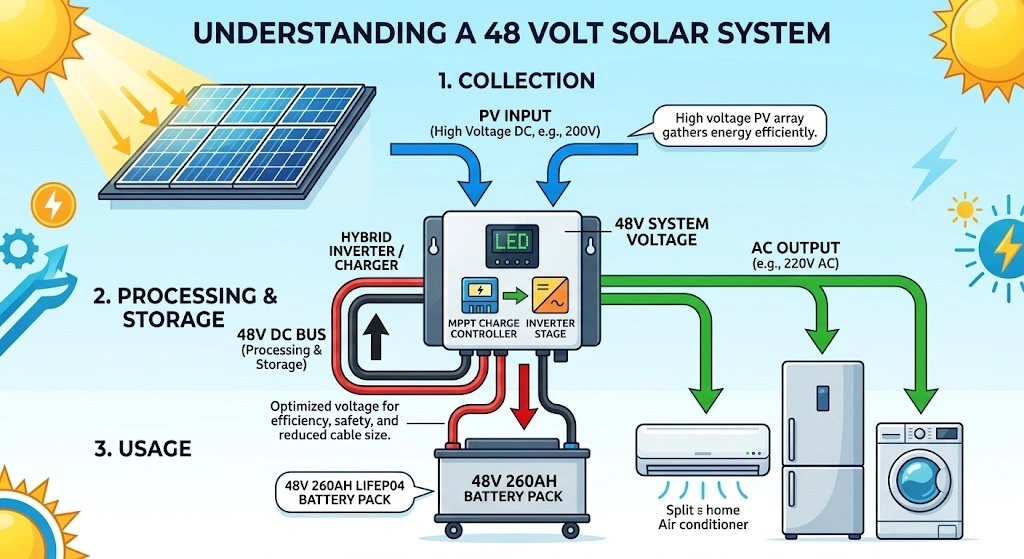
Figure 1: This diagram illustrates the flow from collection to usage, highlighting the 48V DC Bus as the central processing hub.
2. The 51.2V Mystery: Is it the same as a 48 Volt Solar System?
A common question from buyers is: "My battery says 51.2V, but I bought a 48V system. Is this a mistake?"
Actually, 48V and 51.2V refer to the same thing. In the solar industry, "48V" is the nominal nickname, while "51.2V" is the actual physical voltage of modern LiFePO4 (Lithium Iron Phosphate) batteries.
- The Math: A single LiFePO4 cell has a voltage of 3.2V. To reach the industry standard "48V" class, 16 cells are connected in a series.
- The Result: 3.2V×16=51.2V
This 51.2V platform is superior to old lead-acid 48V batteries because the voltage remains stable even when the battery is low, allowing your 48 Volt Solar System to work at peak efficiency longer.
3. Under the Hood: How the Inverter Processes Power
The heart of any 48 Volt Solar System is the Hybrid Inverter. It acts as the "General Manager" of the factory. But how does it turn DC battery power into the AC power in your wall socket?
Figure 2: A technical look at the internal stages of power conversion: DC-to-DC boost, high-speed switching (H-Bridge), and LC filtering.
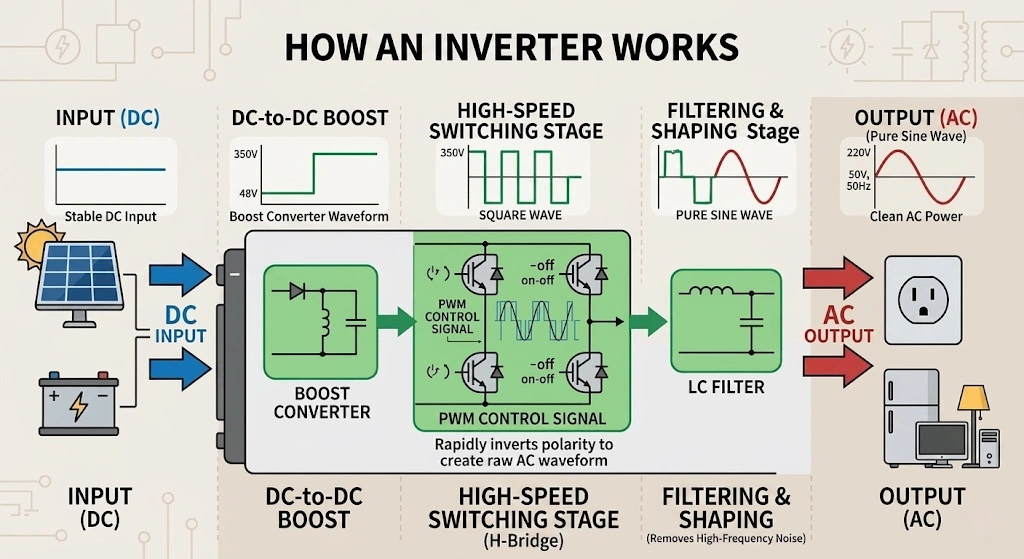
As shown in the diagram above, the inverter takes the stable 48V DC input and uses a DC-to-DC Boost to reach high voltage. Then, through a High-Speed Switching Stage, it creates a raw waveform which is finally smoothed by an LC Filter into a Pure Sine Wave—identical to the power you get from the utility grid.
4. Case Study: The Sunchees 10kW 48 Volt Solar System Architecture
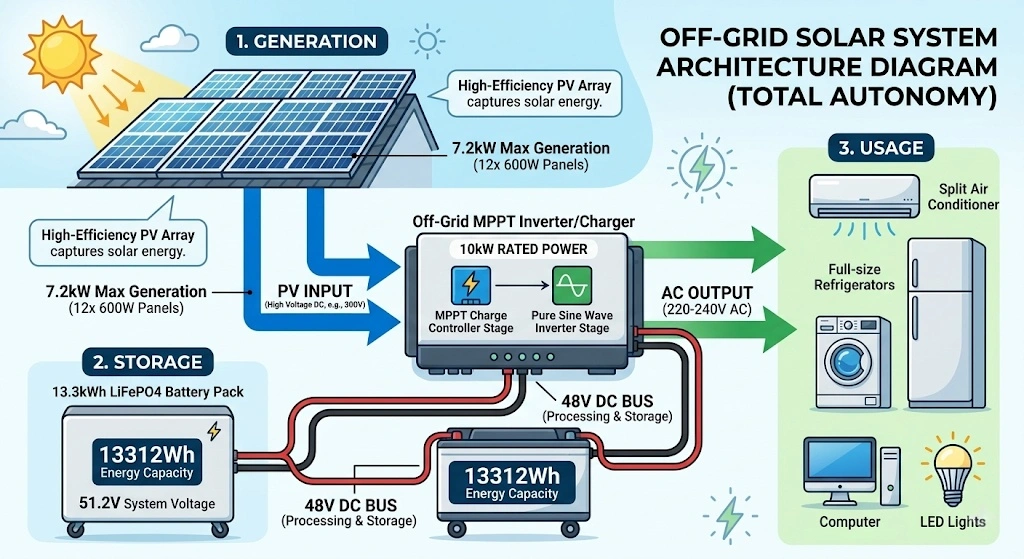
For a high-demand household, a 10kW system is the benchmark. Let’s map out the components of a Sunchees high-performance setup.
|
|
|
|
|
|
|
|
|
|
|
|
|
|
|
|
|
|
|
|
Figure 3: Mapping parameters to performance. This architecture ensures total autonomy for heavy loads.
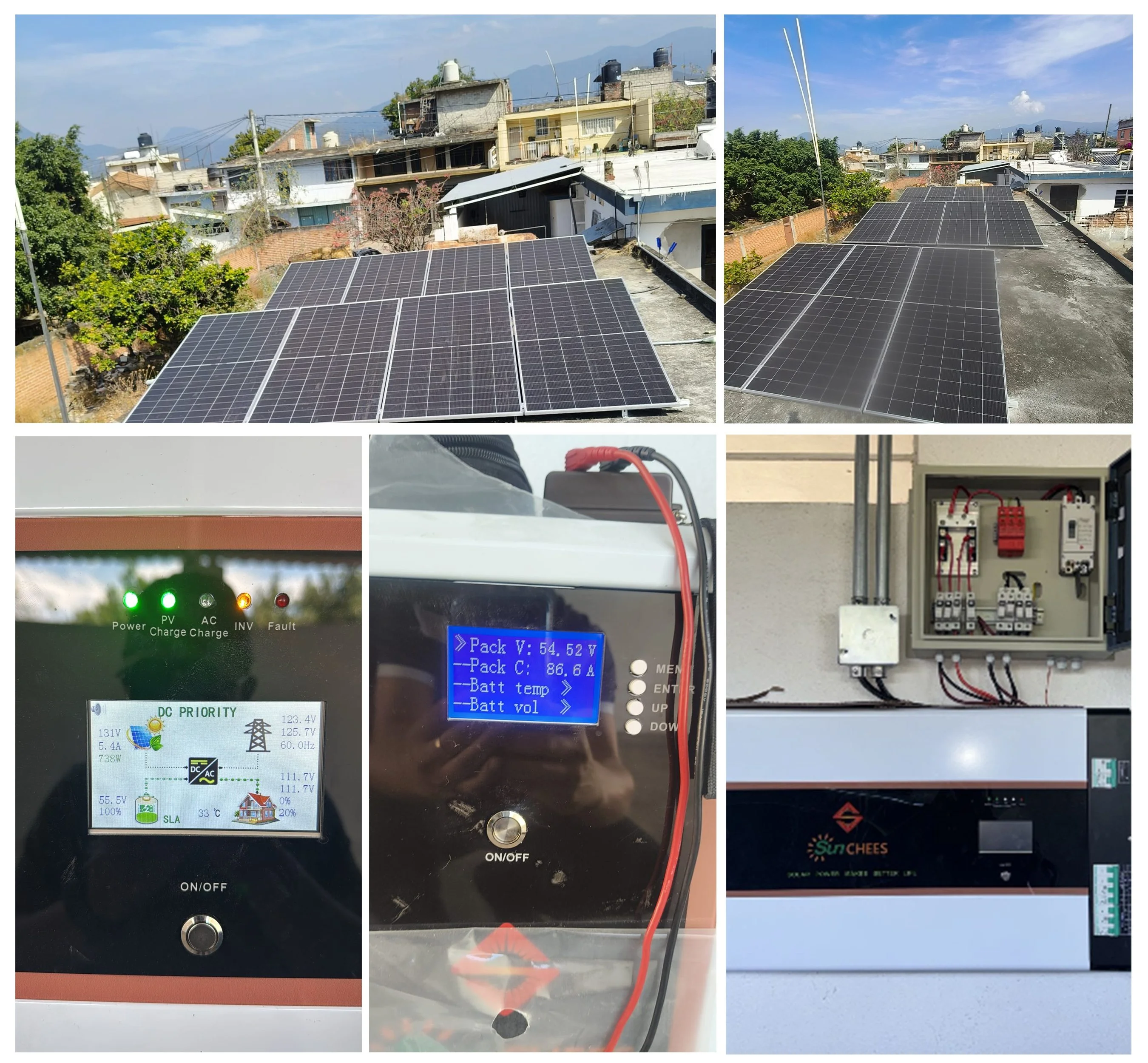
5. Why Sunchees is the Preferred Choice for the Caribbean & Latin America
In regions like Jamaica, Guyana, or the Dominican Republic, the environment is a challenge. High electricity costs, frequent hurricane threats, and high humidity require a robust 48 Volt Solar System.
- Hurricane Backup: When the grid fails, the Sunchees system provides a "Total Autonomy" sanctuary. The 13.3kWh battery keeps your Starlink, medical fridges, and pumps running.
- Heat Resistance: Our LiFePO4 batteries handle temperatures up to 65°C, outperforming traditional batteries in tropical climates.
- 100% Compatibility: Because Sunchees develops its own inverters and batteries, you avoid the "communication errors" common when mixing different brands.
Sunchees Brand Overview
|
|
|
|
|
|
|
|
|
|
|
|
|
|
|
|
|
|
|
|
|
6. Expert QA: Everything You Need to Know
Q: Can a 48 Volt Solar System run a high-power air conditioner?
A: Yes. A 48 Volt Solar System with a 10000W rated inverter is perfectly capable of handling the high "start-up" current of multiple split air conditioners. Because the voltage is higher than 12V systems, the current is lower, which prevents the system from overheating during heavy use.
Q: Is it easy to expand a 48 Volt Solar System later?
A: Very easy. The 48 Volt Solar System uses a standardized DC bus. If your energy needs grow, you can simply parallel an additional 48V battery pack to the existing bus to double your storage capacity.
Q: Why does Sunchees focus on the 48 Volt Solar System for off-grid projects?
A: We focus on 48V because it is the "Safety Goldilocks Zone." It is powerful enough for industrial-grade 10kW loads but keeps the voltage low enough to be safe for residential installation and maintenance.
Ready to achieve total autonomy? Sunchees provides end-to-end support for your 48 Volt Solar System, from design to remote installation. Find us on YouTube, TikTok, and Facebook to see our latest projects across the Caribbean and the globe.
Do you have specific power requirements for your home or business, and would you like a customized calculation for your 48 Volt Solar System?
 Solar Power for Simpson Bay Beach St Maarten: The Ultimate Energy Guide for Luxury Villas and Condos
 You May Also Like



 Tel
Tel
 Email
Email
 Address
6th Floor, Zhonghe Zinan Industrial Park, No. 1 Zinan Changang West Road, Nanzhuang Town, Chancheng District, Foshan City, Guangdong Province. China (Mainland)